
As cyclists, we’ve all been there: pushing hard, following a training plan, but sometimes feeling like we’re hitting a plateau. Or perhaps you’re wondering if your efforts are truly optimized for your goals. In a world increasingly driven by data, the question isn’t just “how hard did I ride?” but “what can my data tell me about tomorrow’s ride, or next season’s breakthrough?” At Explore the Cosmos, our mission is to empower you to answer these complex questions through data-driven analysis, bridging the gap between raw numbers and profound discoveries, whether in space science or human performance. This article will guide you through an end-to-end project to predict cycling performance, demystifying the process and showing you how to turn your ride data into actionable insights.
The journey from data collection to predictive power might seem daunting, especially with terms like “machine learning” and “predictive analytics” thrown around. But we believe in making complex topics accessible. We’ll walk you through the entire workflow, from gathering your training data to building models that forecast your future performance, all while keeping a keen eye on practicality and, most importantly, your privacy. By the end, you’ll understand not just the ‘what,’ but the ‘how’ and ‘why’ behind using data science to elevate your cycling.
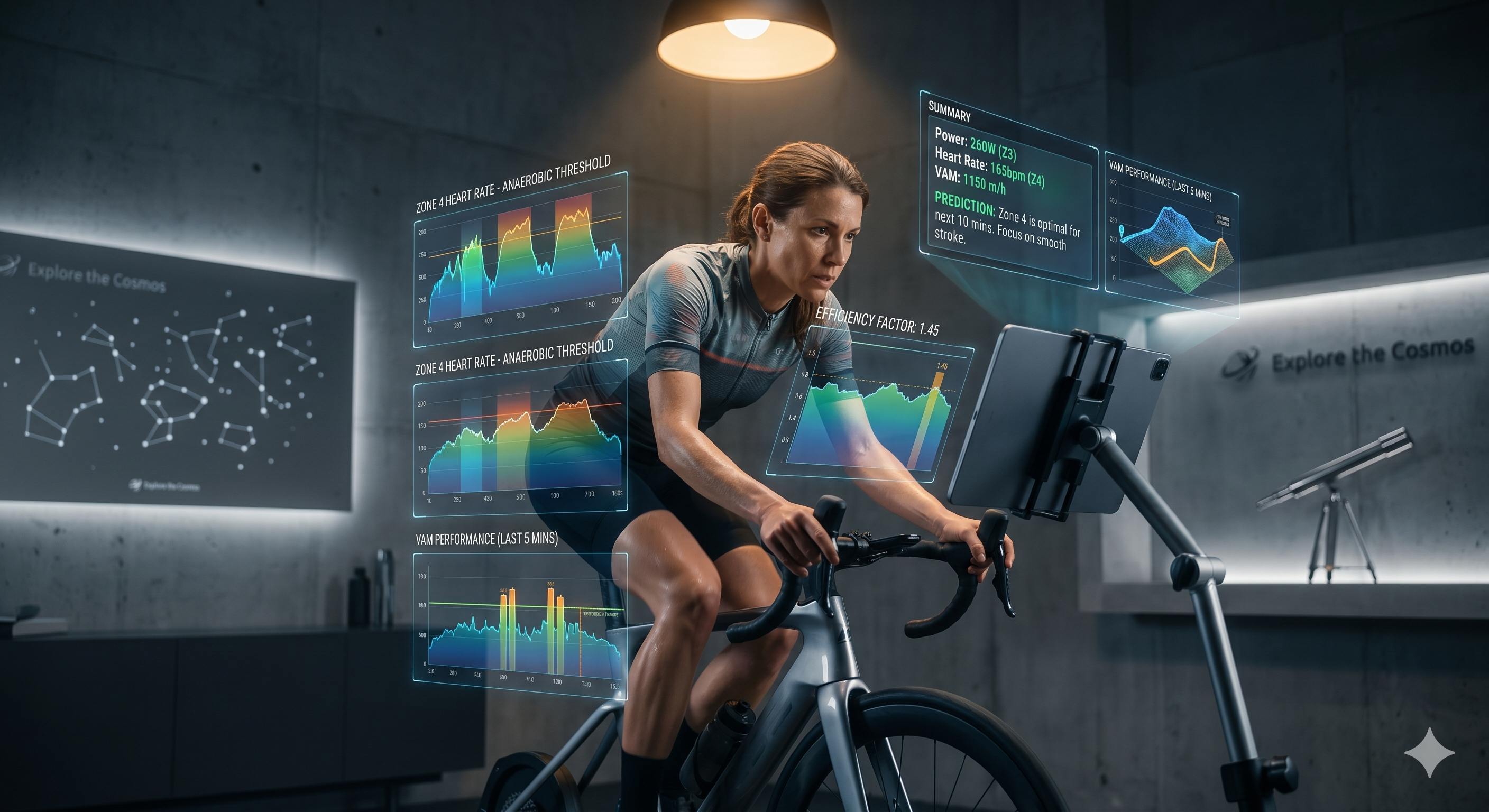
The Promise of Prediction: Why Data-Driven Cycling Matters
Why should we bother predicting cycling performance? The answer lies in the power of personalization and optimization. Imagine having a crystal ball that could tell you when you’re most likely to hit a new personal best, when you’re on the verge of overtraining, or which specific workouts will yield the greatest gains for your unique physiology. This isn’t science fiction; it’s the promise of data science.
For recreational and serious amateur cyclists alike, predicting performance means moving beyond guesswork. It allows for more precise training adjustments, injury prevention by recognizing fatigue patterns, and a deeper understanding of how nutrition, sleep, and recovery truly impact your output. An end-to-end project in this context means taking all available data, processing it, extracting meaningful features, applying predictive models, and then interpreting those predictions to inform your training decisions. It’s a holistic approach to athletic development, grounded in the scientific method.
The Data Foundation: What You Need to Gather
Every data science project begins with, well, data. For cycling performance prediction, the richer and more consistent your data, the better your predictions will be. What kind of data are we talking about?
- Core Cycling Metrics: Power output (watts), heart rate (bpm), speed (km/h or mph), cadence (rpm), and elevation gain are fundamental. These are typically recorded by your cycling computer, power meter, and heart rate monitor.
- Environmental Factors: Temperature, humidity, and wind can significantly affect performance. While harder to collect precisely for every ride, general weather data for your location can be integrated.
- Physiological Markers: Beyond basic heart rate, metrics like Heart Rate Variability (HRV), sleep duration and quality, and perceived exertion (RPE) are invaluable for understanding your body’s readiness and recovery. These often come from smartwatches or dedicated recovery trackers.
- Training Context: Details about your workout – type (e.g., endurance, intervals, race), duration, and specific goals – add crucial context.
Collecting this data has become increasingly seamless thanks to wearable technology. In 2026, wearable devices are no longer simple activity trackers; the data they generate is becoming critical infrastructure for health and fitness products. From smartwatches to dedicated cycling computers, these devices stream a wealth of information. At Explore the Cosmos, we understand the importance of making this data accessible and actionable. That’s why our primary tool, the Apple Health Cycling Analyzer, is specifically designed to help you process your Apple Health export data – a privacy-first, browser-based solution that never uploads your sensitive information to any server. This allows you to gain insights into efficiency factor, HR drift, VAM, and fitness assessments directly from your own device, respecting your privacy while providing powerful analytical capabilities.
Demystifying the End-to-End Process of Prediction
An “end-to-end” project refers to the complete lifecycle of a data science initiative, from raw data to deployed insights. Let’s break it down in plain English, connecting it to our cycling performance goal:
1. Data Collection & Cleaning: The Foundation of Accuracy
This is where you gather all your ride data, Apple Health metrics, and any other relevant information. But raw data is rarely perfect. It often contains gaps, errors, or inconsistencies. For example, a heart rate spike that’s clearly an anomaly, or a power meter dropout. Data cleaning involves identifying and correcting these issues. For your Apple Health export, our Apple Health Cycling Analyzer performs initial processing to ensure your data is ready for analysis, presenting it in a structured way that highlights key performance indicators.
2. Exploratory Data Analysis (EDA): Understanding Your Story
Before jumping into predictions, you need to understand the story your data is already telling. EDA involves visualizing your data – plotting trends in power output over time, comparing average speeds on different routes, or seeing how your heart rate drift changes with fatigue. This step helps identify patterns, correlations, and potential problems. It’s about asking questions like: “What’s my average power for a typical one-hour ride?” or “Does my sleep quality consistently affect my training readiness?” This is where you gain the intuition behind the numbers, laying the groundwork for more advanced modeling.
3. Feature Engineering: Creating Meaningful Metrics
Raw data points like “heart rate” or “power” are useful, but combining them into more insightful “features” can unlock deeper understanding. For example, instead of just power, we can calculate “normalized power” (which accounts for variability), “training stress score (TSS)” (a measure of workout intensity and duration), or “efficiency factor” (power output relative to heart rate). Our Apple Health Cycling Analyzer already computes several such features, including efficiency factor, HR drift, and VAM (velocity ascending meters), providing you with these expertly derived metrics to streamline your analysis and enhance your predictive capabilities.
4. Model Selection & Training: The Predictive Engine
Now for the exciting part: building the predictive model. This is where machine learning comes in. In plain English, machine learning algorithms learn from your historical data to find relationships and patterns that can be used to make predictions. For cycling performance, you might use techniques like regression models to predict future power outputs, ride times for a specific segment, or even your readiness to perform a hard workout based on your recovery metrics.
The model “learns” by being shown many examples of your past rides – inputs (like power, heart rate, ride type, sleep quality) and corresponding outputs (like your average speed for that day, or your performance on a specific climb). The goal is for the model to generalize these relationships so it can make educated guesses about future, unseen scenarios.
5. Evaluation & Iteration: How Good is Your Crystal Ball?
Once a model is trained, it’s crucial to evaluate how well it performs. We test the model on data it hasn’t seen before to ensure it’s not just memorizing past results but actually understanding underlying patterns. Metrics like Root Mean Squared Error (RMSE) for numerical predictions tell us, on average, how far off our predictions are. If the model isn’t performing well, we go back to earlier steps – maybe collect more data, engineer better features, or try a different algorithm. This iterative process is key to refining any predictive system.
6. Deployment & Application: Putting Predictions to Work
Finally, the predictions need to be integrated into your training. This could mean a simple dashboard that displays predicted FTP increases, alerts you to potential overtraining based on recovery metrics, or suggests optimal pacing for an upcoming event. The key is that the predictions are clear, actionable, and tailored to your individual goals, helping you to make informed decisions about your next steps.
Key Trends Shaping Cycling Performance Prediction in 2026
The world of data science and cycling performance is evolving rapidly. As we look at 2026, several key trends underscore the importance of understanding this end-to-end predictive process:
1. Pervasive Integration of AI in Cycling Training & Devices: AI is no longer a futuristic concept but is deeply integrating into various aspects of cycling. AI-powered coaching platforms are generating personalized, adaptive training plans based on real-time data like heart rate, sleep, power output, and HRV. Beyond apps, AI is moving into on-device health predictions on wearables, with the market for AI on wrists projected to reach $169 billion by 2029. This signifies a shift from purely descriptive data to truly predictive and even prescriptive analytics, offering real-time adjustments to training based on an athlete’s current readiness and performance. At Explore the Cosmos, we recognize this shift and aim to provide you with the tools to harness this power responsibly.
2. Shift Towards End-to-End, Adaptive, and Holistic Wearable Data Analysis: Wearable technology in 2026 is moving beyond isolated metrics to continuous time-series data, enabling a shift from reactive to predictive and preventive health. The focus is increasingly on standardizing and contextualizing this data, ensuring that AI models move from population averages to personal baselines. This also includes a broader focus on holistic well-being tracking – sleep, recovery, and stress – as direct indicators of training efficacy. This trend highlights the need for a comprehensive understanding of the entire data pipeline, from raw collection to sophisticated, contextualized insights.
3. The Rise of Data-Driven Decision Making with a “Human-First” Approach: In 2026, data-driven approaches are paramount, not just for professional teams but also for amateur cyclists seeking optimization. Data scientists are increasingly crucial, shaping training and race strategy with precise analysis. However, there’s also a strong acknowledgment of the “human element.” AI tools are seen as intelligent assistants, not replacements for human coaches or intuition. The goal is to blend AI and human coaching for the best of both worlds. This reinforces our belief at Explore the Cosmos that tools should empower users to understand and apply data, fostering true discovery rather than blindly following automated advice.
Our Approach: Privacy-First Performance Analysis
These trends underscore the critical importance of robust, privacy-first tools for performance analysis. Our Apple Health Cycling Analyzer stands at the forefront of this philosophy. By processing your Apple Health export data directly in your browser, without any server uploads, we ensure your personal performance data remains solely yours. This aligns perfectly with the need for personalized baselines and detailed insights from continuous data streams, as highlighted by the latest trends.
The Analyzer provides you with a crucial starting point for your end-to-end project, offering calculated metrics like efficiency factor, HR drift, and VAM that serve as excellent features for predictive models. It’s a powerful illustration of how practical analysis tools, combined with clear explanations of data science concepts, can help you gain a profound understanding of your own performance and make truly informed decisions.
Beyond the Numbers: Practical Application and Limitations
While predictive models offer incredible potential, it’s important to approach them with a practical mindset and acknowledge their limitations. A model’s prediction is a probability, not a certainty. Individual variability, unforeseen external factors (like a sudden headwind or a change in your daily routine), and the inherent complexity of human physiology mean no model will ever be 100% accurate.
The real value lies in using these predictions as informed guidance, a sophisticated data-driven intuition to complement your own bodily awareness and, if applicable, your coach’s expertise. Data and AI should assist and augment human decision-making, not replace it entirely. Think of it as another lens through which to view your training, providing objective insights that help you fine-tune your approach and make more effective choices. Understanding these nuances is part of the “Science. Data. Discovery” ethos at Explore the Cosmos – using data intelligently to foster deeper understanding.
Start Your Predictive Journey Today
Embarking on an end-to-end project to predict cycling performance is a journey of discovery. It’s about harnessing the power of your own data, applying the principles of data science, and ultimately, unlocking new levels of performance and understanding. We encourage you to explore your own data, ask challenging questions, and utilize tools that respect your privacy while providing unparalleled insight.
Whether you’re a data-curious individual or a serious amateur cyclist, the path to better performance is increasingly paved with data. Begin your journey today by exploring your Apple Health cycling metrics with our Apple Health Cycling Analyzer, and continue to learn how the principles of data science can transform your understanding of human performance. The cosmos of your own potential awaits your exploration.
Leave a Reply