
In the vast cosmos of data, understanding complex systems requires more than just a single viewpoint. Whether we’re analyzing the intricate patterns of celestial bodies, optimizing human performance data from our Apple Health Cycling Analyzer, or simply making sense of everyday information, relying on a solitary source can lead to skewed perspectives and missed opportunities. At Explore the Cosmos, we believe in illuminating complexity with clarity, and in data science, few concepts embody this principle as powerfully as Ensemble Models.
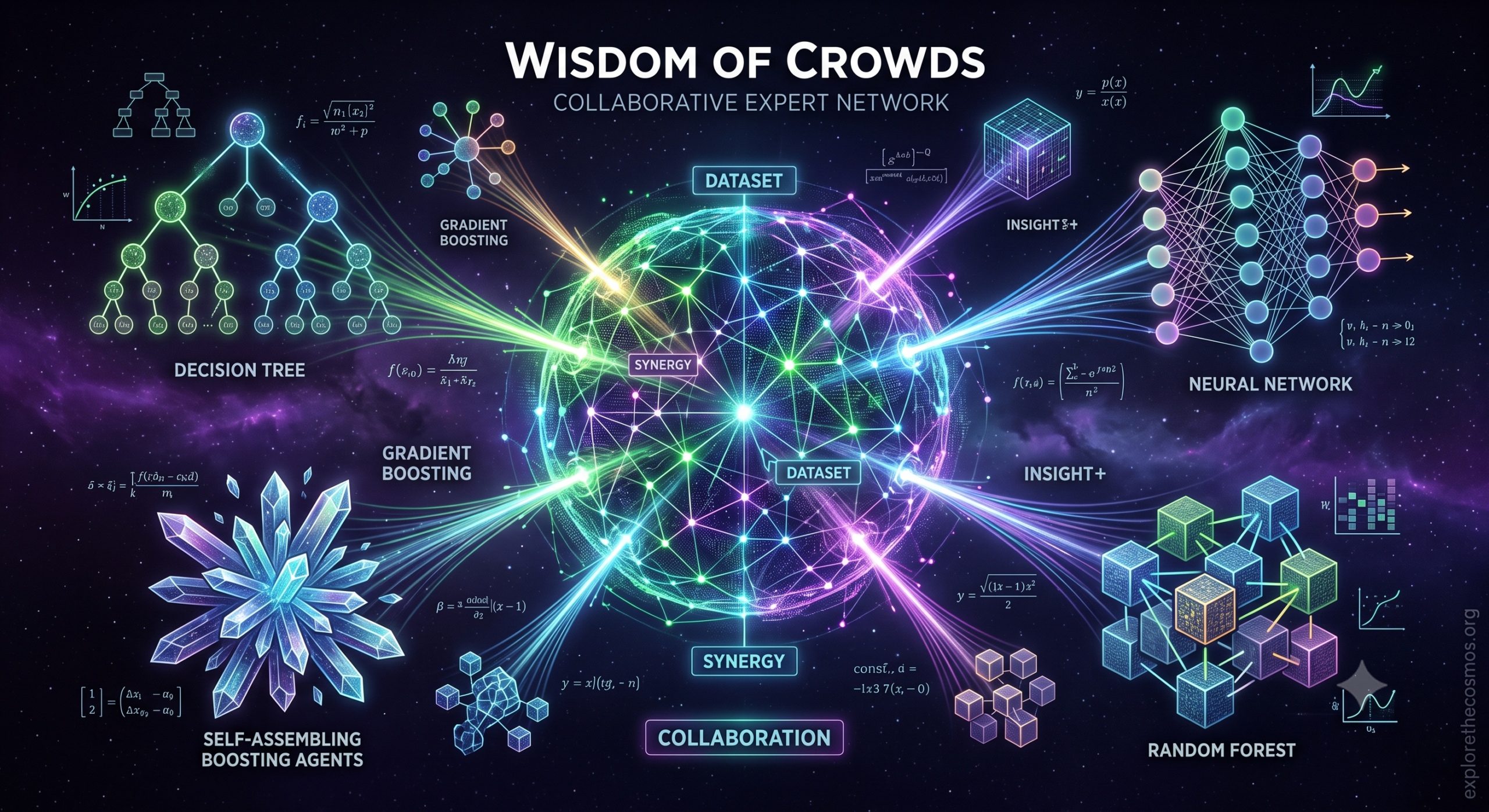
Imagine you’re trying to predict the outcome of a complex event. Would you trust the opinion of one expert, or a panel of diverse specialists, each bringing their unique insights to the table? The answer, intuitively, is the panel. This “wisdom of crowds” is the very essence of ensemble learning in machine learning – a collection of individual models, working together to achieve a superior prediction than any single model could accomplish on its own. It’s a sophisticated approach that aligns perfectly with our mission to make data-driven discovery accessible and actionable.
This post will demystify ensemble models, exploring how these powerful techniques, particularly Random Forests and Boosting, operate, why they are indispensable in today’s data landscape, and the exciting new directions they are taking. We’ll show you how combining forces can lead to unparalleled accuracy and robustness in your data analysis endeavors.
What Exactly Are Ensemble Models?
At its core, an ensemble model is a machine learning technique that combines predictions from multiple individual “base” models to improve overall predictive performance, robustness, and generalization. Instead of training one monolithic model, ensemble methods leverage the strengths of several simpler models, often called “weak learners,” to create a formidable “strong learner.”
Think of it like building a robust, privacy-first tool such as our Apple Health Cycling Analyzer. It’s not just one calculation that gives you your efficiency factor or HR drift; it’s a series of carefully designed analytical steps that, when combined, provide a comprehensive picture of your performance. Similarly, ensemble models synthesize information from various algorithms to form a more complete and accurate understanding of the underlying data patterns.
Why Not Just One Model? The Bias-Variance Trade-off
While a single, well-tuned machine learning model can perform admirably, it often struggles with what data scientists call the “bias-variance trade-off.”
- Bias: A model with high bias makes strong assumptions about the data’s underlying relationships, potentially oversimplifying them. This leads to underfitting, where the model consistently misses important patterns.
- Variance: A model with high variance is overly sensitive to the training data, capturing noise and random fluctuations rather than the true signal. This results in overfitting, where the model performs excellently on seen data but poorly on new, unseen data.
A single model typically faces the challenge of minimizing both bias and variance simultaneously – often, reducing one increases the other. Ensemble methods offer an elegant solution by strategically combining models to mitigate these issues. By averaging or combining the predictions of multiple diverse models, the ensemble can reduce variance (if the base models are independent enough) and/or reduce bias (if the base models focus on different aspects of the data), leading to a more balanced and powerful overall predictor.
How Ensemble Models Work: The Wisdom of Diverse Perspectives
The magic of ensemble models lies in their ability to harness collective intelligence. There are several strategies to build an ensemble, but two of the most prominent are Bagging (Bootstrap Aggregating) and Boosting.
Random Forests: The Democracy of Decision Trees
Random Forests are a prime example of a bagging ensemble. The name itself gives a clue: it’s an “ensemble of many decision trees”. Here’s how it works:
- Bootstrap Aggregating (Bagging): Instead of training one decision tree on the entire dataset, Random Forests create multiple (hundreds or even thousands) decision trees. Each tree is trained on a different random subset of the original data, sampled with replacement (meaning some data points might appear multiple times, while others might not appear at all for a specific tree). This “bootstrapping” introduces diversity among the individual trees.
- Feature Randomness: Crucially, at each split point within a decision tree, the Random Forest doesn’t consider all available features. Instead, it only looks at a random subset of features. This “feature randomness” further decorrelates the trees, preventing them from all relying on the same strong predictor and thus behaving like a single tree.
- Collective Voting: Once all the individual trees are trained, when a new data point needs to be predicted, each tree makes its own prediction. For classification tasks, the Random Forest combines these predictions by a majority vote (the class predicted by most trees wins). For regression tasks, it averages the predictions of all the trees.
Why Random Forests Matter: This “divide and combine” strategy significantly reduces overfitting and variance, making Random Forests incredibly robust to noise and outliers in the data. They are exceptionally good at handling high-dimensional data and generally work well with minimal tuning, making them a strong baseline for tabular data problems in diverse fields like fraud detection, credit scoring, and medical diagnostics. As we look to 2026, Random Forests continue to be a go-to algorithm for structured data, quietly excelling in real-world production systems and often being the best choice for practical applications despite the spotlight on newer, more complex models.
Boosting: The Continuous Improvement Committee
Boosting takes a different, sequential approach. Instead of building independent models, boosting algorithms train models iteratively, with each new model attempting to correct the errors made by its predecessors. It’s like a team of experts where each new member learns from the mistakes of the previous one to refine the collective understanding.
The most popular boosting algorithms today include Gradient Boosting Machines (GBMs), XGBoost, LightGBM, and CatBoost. Here’s a simplified overview:
- Sequential Learning: Boosting starts by training an initial “weak” model on the entire dataset.
- Error Correction: Subsequent models are then trained to focus specifically on the data points that the previous models misclassified or predicted poorly. They give more weight to these “difficult” examples.
- Weighted Combination: Each weak model’s contribution to the final prediction is weighted based on its performance, with better-performing models having more influence.
Why Boosting Matters: Boosting algorithms are renowned for their exceptional accuracy and ability to uncover complex relationships within data. They frequently achieve state-of-the-art performance on many tabular datasets, making them a top choice for predictive modeling on structured business data, sales forecasting, and risk assessment. Modern implementations like XGBoost are optimized for speed and performance, handle missing values, and incorporate regularization techniques to prevent overfitting, making them incredibly powerful tools in a data scientist’s arsenal.
Random Forests vs. Boosting: A Quick Comparison
While both are powerful ensemble methods, they have distinct characteristics:
- Random Forests (Bagging): Builds many independent trees in parallel, reducing variance and overfitting. More robust to noisy data and outliers. Generally easier and faster to train due to parallelization.
- Boosting: Builds trees sequentially, focusing on errors from previous trees. Aims to reduce bias and often achieves higher predictive accuracy. Can be more sensitive to noisy data and harder to tune, but offers unparalleled performance when optimized.
The Evolving Landscape: 2026 Trends in Ensemble Models
The field of machine learning is dynamic, and ensemble models are no exception. Here at Explore the Cosmos, we keep a keen eye on developments that empower clearer data-driven analysis. Looking at the landscape in 2026, we see several exciting trends shaping the future of ensemble learning:
1. The Quest for Interpretability: Shedding Light on “Black Boxes”
Historically, a criticism leveled against powerful ensemble models was their “black box” nature – high accuracy but little insight into *why* a particular prediction was made. However, a significant trend in 2026 is the intense focus on making ensemble models more interpretable and trustworthy. Researchers are increasingly integrating techniques like SHAP (SHapley Additive exPlanations) directly into ensemble frameworks. For instance, recent studies propose interpretability heart disease prediction models based on stacking ensembles with SHAP, allowing for visualization of the decision-making logic and identification of key predictive factors. Similarly, deep ensemble learning frameworks for tasks like streamflow forecasting are now employing SHAP to improve model interpretability and quantify predictor contributions. This means we can now not only get accurate predictions but also understand the underlying reasoning, a crucial step for applications in sensitive domains and for demystifying complex systems for our audience.
2. The Enduring Strength of Random Forests and Boosting for Tabular Data
Despite the rapid advancements in deep learning and large language models, Random Forests and boosting algorithms, particularly XGBoost and LightGBM, remain consistently recognized as top performers for structured or tabular data. Experts note that Random Forests continue to “quietly excel in real-world production” and are often the “best choice for practical, structured data problems”. XGBoost, for example, is highlighted for its “superior accuracy on tabular data,” often outperforming deep learning models in business analytics and forecasting. This enduring relevance underscores their robustness, efficiency, and effectiveness, making them foundational tools for any data enthusiast looking to analyze real-world datasets, from market trends to personal cycling performance data.
3. Hybrid Ensemble Frameworks: Combining Strengths for Unprecedented Performance
A compelling trend for 2026 is the development of sophisticated hybrid ensemble frameworks that combine various machine learning paradigms. This involves integrating different ensemble techniques (like stacking and bagging) with deep learning, or even blending machine learning predictions with physics-based models for enhanced forecasting. For example, hybrid ensembles are being used for robust multi-omics breast cancer prognosis, integrating clinical features, gene expression, and other data types through stacked multimodal representations. We also see hybrid ensembles for rare event detection, combining gradient-boosted decision trees, regularized linear models, and neural networks. Another fascinating application is in weather prediction, where hybrid ensemble forecasting combines the superior large-scale skill of machine-learned models with the physical consistency of traditional numerical weather prediction models through techniques like spectral nudging. These innovations demonstrate a sophisticated evolution in how we approach complex data, leveraging the complementary strengths of diverse models to achieve new levels of accuracy and robustness across various domains.
Real-World Impact and Applications
The impact of ensemble models extends far beyond theoretical discussions. In domains ranging from finance to healthcare, and even in our own analysis of human performance, these models are driving significant breakthroughs:
- Healthcare: Interpretable ensemble models are used to predict heart disease, identifying key influencing factors and assisting clinicians in understanding pathogenesis.
- Environmental Forecasting: Hybrid ensembles are improving long-term streamflow forecasting, crucial for water resource management, and even enhancing hurricane activity predictions by combining machine learning with traditional weather models.
- Business Analytics: XGBoost’s superior accuracy makes it a default choice for tasks like sales forecasting and risk assessment on tabular data.
At Explore the Cosmos, our own Apple Health Cycling Analyzer thrives on understanding complex patterns in personal data. While not directly using Random Forests or Boosting in a client-side tool for privacy reasons, the principle of identifying nuanced patterns from multiple data points to derive insights into efficiency, HR drift, or VAM, resonates with the collaborative intelligence of ensemble models. They teach us that better understanding comes from a comprehensive, multi-faceted approach.
Addressing Limitations and Misconceptions
While powerful, ensemble models are not without their considerations:
- Computational Cost: Training many models can be more computationally intensive and time-consuming than training a single model. However, advancements in parallel processing (especially for Random Forests) and optimized implementations (like XGBoost) have largely mitigated this concern.
- Interpretability (Historically): As discussed, this was a major challenge, but the integration of Explainable AI (XAI) techniques like SHAP is making significant strides in opening up these “black boxes”.
- Not a Silver Bullet: No single algorithm or technique is perfect for every problem. The choice of ensemble method and base learners depends heavily on the specific dataset and task at hand.
Embark on Your Data Discovery Journey
Ensemble models like Random Forests and Boosting represent a cornerstone of modern machine learning. By embracing the “wisdom of crowds,” they provide unparalleled accuracy, robustness, and, increasingly, interpretability across a vast array of complex systems. As we continue our journey at Explore the Cosmos, we are committed to providing you with the knowledge and tools to navigate these fascinating frontiers of science, data, and discovery.
Whether you’re delving into the intricacies of machine learning algorithms or simply seeking to understand your own cycling performance data with our privacy-first Apple Health Cycling Analyzer, the principles of clear, data-driven analysis remain paramount. Keep exploring, keep learning, and let the power of collective intelligence guide your next big discovery.
Leave a Reply