
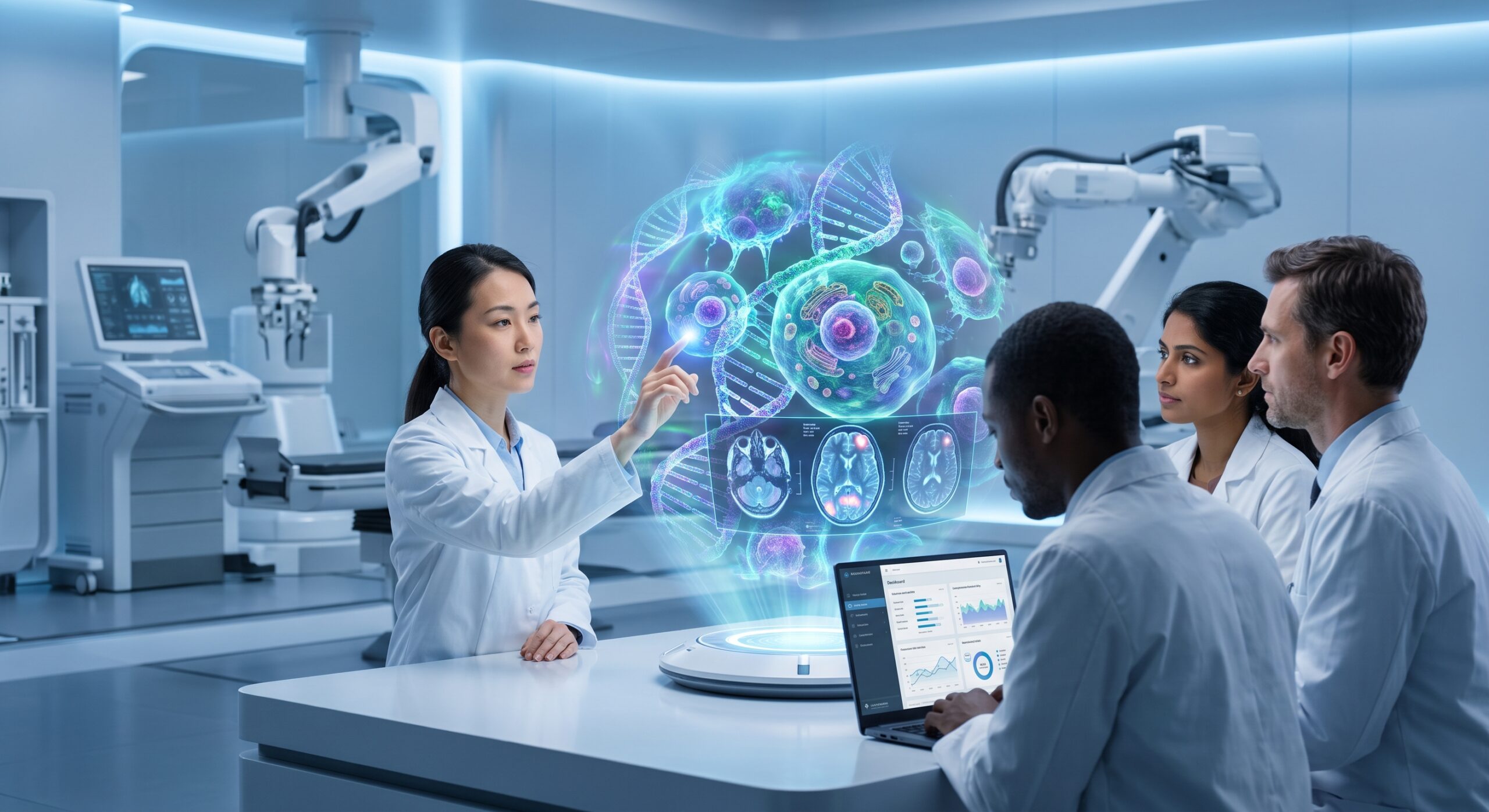
At Explore the Cosmos, we’re driven by the conviction that understanding complex systems through data-driven analysis is the key to discovery—whether we’re mapping distant galaxies, optimizing human performance, or navigating the intricate world of personal finance with tools like our FinFortress. Healthcare, arguably one of the most complex systems humanity faces, is undergoing a profound transformation thanks to Machine Learning (ML). But this isn’t just about flashy AI; it’s about harnessing data responsibly to improve lives, an endeavor that demands both excitement for innovation and rigorous attention to ethical safeguards.
The promise of ML in medicine is immense, offering paths to personalized treatments, faster diagnoses, and more efficient operations. Yet, as with any powerful technology, it comes with significant risks—particularly around data privacy, algorithmic bias, and the critical need for human oversight. In this comprehensive guide, we’ll demystify ML’s role in healthcare, exploring its most compelling opportunities for 2026 and beyond, while also candidly addressing the crucial challenges we must navigate to ensure a future of equitable and effective care. Join us as we explore the cosmos of health data, seeking both discovery and data sovereignty.
What is Machine Learning in Healthcare?
At its core, Machine Learning is a subset of Artificial Intelligence that enables computer systems to learn from data without being explicitly programmed. Think of it like teaching a child to recognize different animals: instead of giving them a strict set of rules for “cat” or “dog,” you show them many examples until they learn to identify new ones on their own. In healthcare, this means feeding algorithms vast amounts of medical data—patient records, lab results, imaging scans, genomic sequences, and even wearable device data—to help them identify patterns, make predictions, and support decision-making.
Unlike traditional software that follows rigid instructions, ML models adapt and improve as they encounter more data. This adaptability makes them incredibly powerful for tackling the dynamic and often nuanced challenges of medicine. For us at Explore the Cosmos, this resonates deeply with our mission to make complex data understandable. ML in healthcare isn’t about replacing human doctors, but about augmenting their capabilities, providing insights that can lead to more precise and proactive care.
Opportunities: Charting a Course for Health Innovation in 2026
The year 2026 marks a significant inflection point, with ML moving from experimental stages into core healthcare systems, promising tangible benefits across the board. Here are some of the most impactful opportunities we see unfolding:
Precision Medicine & Accelerated Drug Discovery
Imagine a future where treatments are tailored not just to a disease, but to your unique genetic makeup and health history. This is the heart of precision medicine, and ML is its engine. By analyzing multi-modal data—genomics, transcriptomics, proteomic data, medical history, imaging, and electronic health records—ML models can identify optimal therapies for individual patients. This includes predicting how well a patient might respond to a particular drug, identifying potential adverse reactions, and even matching patients to the most suitable clinical trials.
- Tailored Treatments: ML models are increasingly predicting treatment resistance for antidepressants, guiding genotype-directed dosing for medications like warfarin, and enabling “ultra-targeted therapies” in oncology that strike tumor-specific mutations with remarkable precision.
- Expedited Drug Development: ML accelerates drug discovery by modeling molecular interactions, screening drug candidates, and predicting toxicity, significantly reducing the time and cost associated with early-stage development. The global personalized medicine market is expected to reach $1.37 trillion by 2035, signaling real-world clinical adoption.
Enhanced Diagnostics & Predictive Power
One of the most immediate and profound impacts of ML is in improving diagnostic accuracy and enabling proactive care. ML algorithms excel at recognizing subtle patterns within complex datasets that human eyes might miss, leading to earlier detection of diseases like cancer, diabetes, and cardiovascular conditions.
- AI-Assisted Diagnosis: AI systems can analyze medical images such as mammograms and CT scans with high accuracy, comparing them to vast datasets of historical images to identify abnormalities and help doctors detect diseases earlier. The FDA had authorized 1,451 AI-enabled medical devices by the end of 2025, with radiology accounting for a significant portion, underscoring mainstream adoption.
- Predictive Analytics for Proactive Care: ML strengthens prediction models across healthcare, forecasting readmission risks, disease progression, bed occupancy, and staffing requirements. This shift from reactive treatment to proactive and preventive care is a defining characteristic of healthcare in 2026. We see parallels here to how our own tools, like the Apple Health Cycling Analyzer, allow users to predict performance trends and proactively optimize their training, demonstrating the power of data to inform future actions.
Operational Efficiency & Streamlined Workflows
Beyond direct patient care, ML is revolutionizing the operational backbone of healthcare. From administrative tasks to complex logistical challenges, AI-driven solutions are improving efficiency and reducing burdens.
- Administrative Automation: AI is being immediately applied to legacy systems for pharmaceutical supply chains, tailored health insurance offerings, revenue cycle management, and payer operations. Generative AI-driven orchestration is increasingly replacing traditional business process management.
- Reduced Documentation Burden: One of the most significant near-term opportunities is the potential to reduce documentation time for physicians while improving the quality and completeness of records. This frees up valuable time for healthcare professionals to focus on what matters most: patient care.
- Evolution of AI Models: Looking ahead, 2026 is seeing a promising shift towards smaller, domain-specific AI models that balance efficiency with precision, moving away from bulky, general-purpose large language models (LLMs). This development aligns with our emphasis on specialized, efficient tools that deliver targeted value.
Risks & Critical Safeguards: Ensuring Ethical and Equitable AI
While the opportunities are compelling, we at Explore the Cosmos believe in an honest assessment of limitations. The rapid integration of ML into healthcare also introduces complex ethical, legal, and regulatory questions that demand careful consideration and robust safeguards.
The Shadow of Algorithmic Bias
One of the most pressing concerns is the inherent risk of algorithmic bias. AI models learn from vast datasets, and if these datasets reflect historical and systemic biases present in medical literature or real-world patient populations, the AI will perpetuate and even amplify them.
- Inequitable Outcomes: If training data is dominated by studies on a particular demographic (e.g., male subjects in cardiology), the AI might de-prioritize or miss crucial information for other groups, leading to misdiagnosis or inequitable care. This isn’t just a theoretical problem; it creates a powerful “echo chamber effect” that reinforces the status quo.
- Transparency and Human Oversight: Forward-looking ethical standards taking shape in 2026 are shifting the focus to transparency (disclosing training data composition), interrogability (understanding how AI reaches conclusions), and critical human oversight. This aligns with our philosophy of not blindly trusting automation, but rather treating AI as a powerful yet fallible assistant.
Data Quality, Privacy & Security: The Local-First Imperative
Healthcare data is among the most sensitive personal information. The quality of the data fed into ML models is paramount, and its security and privacy are non-negotiable.
- Fragmentation and Flaws: Challenges include data quality issues, fragmentation across different systems, and the sheer complexity of ensuring patient data security and privacy. Concerns about data security can erode trust in AI outputs.
- HIPAA Compliance & Ethical Concerns: In 2026, navigating the regulatory landscape for AI tools requires ensuring HIPAA compliance, robust data encryption (at rest and in transit), and stringent role-based access controls with multi-factor authentication. Vendors unwilling to sign Business Associate Agreements pose serious compliance risks.
- Our Perspective on Data Sovereignty: This is where our commitment to data sovereignty truly resonates. Just as with FinFortress, which processes sensitive financial data 100% offline to protect user privacy, the ideal for certain healthcare applications would involve local-first, privacy-centric architectures. Minimizing the need to upload sensitive patient telemetry to the cloud drastically reduces exposure risks, putting control back into the hands of individuals and their care providers.
Explainability & Clinician Trust
Many advanced ML models, particularly deep learning networks, operate as “black boxes”—they provide accurate predictions but cannot easily explain *how* they arrived at that conclusion. This lack of explainability is a significant barrier to clinician trust and adoption.
- The “Black Box” Problem: If a doctor doesn’t understand the reasoning behind an AI’s diagnostic recommendation, they are less likely to trust it or be able to defend their decision to a patient. Human oversight is explicitly required for adverse determinations made by AI in many state regulations by 2026.
- Diagnostic Inconsistency & Over-reliance: While AI promises to improve diagnostics, its performance can be inconsistent. Over-reliance on AI without factoring in clinician experience can lead to misdiagnosis, ranking as a top patient safety concern in 2026.
The Evolving Regulatory and Legal Landscape
The speed of AI’s integration necessitates a rapidly evolving regulatory framework. In 2026, states are leading efforts to regulate AI in healthcare, enacting laws around insurers’ use of AI, transparency requirements, and limiting autonomous clinical decision-making.
- State-Level Regulation: Key legislative themes include regulating AI chatbots (especially in mental health contexts), requiring clinical oversight and patient disclosure/consent, and establishing AI “regulatory sandboxes” to test systems in controlled environments.
- Ethical Imperatives: Frameworks like the EU AI Act, NIST AI Risk Management Framework, and ISO 42001 carry real enforcement weight in 2026, making robust governance an ethical and legal imperative. These regulations demand documented risk management processes, bias testing, data governance controls, and clear accountability chains.
Our Approach: Data, Discovery, and Deliberation
At Explore the Cosmos, our mission is to provide clear explanations and practical tools for understanding complex systems. The landscape of ML in healthcare exemplifies this complexity. We advocate for a future where the incredible power of ML is harnessed with an unwavering commitment to ethical principles and data sovereignty.
- Demystifying the “Black Box”: We believe in foundational concepts and clear explanations without jargon, much like how we break down data science for our audience. Understanding how an ML classifier like FinFortress‘s LinearSVC works locally to categorize transactions helps demystify the power (and limitations) of these algorithms.
- Prioritizing Data Sovereignty: The privacy challenges in healthcare AI underscore the “Anti-SaaS” movement we champion. Where feasible, local-first software and on-device machine learning can provide powerful analytical capabilities without compromising sensitive patient data to cloud servers. Imagine health insights delivered directly from your personal health data, processed securely on your device, just like our Apple Health Cycling Analyzer.
- Emphasizing Human Oversight: True intelligence in healthcare will always be a collaboration between advanced algorithms and compassionate human expertise. ML is a tool for discovery, not a replacement for the profound human element of care.
The Future is Now, But We Must Build it Responsibly
Machine Learning is undeniably transforming healthcare, offering unprecedented opportunities to personalize treatment, enhance diagnosis, and improve operational efficiency. From accelerating drug discovery to enabling proactive care, the benefits unfolding in 2026 are profound. However, these advancements come with equally significant responsibilities—to mitigate algorithmic bias, safeguard patient privacy, ensure explainability, and navigate a rapidly evolving regulatory maze.
As we continue to explore the cosmos of data-driven possibilities, our commitment at Explore the Cosmos remains steadfast: to foster understanding, promote ethical data practices, and champion privacy-first solutions. The future of health is bright, but it is a future we must build deliberately, with both innovation and integrity at its core.
Leave a Reply