
Imagine spending months, even years, perfecting a machine learning model. You’ve fine-tuned its parameters, validated its accuracy, and you’re confident it can solve a specific problem. But then comes the critical question: what next? How do you take this powerful creation from your development environment and make it accessible and useful to your users? This is the realm of model deployment, a crucial, yet often overlooked, step in the machine learning lifecycle. At Explore the Cosmos, where we believe in the power of data for discovery and understanding, we’re dedicated to demystifying complex topics like model deployment. We aim to equip you with the knowledge to not only build powerful models but also to integrate them seamlessly into practical applications, respecting your data sovereignty along the way.
From Lab to Real-World: The Essence of Model Deployment
Model deployment is the process of making your trained machine learning model available for use in a production environment. It’s the bridge between theory and practice, transforming a static algorithm into a dynamic tool that can generate predictions or insights based on new, real-world data. Without effective deployment, even the most sophisticated model remains an academic exercise, confined to the virtual sandbox where it was trained.
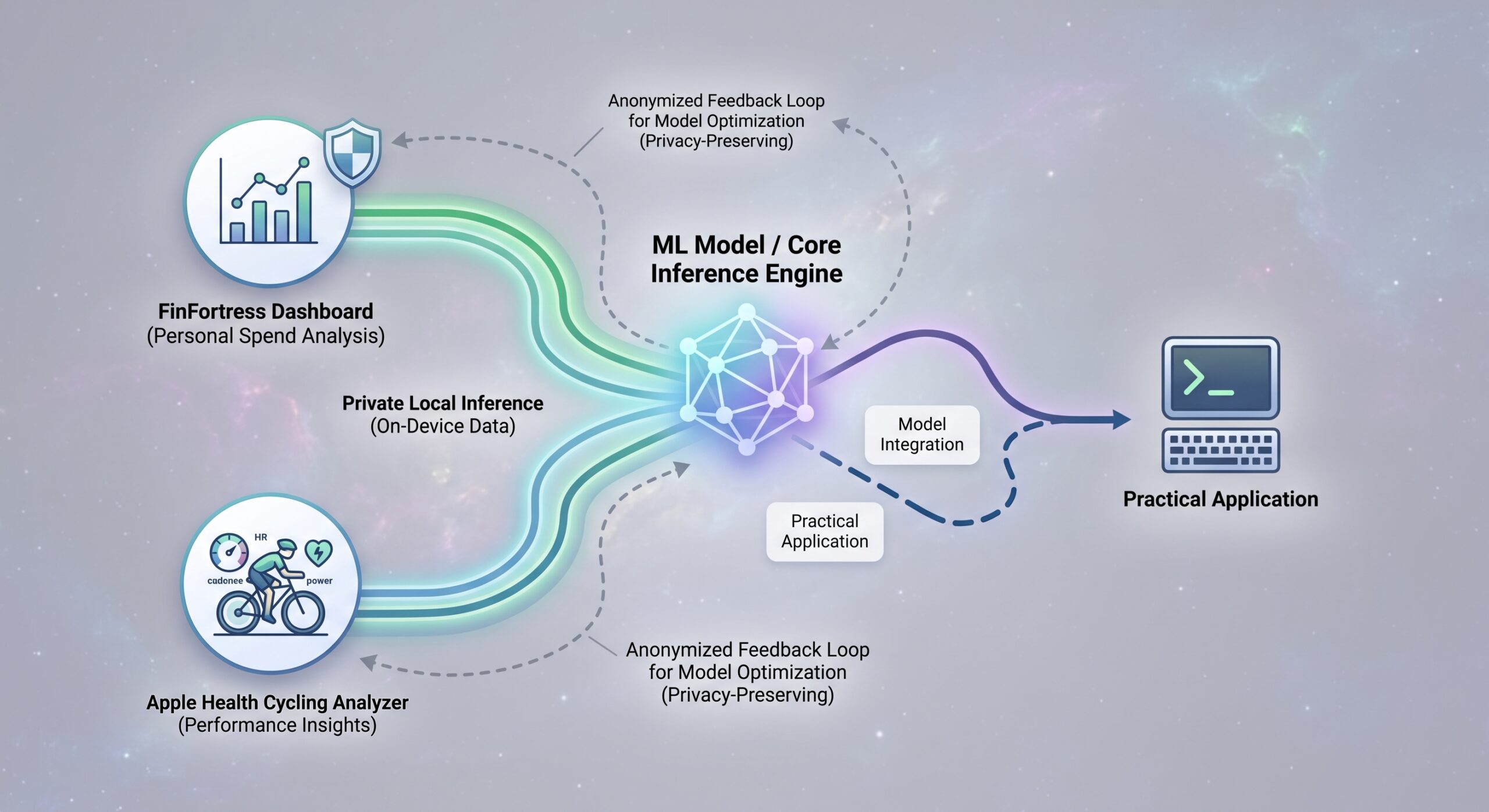
For us at Explore the Cosmos, this process is deeply intertwined with our mission of data-driven analysis and local-first software. We envision a world where powerful AI capabilities are not locked behind proprietary cloud services, but are accessible, understandable, and controllable by the user. This philosophy is at the heart of tools like our FinFortress, which leverages local ML for financial data analysis, and our Apple Health Cycling Analyzer, providing privacy-centric performance insights. These applications showcase how model deployment can empower users directly, without compromising their data.
Why Model Deployment Matters More Than Ever in 2026
As we look towards 2026, the landscape of machine learning is evolving at an unprecedented pace. The rise of generative AI, coupled with an increasing emphasis on efficiency and privacy, is reshaping how we think about deploying models. Several key trends highlight the growing importance of robust model deployment strategies:
The Rise of Edge AI and Localized Deployments
One of the most significant shifts is the move towards “Edge AI.” This refers to deploying AI models directly onto local devices or infrastructure, rather than relying solely on cloud-based processing. By 2026, edge AI is predicted to become an integral part of industrial operations, offering real-time inference, reduced latency, and greater control over data. This trend aligns perfectly with our commitment to privacy-centric, local-first software. Imagine your cycling performance data being analyzed directly on your device, or your financial transactions being categorized locally, without ever leaving your machine. This is the promise of edge deployment.
The development of smaller, more efficient AI models, such as Small Language Models (SLMs), is a key enabler of this trend. These models require less computational power and can run on resource-constrained edge hardware, making them ideal for deployment on smartphones, IoT devices, and even within specialized local applications like FinFortress.
MLOps: The Backbone of Scalable AI
The complexity of deploying and managing machine learning models at scale has given rise to MLOps (Machine Learning Operations). MLOps integrates principles from DevOps with the unique demands of the ML lifecycle, aiming to streamline development, deployment, monitoring, and maintenance. The MLOps market is projected for significant growth, expected to reach $4.38 billion by 2026, underscoring its critical role.
For organizations, MLOps ensures that models can be deployed quickly, consistently, and reliably. This includes automated pipelines for training, testing, and deploying models, as well as continuous monitoring for performance degradation or drift. As models become more sophisticated and their applications more diverse, robust MLOps practices are essential for maintaining their effectiveness and trustworthiness in production environments.
The Evolution of Generative AI Deployment (LLMOps)
The explosion of Large Language Models (LLMs) has introduced new challenges and opportunities in deployment, leading to the emergence of LLMOps. By 2026, operationalizing LLMs is becoming a core focus, encompassing LLM serving, scaling, and the implementation of Retrieval-Augmented Generation (RAG) pipelines.
LLMOps addresses specific needs like prompt management, versioning, and the integration of LLMs with external data sources. For us, understanding LLMOps is vital as we explore how to best leverage advanced AI capabilities while maintaining our core principles of user control and data privacy. While we champion local-first solutions, acknowledging the advancements in LLM deployment helps us understand the broader ecosystem and potential future integrations.
Key Considerations for Model Deployment
Deploying a model isn’t a one-size-fits-all process. Several factors influence the best deployment strategy:
1. Deployment Environment: Cloud, On-Premise, or Edge?
- Cloud Deployment: Offers scalability, flexibility, and access to powerful computing resources. However, it often involves recurring costs and potential data privacy concerns, which we aim to mitigate through our local-first approach.
- On-Premise Deployment: Provides greater control over data and infrastructure but requires significant upfront investment and ongoing maintenance.
- Edge Deployment: Ideal for real-time applications, low-latency needs, and enhanced data privacy. This is where our focus on local-compute solutions like FinFortress truly shines. As noted in recent trends, by 2026, edge inference is becoming a critical competitive battleground.
2. Model Serving and Inference
Once deployed, models need a way to serve predictions. This involves setting up an inference server that can receive input data, pass it to the model, and return the output. Popular platforms like Hugging Face Inference Endpoints, Seldon Core, and NVIDIA Triton Inference Server are leading the way in efficient model serving for 2026. For local applications, this might involve a Python script directly executing the model, as we do with LinearSVC in FinFortress.
3. Monitoring and Maintenance
Deployment is not the end of the journey. Models can degrade over time due to changes in the underlying data distribution (model drift). Continuous monitoring is essential to detect these issues and trigger retraining or updates. Tools and practices within MLOps are critical here, ensuring that deployed models remain accurate and reliable. For our users, this means that even our offline tools can be updated to improve their analytical capabilities over time.
4. Scalability and Performance
As user demand grows, your deployed model must be able to handle the increased load. This might involve scaling up server resources, optimizing model inference speed, or employing techniques like model quantization for edge devices. Performance is a key consideration, especially for applications like real-time analytics or financial dashboards where speed is crucial.
5. Governance and Compliance
With increasing regulatory scrutiny, especially around AI, governance and compliance are paramount. This includes ensuring data lineage, model versioning, fairness, and adherence to privacy regulations. “Policy-as-Code” is emerging as a key trend for 2026, embedding governance rules directly into MLOps pipelines. For us, data sovereignty and privacy are not afterthoughts but foundational principles, ensuring our users remain in control.
Model Deployment in Action: Our Privacy-First Approach
At Explore the Cosmos, we embody these principles through our practical, privacy-centric tools. Consider FinFortress:
- Local-First Deployment: The LinearSVC model for auto-categorizing bank CSVs is deployed entirely offline on the user’s machine. No data is uploaded, ensuring maximum data sovereignty.
- Efficiency: By using a lightweight, local classifier, we bypass the need for cloud-based AI services, offering a fast and responsive user experience.
- Transparency: We demystify the process, explaining that this isn’t AGI, but an efficient sorting mechanism, aligning with our honest approach to ML.
Similarly, the Apple Health Cycling Analyzer deploys its analysis logic within the user’s browser. Data export from Apple Health is processed locally, providing insights like efficiency factor and HR drift without sending sensitive health metrics to any server.
These examples demonstrate that effective model deployment doesn’t always mean complex cloud architectures. It can mean empowering users with on-device intelligence that is both powerful and respects their privacy.
The Future is Accessible and Controlled
Model deployment is no longer an esoteric topic reserved for seasoned engineers. As machine learning permeates more aspects of our lives, understanding the basics of how models are delivered and maintained becomes increasingly important. The trends pointing towards edge AI, hyper-automation, and localized deployments in 2026 suggest a future where AI is not only more powerful but also more accessible and controllable by the individual.
At Explore the Cosmos, we are committed to being at the forefront of this movement. By combining clear explanations with practical, privacy-centric tools, we empower you to understand, utilize, and benefit from the incredible potential of data science and machine learning, ensuring your journey of discovery is secure and sovereign. Whether you’re analyzing financial flows with FinFortress or optimizing your cycling performance, the power of your data is yours to command.
Leave a Reply