
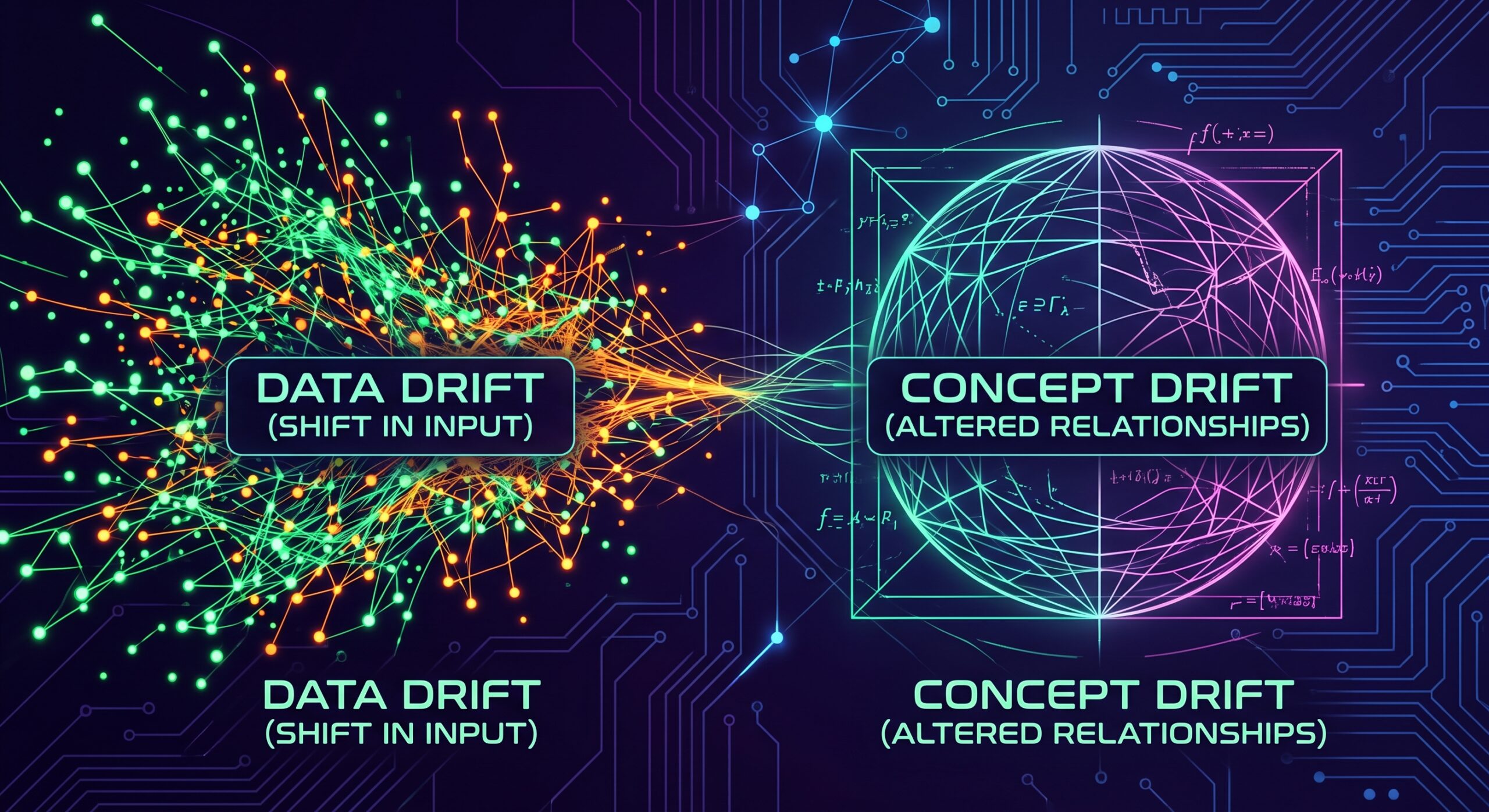
In the ever-evolving universe of data and machine learning, a silent threat lurks, capable of rendering even the most sophisticated models ineffective: model drift. It’s not a bug in the code, nor a flaw in the algorithm itself. Instead, it’s the natural consequence of a world in constant flux. At Explore the Cosmos, where we champion data-driven discovery, understanding these subtle yet powerful shifts is paramount. We believe in demystifying complex topics, and that includes the often-overlooked phenomena of data drift and concept drift. By the end of this article, you’ll grasp what these terms mean, why they’re critical for the accuracy of our local-first analysis tools like FinFortress and the Apple Health Cycling Analyzer, and how we at Explore the Cosmos approach them.
The Silent Erosion of Model Accuracy
Imagine building a powerful telescope, perfectly calibrated to observe distant galaxies. You meticulously collect data, train your systems, and the results are breathtaking. But over time, subtle changes in atmospheric conditions or the telescope’s own internal mechanisms can begin to distort the image, making your once-clear observations fuzzy and unreliable. This is analogous to what happens with machine learning models in production. As they are exposed to new, real-world data, the patterns they were trained on can slowly become outdated. This degradation in performance is known as model drift, and it’s a pervasive challenge. Studies consistently show that a significant percentage of production machine learning systems experience accuracy loss within their first year. In 2026, with AI becoming more integrated into critical decision-making, the stakes are higher than ever. For us at Explore the Cosmos, ensuring the continued accuracy of our privacy-centric tools relies on our vigilance against these subtle shifts.
Data Drift: When the Inputs Change, But the Rules Stay the Same
Let’s first tackle data drift, also known as covariate shift. At its core, data drift occurs when the statistical properties of the input data change over time, but the underlying relationship between the input features and the target variable remains the same. Think of our Apple Health Cycling Analyzer. Initially, it might be trained on data from cyclists using a specific type of sensor. If suddenly a large influx of users starts using a new generation of sensors with different baseline readings (perhaps more precise or with a slightly altered data output), that’s data drift. The way the model *interprets* heart rate, power output, or cadence might still be valid, but the raw numbers it’s receiving have changed distribution.
Consider our FinFortress tool. It’s designed to auto-categorize your bank CSVs using a local machine learning script. If your spending habits evolve dramatically – say, you move to a new city and your typical transaction categories shift from “groceries” and “gas” to “rent” and “public transport” more frequently – that’s data drift. The model’s understanding of how to categorize expenses hasn’t fundamentally changed, but the *frequency* and *distribution* of those expense types in your data have shifted. As of 2026, understanding these shifts is crucial. Emerging data distributions, driven by seasonal variations, market trends, or economic shifts, are a primary cause of data drift. This means our tools must be robust enough to adapt or be easily retrained on new, representative data to maintain their effectiveness.
Several factors can lead to data drift:
- Changing User Behavior: As seen with FinFortress, how users interact with systems and generate data evolves.
- Seasonal Variations and Market Trends: Economic shifts or recurring patterns (like holiday spending) alter data distributions.
- Data Quality Divergence: Inconsistent data collection or upstream system changes can subtly alter feature distributions.
- External Factors: Events like pandemics or new regulations can dramatically impact data patterns.
Detecting data drift often involves statistical tests that compare the distribution of new data against the training data. Techniques like the Kolmogorov-Smirnov (KS) test or Population Stability Index (PSI) are commonly employed. The key here is that the *relationship* the model learned is still sound; it’s just that the *inputs* it’s seeing are different.
Concept Drift: When the Meaning of the Data Changes
While data drift alters the *inputs*, concept drift fundamentally changes the *relationship* between the input features and the target variable. This is a more profound challenge because it means the very rules the model learned are no longer applicable. Imagine our Apple Health Cycling Analyzer again. If, for instance, a new scientific understanding emerges that links a specific heart rate variability pattern to a different performance metric than previously thought, that’s concept drift. The heart rate data itself might look the same, but its *meaning* or its *predictive power* for a certain outcome has changed.
In financial contexts, concept drift is particularly insidious. For example, a model trained to predict credit risk based on historical data might become unreliable if a major economic crisis fundamentally alters the relationship between traditional financial indicators and default probabilities. What once was a strong predictor might become a weak one, or vice versa. As highlighted in research for 2026, the relationship between input features and target variables can evolve substantially during economic crises, rendering models trained in stable periods ineffective. This also applies to our FinFortress tool; if a new type of financial instrument or a novel loophole emerges that changes how certain transactions relate to wealth accumulation or debt, the model’s categorization logic, while technically sound, might misinterpret its purpose.
Concept drift can manifest in various ways:
- Sudden Drift: A rapid, overnight change in the relationship.
- Gradual Drift: A slow, steady evolution of the relationship over time.
- Incremental Drift: Small, cumulative changes that eventually become significant.
- Recurring Drift: Patterns that change and then revert, often seasonally.
Detecting concept drift is often more challenging than data drift because it requires ground truth labels to observe the degradation in performance metrics like accuracy or precision. When labels are delayed, proxy metrics or domain-specific heuristics become vital. The core issue is that the underlying “concept” the model is trying to learn has shifted.
Why This Matters for Explore the Cosmos and Our Tools
At Explore the Cosmos, our mission is to empower users with data-driven insights, grounded in privacy and transparency. Our local-first software, like FinFortress and the Apple Health Cycling Analyzer, processes sensitive user data on their own devices. This inherently privacy-preserving approach means we don’t rely on massive, cloud-based data lakes that can be constantly updated by a central authority. Instead, our models learn from the data *you* provide, locally.
This is where understanding drift becomes critical. A local classifier, like the LinearSVC used in FinFortress, is efficient and private, but it’s also a snapshot in time. If the nature of financial transactions or cycling performance metrics evolves significantly, that local model, without intervention, will eventually reflect outdated patterns. It’s why we emphasize that local ML isn’t Artificial General Intelligence; it’s efficient sorting and pattern recognition based on the data it has. We are honest about these limitations and committed to providing pathways for users to keep their insights relevant. This could involve easily updating the model with new data or understanding when a retraining cycle might be beneficial.
Furthermore, the rise of advanced AI governance and MLOps frameworks in 2026 highlights the industry’s recognition of drift’s importance. Continuous monitoring, automated alerting, and clear differentiation between data drift and concept drift are becoming standard practice for reliable AI systems. While our local-first philosophy might differ from large-scale cloud deployments, the underlying principle remains: understanding and managing how data and concepts change is vital for maintaining accurate, trustworthy analysis.
Detecting and Mitigating Drift: Our Approach
While the exact implementation details for continuous drift monitoring in a purely local-first, privacy-preserving environment are complex, our philosophy guides our strategy. We focus on:
- User Education: Empowering you, our users, to understand when your data might be changing in ways that impact analysis.
- Transparent Methodologies: Clearly explaining how our tools work, including the types of models used and their inherent limitations regarding drift.
- Facilitating Updates: Designing our tools so that incorporating new data or retraining local models can be straightforward processes, should the need arise. For instance, providing clear instructions or simple mechanisms for re-running categorization on updated CSVs in FinFortress, or reprocessing Apple Health data with updated insights.
- Focus on Foundational Concepts: By thoroughly explaining concepts like data types, workflows, and algorithms in plain English, we equip our audience to better understand potential shifts in their own data.
As research in 2026 shows, managing drift is a continuous cycle: Detect, Diagnose, Retrain. While automated retraining pipelines are common in cloud environments, our approach prioritizes user control and understanding. We aim to provide the insights and tools that allow you to be an active participant in maintaining the accuracy of your personal data analysis. This might mean periodic reviews of your financial categories in FinFortress or noticing changes in your cycling performance metrics that warrant a deeper look, potentially leading to re-analysis.
Conclusion: Embracing the Evolving Data Landscape
Data drift and concept drift are not just abstract academic concepts; they are the silent forces that can degrade the effectiveness of machine learning models in the real world. For us at Explore the Cosmos, with our commitment to science, data, and discovery, these phenomena are central to ensuring the enduring value of our tools. By demystifying data drift and concept drift, we empower our users to better understand their data and maintain the accuracy of their personal analyses. As we continue to explore the cosmos of knowledge, understanding these shifts ensures that our journey is not just about discovery, but about maintaining the precision and relevance of that discovery over time. We embrace the evolving data landscape, not as a challenge to be feared, but as an inherent part of the dynamic systems we strive to understand and analyze.
Leave a Reply