
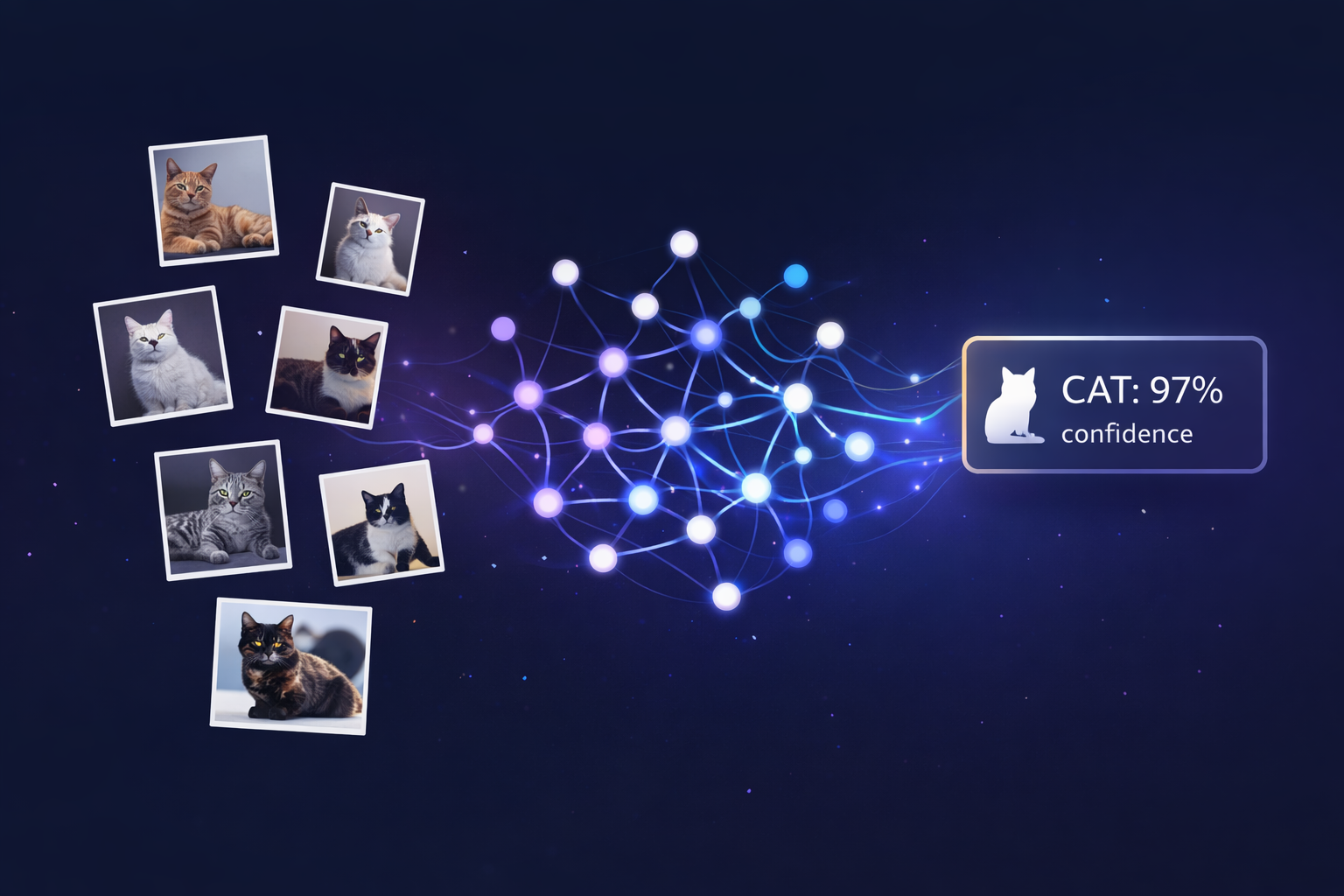
Imagine teaching a child to recognize cats.
You don’t give them a rulebook: “A cat has four legs, pointy ears, whiskers, fur, and a tail.” That description also matches foxes, some dogs, and countless other animals.
Instead, you show them cat after cat after cat. Tabby cats. Black cats. Fluffy Persian cats. Hairless Sphynx cats. Fat cats. Skinny cats. Cats sitting, running, sleeping, and hiding in boxes.
Eventually, something clicks. The child learns what makes a cat a cat – not through explicit rules, but through exposure to examples. They can now recognize cats they’ve never seen before, even cats that look quite different from any you showed them.
That’s machine learning.
Instead of programming a computer with explicit rules to follow, we give it examples and let it figure out the patterns on its own.
Traditional Programming vs. Machine Learning
To understand machine learning, it helps to contrast it with traditional programming.
Traditional Programming
Input: Data + Rules
Output: Answers
How it works: A programmer writes explicit instructions. The computer follows those instructions exactly.
Example: Spam filter using rules
A programmer decides:
- If email contains “FREE MONEY” → spam
- If sender is not in contacts AND contains “urgent” → spam
- If email has more than 3 links → maybe spam
The computer checks each rule. If conditions are met, it flags the email.
The problem: Spammers adapt. They write “FR33 M0N3Y” instead. The rules miss it. The programmer must update the rules. Spammers adapt again. Endless cycle.
Machine Learning Approach
Input: Data + Answers
Output: Rules (learned patterns)
How it works: Instead of writing rules, we show the computer thousands of examples: “This is spam. This is not spam. This is spam. This is not spam.”
The computer analyzes these examples and discovers its own patterns – patterns a human might never explicitly define or even notice.
Example: Spam filter using machine learning
We feed the system 100,000 emails labeled “spam” or “not spam.” The algorithm examines everything: words, sentence structure, punctuation, timing, sender patterns, formatting, links, images.
It learns: emails with certain combinations of characteristics tend to be spam. Not just obvious keywords, but subtle patterns across dozens of variables.
When “FR33 M0N3Y” shows up, the system recognizes it shares other characteristics with known spam – even though no one programmed that specific variation.
The key difference: Traditional programming requires humans to anticipate every scenario. Machine learning discovers patterns from data, including patterns humans didn’t explicitly identify.
How Machine Learning Actually Works (Simplified)
Let’s walk through the basic process without getting lost in mathematics.
Step 1: Gather Data
Machine learning needs examples to learn from. The more examples, generally the better.
For a cat recognizer:
- Thousands of images labeled “cat”
- Thousands of images labeled “not cat”
For a spam filter:
- Thousands of emails labeled “spam”
- Thousands of emails labeled “not spam”
For predicting house prices:
- Thousands of past sales with features (size, location, bedrooms) and final prices
This labeled data is called training data – the examples the system learns from.
Step 2: Choose an Algorithm
An algorithm is the mathematical method the computer uses to find patterns. Different algorithms suit different problems.
Think of algorithms like different approaches to learning:
- Some look for boundaries between categories
- Some find similarities and group similar things together
- Some build decision trees (if this, then that)
- Some mimic how brain neurons connect
You don’t need to understand the math. Just know that the algorithm is the approach to finding patterns.
Step 3: Training
This is where the “learning” happens.
The algorithm processes the training data, looking for patterns that help distinguish between outcomes (cat vs. not cat, spam vs. not spam, high price vs. low price).
What “learning” means technically:
The algorithm adjusts internal numerical values (called weights or parameters) to minimize errors. It makes predictions, checks if they’re right, and adjusts its approach when wrong.
Analogy: Imagine adjusting a recipe. You bake cookies, taste them, note they’re too sweet, and reduce sugar next time. You repeat this hundreds of times until the cookies are perfect. The algorithm does something similar – adjusting its internal “recipe” based on feedback until predictions improve.
Step 4: Evaluation
After training, we test the model on new data it hasn’t seen before. This reveals whether it actually learned useful patterns or just memorized the training examples.
Why this matters: A student who memorizes test answers without understanding the material will fail new questions. Similarly, a machine learning model must generalize – apply learned patterns to new situations.
Step 5: Prediction
Once trained and validated, the model can make predictions on completely new data.
- Show it a new image → it predicts “cat” or “not cat”
- Show it a new email → it predicts “spam” or “not spam”
- Show it a new house listing → it predicts a price
The Three Main Types of Machine Learning
Machine learning approaches fall into three broad categories based on how they learn.
1. Supervised Learning
The setup: Learning from labeled examples.
Analogy: A teacher shows you problems with correct answers. You learn patterns, then solve new problems independently.
How it works:
- Training data includes both inputs AND correct outputs
- Algorithm learns the relationship between inputs and outputs
- Model predicts outputs for new inputs
Examples:
| Task | Input | Output (Label) |
| Email spam detection | Email content | Spam / Not spam |
| Image recognition | Photo | Cat / Dog / Bird / etc. |
| Price prediction | House features | Price |
| Medical diagnosis | Patient data | Disease / No disease |
When to use: When you have historical data with known outcomes and want to predict outcomes for new cases.
2. Unsupervised Learning
The setup: Finding patterns without labeled answers.
Analogy: Given a pile of mixed Lego bricks with no instructions, you group them by color, shape, or size – discovering natural categories yourself.
How it works:
- Training data has NO labels – just inputs
- Algorithm finds natural groupings, patterns, or structures
- Humans interpret what those patterns mean
Examples:
| Task | Input | Output |
| Customer segmentation | Purchase history | Groups of similar customers |
| Anomaly detection | Network traffic | Unusual patterns (potential attacks) |
| Topic discovery | Text documents | Clusters of related topics |
| Recommendation systems | User behavior | Similar items/users |
When to use: When you want to discover hidden patterns or don’t have labeled data.
3. Reinforcement Learning
The setup: Learning through trial, error, and feedback.
Analogy: Learning to ride a bike. No one gives you step-by-step rules. You try, fall, adjust, try again. Staying upright = good (reward). Falling = bad (penalty). You gradually learn through experience.
How it works:
- An “agent” takes actions in an environment
- Each action produces a reward (good) or penalty (bad)
- Agent learns to maximize rewards over time
- No explicit labels – just feedback on outcomes
Examples:
| Task | Agent | Actions | Reward |
| Game playing | Game AI | Moves | Winning / Points |
| Robot navigation | Robot | Movement | Reaching destination |
| Trading systems | Trading bot | Buy / Sell / Hold | Profit |
| Self-driving cars | Vehicle AI | Steering, speed | Safe arrival |
When to use: When the correct action isn’t known in advance but feedback is available, especially in sequential decision-making scenarios.
Deep Learning: Machine Learning’s Powerful Subset
You’ve likely heard “deep learning” alongside machine learning. Here’s how they relate.
Deep learning is a type of machine learning that uses artificial neural networks with many layers (hence “deep”).
The Neural Network Concept
Artificial neural networks are loosely inspired by biological brains:
- Neurons: Basic processing units that receive inputs and produce outputs
- Layers: Neurons organized in layers – input layer, hidden layers, output layer
- Connections: Neurons connect to each other with varying strengths (weights)
Simple network:
Input → [Layer 1] → Output
Deep network:
Input → [Layer 1] → [Layer 2] → [Layer 3] → … → [Layer N] → Output
Why Depth Matters
Each layer extracts increasingly abstract features.
Example: Image recognition
- Layer 1: Detects edges and simple shapes
- Layer 2: Combines edges into basic forms (curves, corners)
- Layer 3: Recognizes parts (eyes, ears, nose)
- Layer 4: Identifies objects (face, cat, car)
- Deeper layers: Understand context, relationships, complex concepts
This hierarchical feature learning allows deep networks to tackle problems that stumped earlier approaches.
Where Deep Learning Excels
| Domain | Application |
| Computer vision | Image recognition, facial recognition, medical imaging |
| Natural language | Translation, chatbots, text generation, sentiment analysis |
| Speech | Voice assistants, transcription, voice synthesis |
| Games | Defeating world champions at chess, Go, video games |
| Science | Protein folding, drug discovery, climate modeling |
The Tradeoff
Deep learning is powerful but demanding:
| Advantage | Disadvantage |
| Handles complex patterns | Requires massive data |
| Learns features automatically | Computationally expensive |
| State-of-the-art results | “Black box” – hard to interpret |
| Improves with scale | Can require specialized hardware |
Real-World Machine Learning Examples
Machine learning isn’t theoretical – it’s embedded in products you likely use daily.
Recommendation Systems
How Netflix suggests shows:
Netflix tracks what you watch, when you pause, what you rewatch, and what you abandon. It compares your patterns to millions of other users. People with similar tastes become your “neighbors.” What they loved that you haven’t seen gets recommended.
No one programmed “if user likes crime dramas, suggest Breaking Bad.” The algorithm discovered that pattern from data.
Voice Assistants
How Siri understands you:
When you speak, your voice becomes a sound wave. That wave converts to numerical data. A deep learning model – trained on millions of voice samples – converts that data into words (speech-to-text). Another model interprets the meaning (natural language processing). Yet another determines the appropriate response.
The system wasn’t programmed with every possible phrase. It learned patterns of how sounds map to words and how words map to meaning.
Photo Organization
How Google Photos finds your dog:
You never labeled your photos. But Google’s algorithm can find every picture containing your specific dog across thousands of images.
It uses deep learning models trained on millions of labeled images to recognize objects, animals, people, and scenes. It learns what “dog” looks like in general, then clusters images of your specific dog based on visual similarity.
Medical Diagnosis
How AI assists radiologists:
Deep learning models trained on millions of medical images can detect patterns associated with diseases – sometimes patterns too subtle for human eyes.
These systems don’t replace doctors. They highlight areas of concern, catch easy-to-miss anomalies, and handle routine screenings so doctors can focus on complex cases.
Fraud Detection
How your bank catches suspicious transactions:
Your purchase history establishes patterns: where you shop, typical amounts, purchase frequency. When a transaction deviates significantly – different country, unusual amount, odd timing – the model flags it.
The algorithm learned what “normal” looks like for you specifically and for customers similar to you. It detects anomalies without explicit rules for every fraud scenario.
Common Misconceptions About Machine Learning
Let’s address some widespread misunderstandings.
Misconception 1: “Machine Learning Is Artificial Intelligence”
Reality: Machine learning is a subset of artificial intelligence, not a synonym.
AI is the broad goal of creating systems that exhibit intelligent behavior.
Machine learning is one approach to achieving that goal – specifically, learning from data rather than explicit programming.
Other AI approaches include rule-based systems, expert systems, and symbolic reasoning. Machine learning has simply become the most successful approach for many problems, so the terms often blur together.
Misconception 2: “The Algorithm Understands What It’s Doing”
Reality: Machine learning models find patterns. They don’t understand meaning.
A language model can generate grammatically perfect sentences about emotions without experiencing or understanding emotion. An image classifier can identify cats without any concept of what a cat is.
This is pattern matching at scale – powerful, useful, but not comprehension.
Misconception 3: “More Data Is Always Better”
Reality: Data quality often matters more than quantity.
Garbage in, garbage out. A million poorly labeled images teach bad patterns. A million examples with biased representation create biased models. Smaller, carefully curated datasets can outperform massive messy ones.
Misconception 4: “Machine Learning Models Are Objective”
Reality: Models inherit biases present in training data.
If historical hiring data reflects past discrimination, a model trained on that data learns discriminatory patterns. The algorithm isn’t malicious – it’s faithfully learning patterns from biased examples.
This makes careful data selection and ongoing monitoring essential.
Misconception 5: “Machine Learning Will Replace Human Jobs Entirely”
Reality: Machine learning automates tasks, not entire jobs.
Most jobs involve many tasks. ML might automate some while making others more important. Radiologists spend less time on routine screenings, more time on complex diagnoses. Accountants spend less time on data entry, more time on strategy.
Disruption is real, but it’s typically transformation rather than wholesale replacement.
The Limitations of Machine Learning
Understanding what machine learning can’t do is as important as knowing what it can.
Requires Abundant Data
Machine learning needs examples to learn from. Rare events, new situations, and domains with limited historical data challenge these systems.
Struggles With Causation
ML excels at finding correlations: “X and Y occur together.” It struggles with causation: “X causes Y.”
A model might discover that ice cream sales and drowning deaths correlate. It cannot conclude that ice cream causes drowning. (Both increase in summer.)
Sensitive to Data Distribution
Models perform well on data similar to their training data. Performance degrades when real-world conditions shift.
A fraud detection model trained on 2019 data might fail in 2020 when pandemic-induced behavior changes made normal patterns look anomalous.
Lacks Common Sense
Humans bring vast background knowledge to every problem. We know water is wet, gravity pulls down, and people don’t appreciate unexpected phone calls at 3 AM.
ML models know only what’s in their training data. They lack the intuitive understanding humans take for granted.
Can Be Fooled
Adversarial examples – inputs carefully crafted to deceive – can fool ML models while appearing normal to humans.
An image that clearly shows a stop sign to human eyes might be misclassified as a speed limit sign by a vision model if subtle perturbations are added.
Getting Started With Machine Learning
Interested in exploring further? Here’s a practical roadmap.
Level 1: Conceptual Understanding
Goal: Understand what ML is, when to use it, and how to evaluate claims about it.
Resources:
- Online courses: Google’s Machine Learning Crash Course (free)
- Books: “The Hundred-Page Machine Learning Book” by Andriy Burkov
- Podcasts: Machine Learning Guide, OCDevel
Level 2: Hands-On Exploration
Goal: Run existing models, modify parameters, see how changes affect outcomes.
Tools:
- Teachable Machine (Google) – train models in your browser without code
- Orange Data Mining – visual ML workflow tool
- Pre-built notebooks on Kaggle – run and modify existing analyses
Level 3: Building Models
Goal: Create your own models for real problems.
Prerequisites:
- Programming (Python most common)
- Basic statistics
- Linear algebra fundamentals
Resources:
- Fast.ai courses – practical deep learning
- Scikit-learn documentation – classical ML library
- Kaggle competitions – real problems, real datasets
The Future Is Learning
Machine learning isn’t magic, and it isn’t science fiction. It’s a powerful tool for finding patterns in data at a scale humans cannot match manually.
Understanding what it is – and what it isn’t – helps you evaluate the ML-powered products you use daily, assess claims about AI capabilities, and potentially explore this field yourself.
The technology will continue advancing. The fundamental concept remains: show the machine enough examples, and it learns to recognize the pattern.
Leave a Reply