
In the vast cosmos of data science, where algorithms strive to unlock insights from seemingly chaotic information, a fundamental tension continually shapes our progress: the bias–variance tradeoff. At Explore the Cosmos, our mission is to demystify complex systems, from human performance data to the intricacies of machine learning. We believe that truly understanding the ‘why’ behind our data-driven discoveries—whether it’s optimizing cycling performance with our Apple Health Cycling Analyzer or making sense of foundational ML concepts—is paramount. This critical balance profoundly impacts how well our models truly generalize, ensuring that the insights you derive are not just accurate for past data, but reliable for future predictions.
If you’ve ever wondered why some models perform flawlessly in training but falter in the real world, or why a seemingly simple adjustment can dramatically change a model’s effectiveness, you’re grappling with the bias–variance tradeoff. It’s a concept that has evolved significantly, particularly in 2026, as machine learning models become ever more sophisticated. Let’s dive deep into this cornerstone of predictive modeling, revisiting its core principles and exploring the latest advancements that are reshaping our understanding.
The Core Concept: Bias and Variance Explained
At its heart, the bias–variance tradeoff describes the delicate balance between two types of prediction error that every machine learning model faces. Our goal in machine learning is always to build a model that generalizes well to unseen data. This means it should perform accurately not just on the data it was trained on, but also on new, real-world data it encounters. Bias and variance are the two main culprits that prevent this ideal generalization.
What is Bias? The Error of Oversimplification
Imagine you’re trying to draw a detailed map of a complex city, but you only allow yourself to use straight lines and simple shapes. You’d likely miss many intricate roads, parks, and buildings. This is analogous to a model with high bias. Bias refers to the error introduced by making overly simplistic assumptions about the data. A model with high bias is too rigid; it can’t capture the true underlying patterns in your data because its assumptions are too strong. This often leads to underfitting, where the model performs poorly on both the training data and new, unseen data, essentially failing to learn enough. For instance, if our Apple Health Cycling Analyzer tried to predict your power output based solely on speed, ignoring factors like incline, wind, and heart rate, it would likely exhibit high bias, providing consistently off predictions.
What is Variance? The Error of Oversensitivity
Now, consider the opposite scenario: you’re drawing that same city map, but you’re so intent on capturing every single pebble and leaf that you end up with a map that’s hyper-specific to one moment in time. If anything changes—a new building goes up, a tree falls—your map becomes quickly inaccurate for the broader city. This is like a model with high variance.
Variance measures how much a model’s predictions would change if it were trained on different subsets of the same data. A high-variance model is overly sensitive to the training data, capturing not just the meaningful patterns but also the random noise, fluctuations, and specific idiosyncrasies present in that particular dataset. This typically results in overfitting, where the model performs exceptionally well on the training data (it practically memorizes it) but performs poorly on new, unseen data. If our cycling analyzer learned to interpret every slight tremor in your GPS data as a significant change in terrain, rather than general trends, it might overfit, giving you inconsistent and unhelpful insights on future rides.
The Interplay: Understanding the Tradeoff
The term “tradeoff” highlights the inherent tension between bias and variance: you usually can’t reduce both simultaneously without making other sacrifices. Increasing a model’s complexity (e.g., adding more features, using a more powerful algorithm) generally allows it to capture more intricate patterns, thereby reducing bias. However, this increased flexibility makes the model more sensitive to the training data, thus increasing variance. Conversely, simplifying a model reduces its sensitivity to noise (lower variance) but might prevent it from capturing important patterns, leading to higher bias.
The goal is to find the “sweet spot”—a model complexity that minimizes the total prediction error on unseen data by striking an optimal balance between bias and variance. This balance is crucial for achieving good generalization, which is the hallmark of a truly useful machine learning model. The total error of a model can be approximated as the sum of squared bias, variance, and irreducible error (random noise in the data that no model can eliminate).
Why This Matters for Reliable Data Analysis
At Explore the Cosmos, we are committed to providing educational articles and practical analysis tools that help you understand complex topics through clear explanation and hands-on application. This commitment extends directly to our understanding and application of the bias–variance tradeoff. When we develop tools like our Apple Health Cycling Analyzer—a privacy-first, browser-based tool that processes your Apple Health export data without uploading it to any server—we meticulously consider this tradeoff. Our analysis of efficiency factor, HR drift, VAM, and fitness assessments relies on models that are carefully balanced.
For your cycling performance insights to be truly actionable, the underlying models must not underfit (missing critical patterns in your unique training data) or overfit (giving you insights specific to one ride but useless for the next). We aim for models that learn the general principles of your physiology and training responses, not just memorizing your last week’s data. This foundational understanding ensures that our tools provide robust, generalizable insights that you can trust to optimize your training, pacing, and recovery.
Revisiting the Tradeoff: New Horizons in 2026
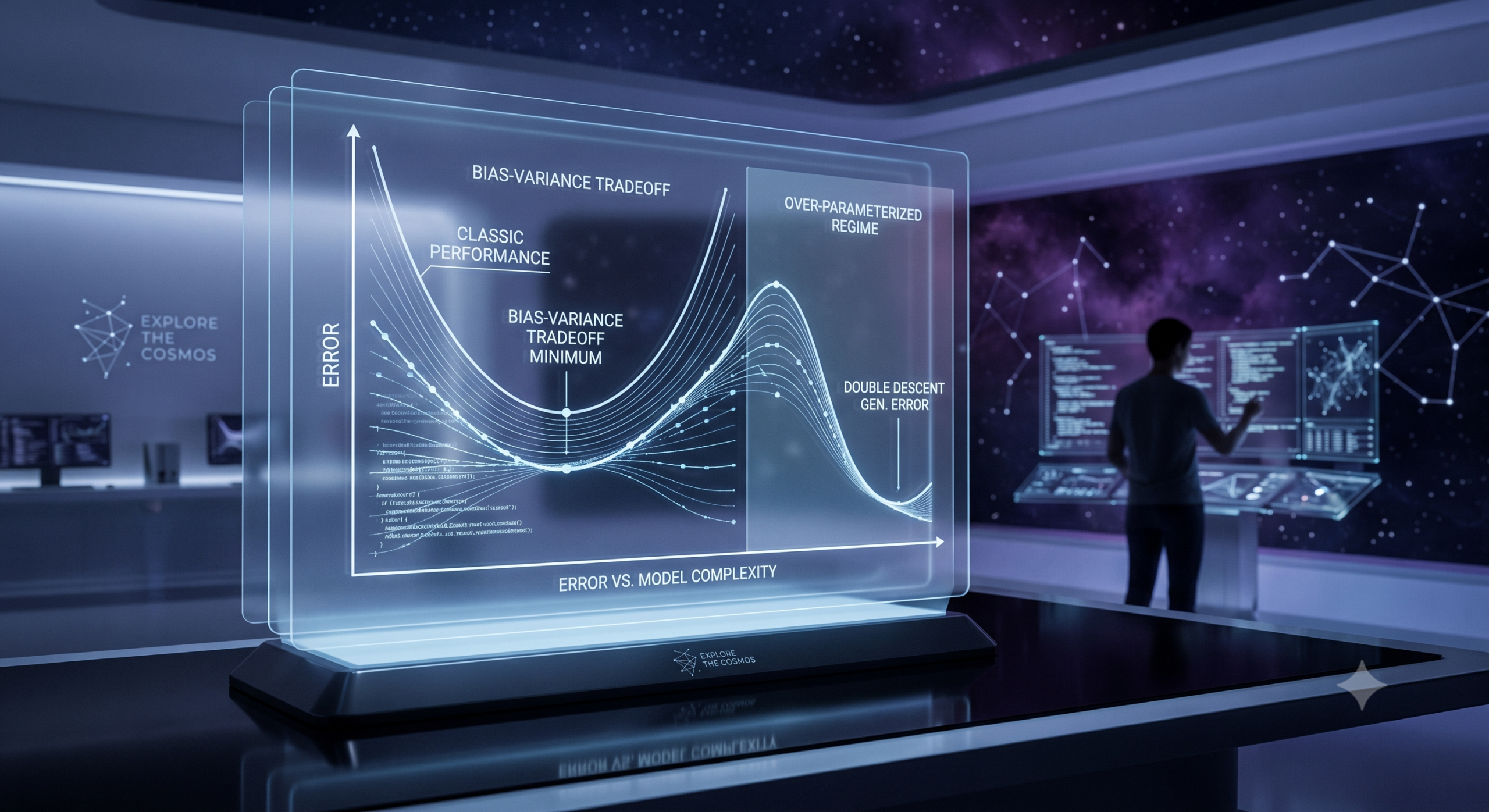
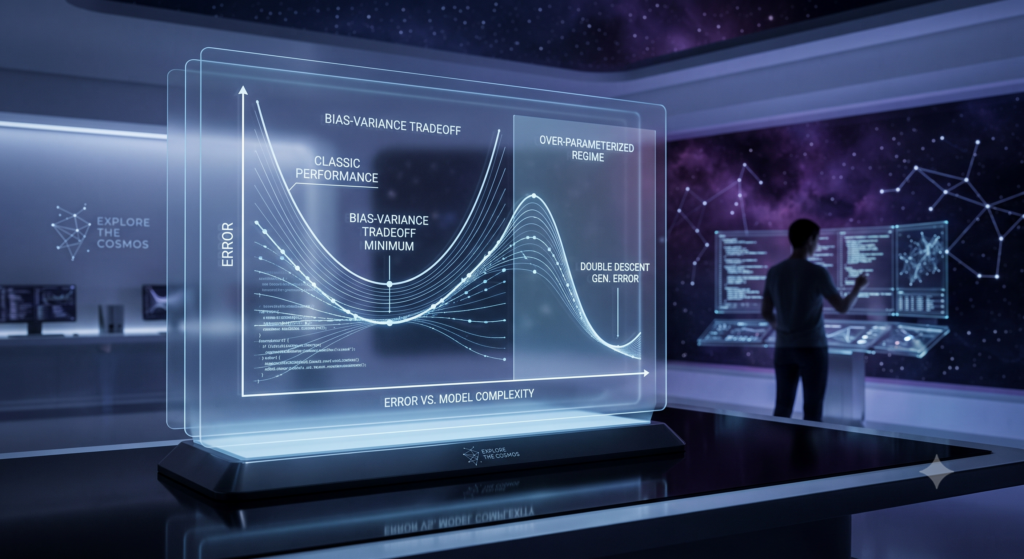
The classical understanding of the bias–variance tradeoff, often visualized as a U-shaped curve where total error first decreases and then increases with model complexity, has been a guiding principle for decades. However, recent advancements, especially in the realm of deep learning, have added fascinating new dimensions to this traditional view.
- The “Double Descent” Phenomenon: Beyond the Classic U-Curve
In 2026, one of the most intriguing developments is the growing recognition of the “double descent” phenomenon. Classically, we’re taught that beyond a certain point of complexity, models overfit, and test error rises. However, for highly overparameterized models, particularly deep neural networks with millions or even billions of parameters, research shows that as model complexity continues to increase past the point of perfect fit (the “interpolation threshold”), the test error can actually decrease again. This challenges the traditional U-shaped curve, indicating a “second descent” in error. This insight is crucial for understanding why extremely complex deep learning models, despite their apparent capacity to overfit, can still generalize remarkably well when given enough data and proper training. - A Shift in Deep Learning Focus: From Bias Reduction to Variance Control
Deep neural networks, by their very nature, are highly flexible models. They can approximate incredibly complex functions and, therefore, inherently tend to have very low bias. The primary challenge with these powerful models in 2026 is often not about reducing bias, but rather about effectively controlling their high variance and preventing overfitting. This means that while deep learning can capture intricate patterns, the focus shifts to robust regularization techniques (which implicitly introduce a small amount of bias to significantly reduce variance) and careful architectural choices to ensure the model learns generalizable features rather than noise. - Emphasis on Uncertainty Quantification (UQ) and Ensemble Methods
The future of reliable and trustworthy AI in 2026 increasingly emphasizes not just making predictions, but also understanding the confidence and uncertainty associated with those predictions. This focus on Uncertainty Quantification (UQ) marries machine learning with rigorous statistical principles, such as Monte Carlo methods and Bayesian approaches, to build models that “know when they might be wrong”. Complementing this, ensemble methods like Random Forests and Gradient Boosting are highlighted as practical and powerful techniques to manage the bias–variance tradeoff. By combining predictions from multiple diverse models, ensembles effectively reduce overall variance without significantly increasing bias, leading to more stable and robust predictions. This aligns perfectly with our ethos at Explore the Cosmos, where we champion data-driven insights that are both accurate and transparent about their limitations.
Strategies to Navigate the Bias–Variance Landscape
Understanding the tradeoff is the first step; mastering it requires applying appropriate strategies. Whether you’re building models from scratch or simply interpreting their output, these techniques are invaluable:
Data-Centric Approaches
- Increase Training Data: A larger and more diverse dataset can help reduce variance, as the model has more examples to learn the true underlying patterns and less likely to memorize noise.
- Feature Engineering and Selection: Carefully selecting relevant features and engineering new ones can significantly impact the tradeoff. Removing irrelevant or redundant features can reduce model complexity and thus variance, without losing important information. Conversely, adding highly predictive features can help reduce bias.
Model Complexity Management
- Regularization: Techniques like L1 (Lasso) and L2 (Ridge) regularization introduce a penalty for complex models, effectively discouraging them from overfitting by shrinking the coefficients of less important features. This explicitly introduces a small amount of bias to significantly reduce variance.
- Cross-Validation: By systematically splitting your data into training and validation sets, cross-validation helps you evaluate how well a model generalizes to unseen data. This is a robust way to identify the optimal model complexity that balances bias and variance.
Advanced Techniques
- Ensemble Methods: As highlighted by the 2026 trends, methods like Bagging (e.g., Random Forests) and Boosting (e.g., Gradient Boosting Machines) combine multiple models to improve overall performance. Bagging primarily reduces variance, while boosting can reduce both bias and variance, by aggregating predictions from many “weak” learners.
- Simpler Models for Small Data: With smaller datasets, leaning towards simpler models (higher bias, lower variance) can often yield better generalization, as complex models quickly overfit the limited samples.
Our Commitment to Robust Data Science
At Explore the Cosmos, we embrace these evolving understandings of the bias–variance tradeoff. Our commitment to data-driven analysis and clear explanation means we consistently integrate these principles into our content and tools. For instance, when we design the algorithms behind our Apple Health Cycling Analyzer, we’re not just aiming for raw accuracy on your past rides; we’re striving for robust models that can provide consistent, reliable insights into your fitness, predict future performance trends, and help you make informed training decisions without compromising your privacy.
We understand that you, our audience—from data-curious individuals to serious amateur cyclists—seek clear explanations, practical information, and tools that respect privacy. By continually revisiting and applying fundamental concepts like the bias–variance tradeoff, we ensure that our platform remains a trusted source for science, data, and discovery, helping you understand “what the numbers mean” and apply them effectively in your own pursuits.
The journey of understanding complex systems, whether it’s the farthest reaches of space or the intricate patterns in your personal performance data, is an ongoing one. The bias–variance tradeoff remains a critical compass, guiding us toward models that are not just accurate, but truly insightful and reliable. As we move further into 2026, new discoveries will undoubtedly continue to refine our understanding, and we at Explore the Cosmos will be here to explore them with you, ensuring our approach remains authoritative, accessible, and practical.
Leave a Reply