
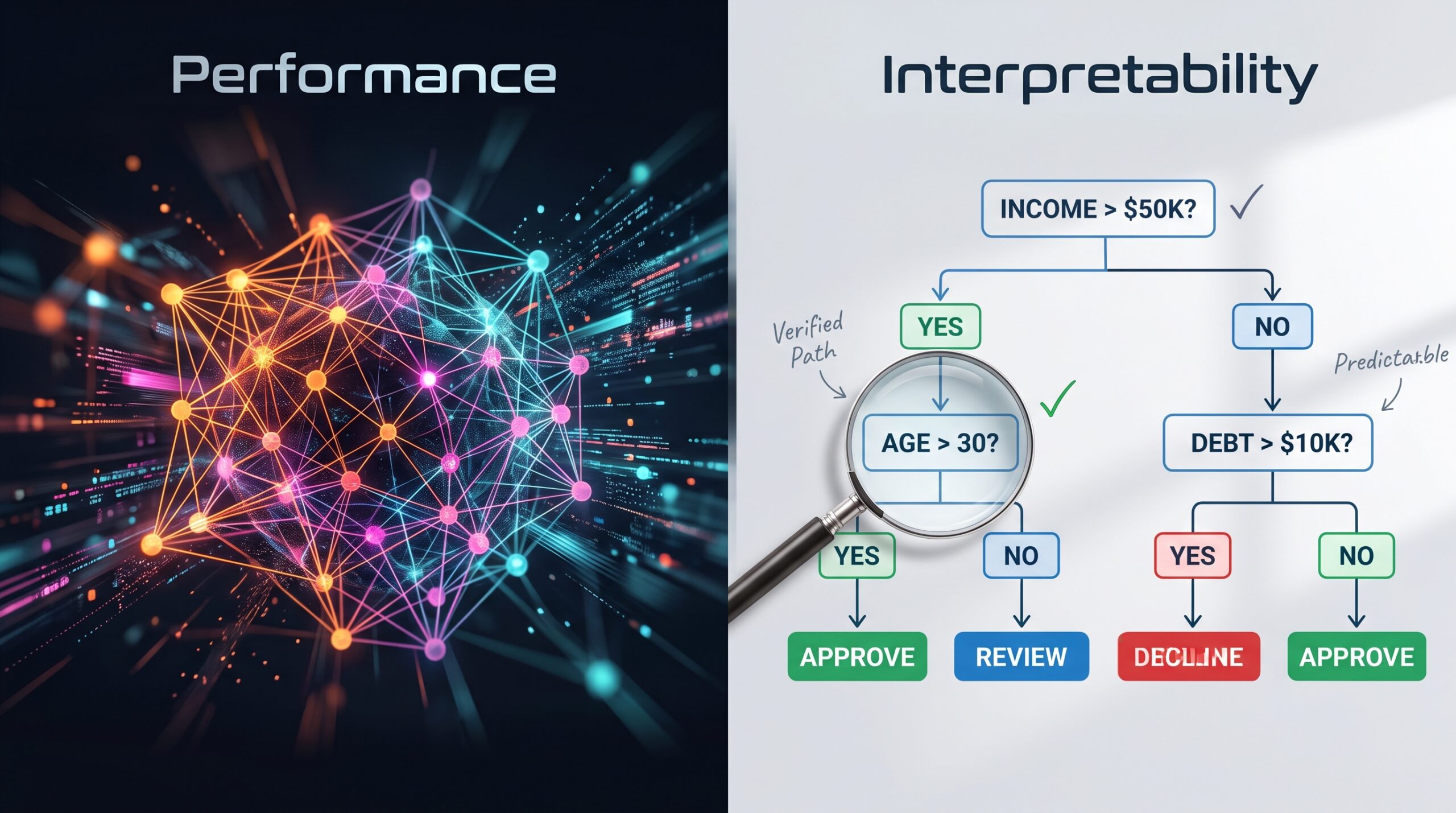
In the rapidly evolving landscape of data science and machine learning, a fundamental tension exists: the drive for peak performance versus the imperative for interpretability. At Explore the Cosmos, our mission is to demystify complex systems through data-driven analysis, and understanding this performance-interpretability trade-off is crucial. Whether we’re analyzing cycling performance metrics, optimizing financial workflows with our FinFortress tool, or exploring the vastness of space, the question of how much we can trust and understand the underlying models directly impacts our ability to make informed discoveries.
For years, the prevailing wisdom in machine learning was that you had to choose. You could have a highly accurate, lightning-fast model, but it would operate as a black box, its decision-making processes opaque. Alternatively, you could opt for simpler, more transparent models, sacrificing some degree of predictive power for clarity. However, recent trends in 2026 indicate that this dichotomy is no longer absolute. The field is actively pushing towards solutions that offer both robust performance and meaningful interpretability, fundamentally reshaping how we build and deploy AI systems.
This shift is vital for us at Explore the Cosmos. Our commitment to providing users with privacy-centric tools like the Apple Health Cycling Analyzer and FinFortress means we don’t just present data; we aim to explain it. We believe in empowering individuals to understand why a system provides certain insights, fostering a deeper connection with their data and leading to more confident decision-making. This article will delve into the performance vs. interpretability debate, explore the latest advancements shaping its future in 2026, and discuss why this balance is critical for our approach to data science, personal finance, and performance analysis.
The Age-Old Trade-off: Accuracy at What Cost?
Traditionally, machine learning models have been broadly categorized into two camps: those that excel in performance but are difficult to understand, and those that are easily interpretable but may lag in accuracy or speed.
Black Box Models: The Powerhouses of Prediction
Deep neural networks, large transformer models, and complex ensemble methods often represent the pinnacle of predictive performance. They can identify intricate patterns in vast datasets that simpler models might miss, leading to breakthroughs in areas like image recognition, natural language processing, and sophisticated forecasting. Think of a cutting-edge diagnostic AI in healthcare that can detect subtle anomalies in medical scans with unprecedented accuracy. The sheer complexity of these models, with millions or billions of parameters, allows them to capture nuanced relationships, but understanding precisely how they arrive at a diagnosis is often a significant challenge.
Interpretable Models: The Pillars of Transparency
On the other hand, models like linear regression, logistic regression, and shallow decision trees are inherently transparent. With a logistic regression, for instance, one can clearly see the weight assigned to each input variable, providing a direct mathematical formula for decision-making. This clarity is invaluable in regulated industries like finance, where understanding the exact reasoning behind a credit score denial is not just desirable but often legally mandated. In our FinFortress tool, while we use a LinearSVC for auto-categorization (a more complex variant of linear classification), the underlying principle remains focused on a more direct, interpretable relationship between features and categories, prioritizing local computation and user understanding over cloud-based, opaque models.
The Evolving Landscape: 2026 and Beyond
The notion that performance and interpretability are mutually exclusive is rapidly becoming a relic of the past. Research and development in 2026 are pushing the boundaries, seeking to bridge this gap and offer the best of both worlds.
Multi-Track Interpretability: Beyond Post-Hoc Explanations
A significant trend emerging in 2026 is the recognition that interpretability is not a one-size-fits-all solution. Instead, it’s becoming a multi-track discipline tailored to specific needs and stakeholders. As highlighted in recent analyses, the field has moved beyond simply applying post-hoc explanation techniques like LIME or SHAP (which explain model behavior *after* the fact) to more sophisticated approaches. These now include:
- Mechanistic Interpretability: Aiming to reverse-engineer the internal computations of a model. This involves understanding the “circuits” and “feature learning” within complex networks.
- Intrinsically Interpretable/Concept-Based Modeling: Developing models that are understandable by design, often by incorporating human-understandable concepts directly into their architecture.
- Human-Centered Explanation: Focusing on whether the explanations generated are actually useful, trustworthy, and actionable for the end-user, rather than just technically correct.
This evolution means that for different applications, we need different transparency capabilities, addressing specific risks. A credit scoring model, an enterprise RAG system, or an autonomous agent all require distinct explanation architectures.
From Output to System Behavior: Holistic Understanding
Another key development is the shift from explaining individual model outputs to understanding the behavior of entire AI systems. Modern AI systems are no longer just classifying images; they are retrieving documents, reasoning across contexts, planning multi-step actions, and interacting dynamically. This means that for tools like our Apple Health Cycling Analyzer, we’re not just interested in the final efficiency factor score; we want to understand the data processing pipeline that leads to that score and how it relates to the raw health data. The explanation target is now the end-to-end system, demanding a more holistic approach to transparency.
Accuracy vs. Performance Redefined: Beyond Raw Metrics
The focus is broadening from mere accuracy to “practical performance.” This includes not only inference cost and latency but also robustness, energy consumption, privacy, and deployment requirements. As global AI spending is projected to reach $2.02 trillion by 2026, efficiency and sustainability become as critical as predictive power. This paradigm shift means that simpler, more efficient models that are also interpretable might be preferred even if they don’t achieve the absolute highest accuracy, especially when data sovereignty and user trust are paramount.
Why This Matters for Explore the Cosmos
At Explore the Cosmos, our core offering is educational and empowering. We provide clear explanations and practical tools that help users grasp complex concepts. The performance vs. interpretability dialogue directly informs how we design and communicate our offerings.
Empowering Users with Data Sovereignty
Our commitment to local-first software and privacy-centric tools is a direct response to the concerns surrounding opaque, cloud-dependent AI. Tools like FinFortress and the Apple Health Cycling Analyzer are built on the principle that users should own and understand their data and the insights derived from it. By prioritizing local computation, we reduce reliance on external, often inscrutable, AI models. For FinFortress, this means using a local machine learning script (LinearSVC) for categorization, which, while powerful, is far more transparent and controllable than a cloud-based API. This approach aligns with the growing demand for ethical AI and responsible machine learning, where transparency, fairness, and accountability are prioritized.
Demystifying Machine Learning for Real-World Application
In our Data Science & Machine Learning pillar, we aim to demystify concepts for general audiences. Understanding the performance vs. interpretability trade-off is fundamental to this. For example, when discussing classification algorithms, we can explain *why* a decision tree is easier to follow than a deep neural network, even if the latter might offer higher accuracy on a complex dataset. This transparency helps users appreciate the strengths and limitations of different approaches, aligning with our honest approach to acknowledging what our tools can and cannot do. We believe in grounding abstract concepts in concrete examples, like using bank transaction categorization to illustrate text classification, making the “how it works” accessible.
Enhancing Cycling Performance Analysis
For our cycling enthusiasts, interpreting performance metrics goes beyond just looking at numbers. It’s about understanding the underlying physiological and biomechanical factors, and critically, the data processing that translates raw sensor input into actionable insights. By prioritizing transparent data handling in our Apple Health Cycling Analyzer, we enable users to not only see their efficiency factor or HR drift but also to gain confidence in *how* these metrics were calculated. This trust is vital for optimizing training and achieving personal bests.
The Path Forward: Towards Balanced AI
The future of AI is not about choosing between performance and interpretability; it’s about achieving a harmonious balance. As AI systems become more integrated into our lives, the demand for explainability will only intensify. This isn’t just about regulatory compliance; it’s about building trust, enabling better decision-making, and ensuring that these powerful tools serve humanity ethically and effectively.
At Explore the Cosmos, we are committed to this balanced approach. By developing practical, privacy-centric tools and creating educational content that demystifies complex data science concepts, we aim to empower our users to explore the cosmos of knowledge with clarity, confidence, and control. The journey towards truly understandable and high-performing AI is ongoing, and we are excited to be a part of it, guiding our community toward smarter data-driven discoveries.
Leave a Reply