
Whether you are trying to bootstrap a business, travel the world, or chart a course for early retirement, you need a reliable launchpad. You cannot navigate your life’s biggest projects if your base financial resources are a mystery. Yet, when I looked at the tools available to track personal wealth—the ultimate “life support system” – I found a glaring problem.
If you want to track your cash flow or calculate your FIRE (Financial Independence, Retire Early) trajectory today, the market hands you two deeply flawed options:
- The Cloud-Scrapers: Expensive, $10-a-month SaaS subscriptions that demand your banking credentials, scrape your data into the cloud, and sell aggregated analytics to third parties.
- The Fragile Spreadsheets: A messy web of manual Excel files that break the moment you forget to update a formula or try to import a CSV from a new bank.
I wanted the powerful analytics and beautiful UI of a modern Silicon Valley startup, but I demanded the privacy and local-first security of a closed-loop system. I didn’t want my financial telemetry sitting on someone else’s server, and I certainly didn’t want to pay a monthly fee to look at my own money.
So, I built FinFortress.
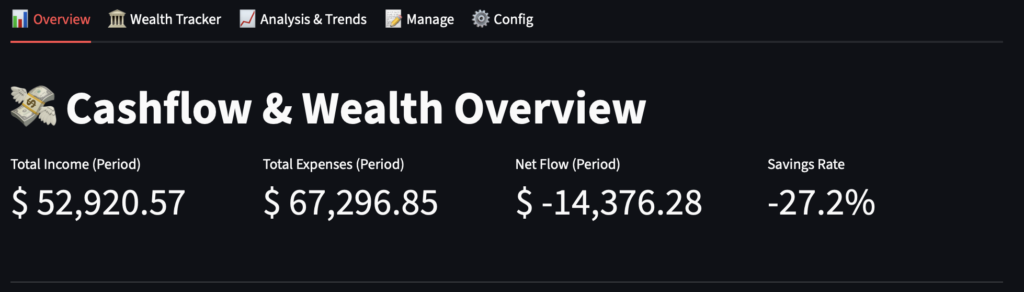
Enter FinFortress: A Privacy-First Financial Engine
FinFortress is a fully offline, Python-based financial dashboard designed for people who take their data sovereignty seriously.
Instead of connecting to your bank via vulnerable third-party APIs (like Plaid), FinFortress lives entirely on your own machine. You download your raw CSV exports, drop them into the app, and a local Python engine takes over.
Here is a deep dive into how it actually works and why I built it this way.
1. Smart Auto-Categorization (That Learns Your Rules)
The biggest pain point of manual budgeting is tagging hundreds of transactions. Most cloud apps try to solve this with black-box algorithms that constantly mislabel your local bakery as “Dining Out” instead of “Groceries.”
FinFortress handles this differently: it uses a transparent, local pattern-recognition algorithm (LinearSVC). It doesn’t guess; it learns strictly from you. When you first start, you manually categorize your transactions. Once the engine sees how you categorize things (after about 20 entries), it starts recognizing patterns in your bank’s text descriptions. When you upload next month’s CSV, the engine automatically applies your logic to known merchants, leaving only the truly new or unique expenses for you to review.
- The Result: You get a system that drastically speeds up your monthly workflow by automating the repetitive stuff, without a single byte of your data ever leaving your hard drive.
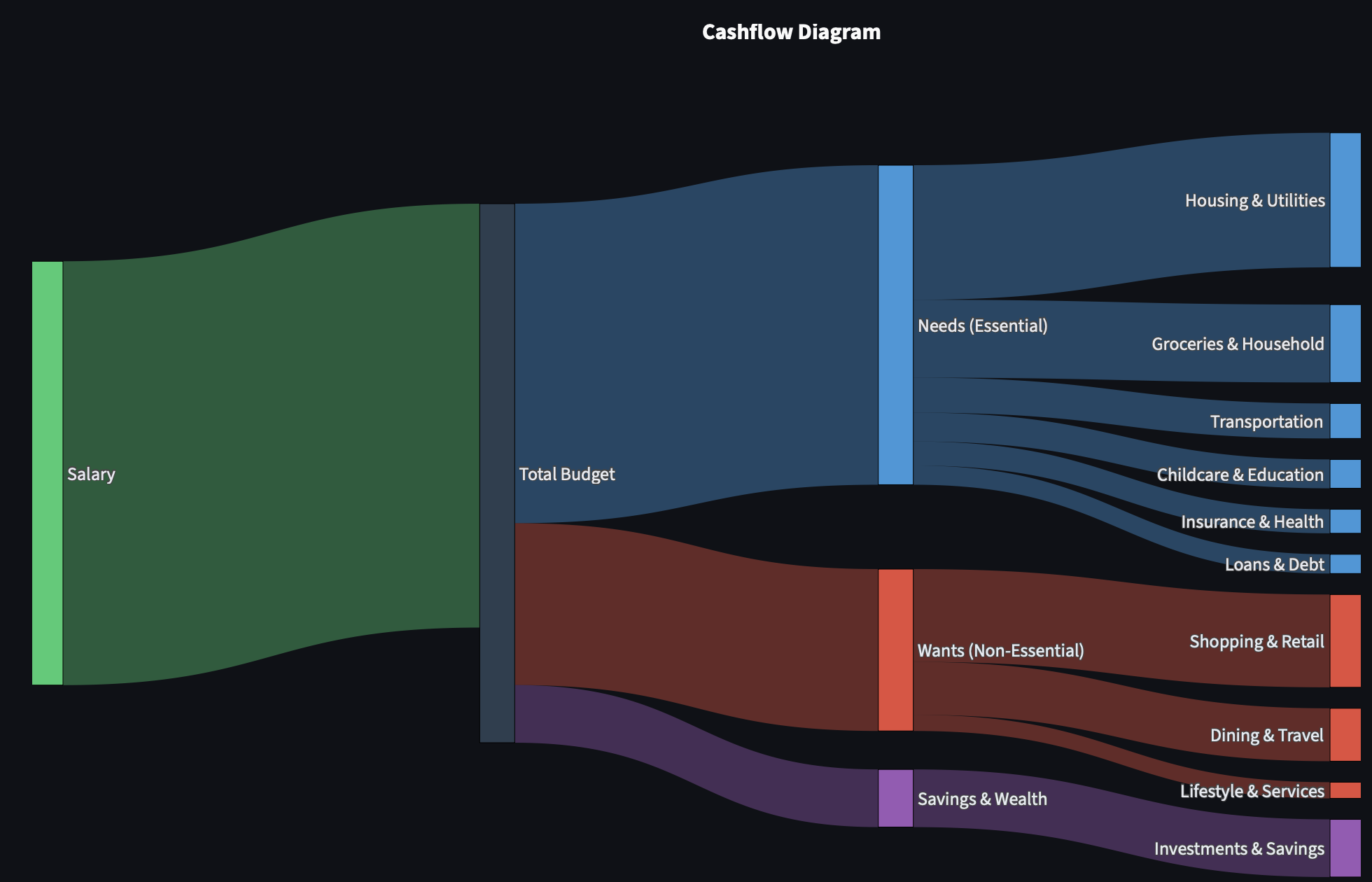
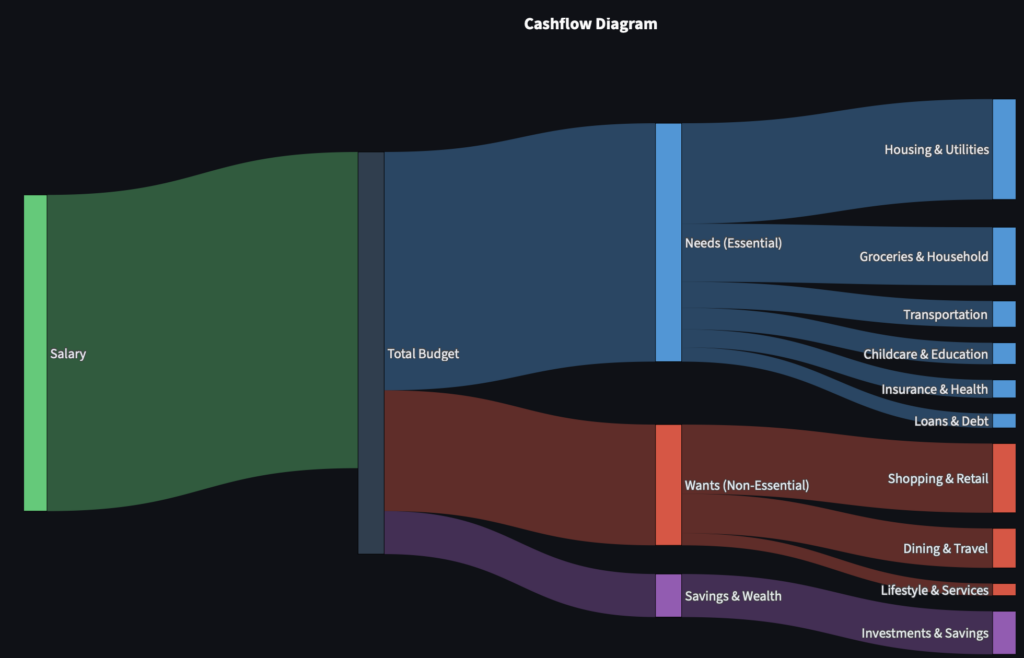
2. Cashflow Dynamics (The Sankey Diagram)
Pie charts are terrible at showing how money actually moves. They show you a static slice, but they don’t show you velocity.
To fix this, I engineered a dynamic Sankey flow-chart into the dashboard. It visually maps every penny entering and leaving your ecosystem. You can literally see the thick stream of your income split into distinct rivers: Needs (Essential), Wants (Non-Essential), and Savings & Wealth.
- The Result: Structural leaks in your budget become instantly obvious. If your “Wants” river is thicker than your “Savings” river, the visual impact is immediate.
3. The Wealth Waterfall & FIRE Projections
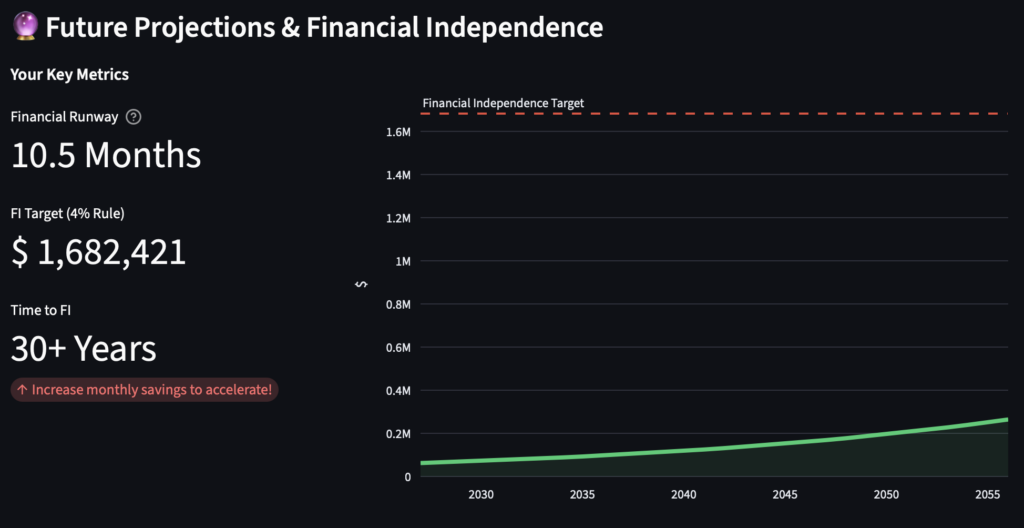
Net equity isn’t just “cash in the checking account.” It’s a complex equation of real estate asset value, fluctuating investment portfolios, and remaining loan balances.
FinFortress includes a dedicated Wealth Tracker that separates your liquid cash from your investments. It calculates your exact portfolio rebalancing needs and projects your current savings rate against traditional FIRE (Financial Independence, Retire Early) metrics.
- The Result: A beautifully rendered “Waterfall Chart” that shows your true net worth, subtracting your debts from your assets in real-time, allowing you to accurately map out your retirement timeline.
4. Total Customization via Local Configs
Because you own the software, you make the rules. FinFortress runs on a simple settings.yaml file that you control. Want to create a highly specific category just for your dog’s medical expenses? Just type it into the settings file. The app instantly dynamically updates all charts, AI models, and dashboards to reflect your custom rules.
Why “Local-First” is the Future
We meticulously track the telemetry of our lives—from our daily step counts to our screen time—yet we carelessly outsource the data that funds our independence.
By utilizing local-first software, you eliminate the risk of server hacks, subscription fatigue, and sudden platform shutdowns. Your historical data, your custom categories, and your financial future belong strictly to you.
You don’t need to be a senior developer to run it. I’ve packaged FinFortress so that anyone with a computer can launch it with a single click. No subscriptions. No cloud servers. Just your data, working for you.
Ready to build your launchpad?
Leave a Reply