
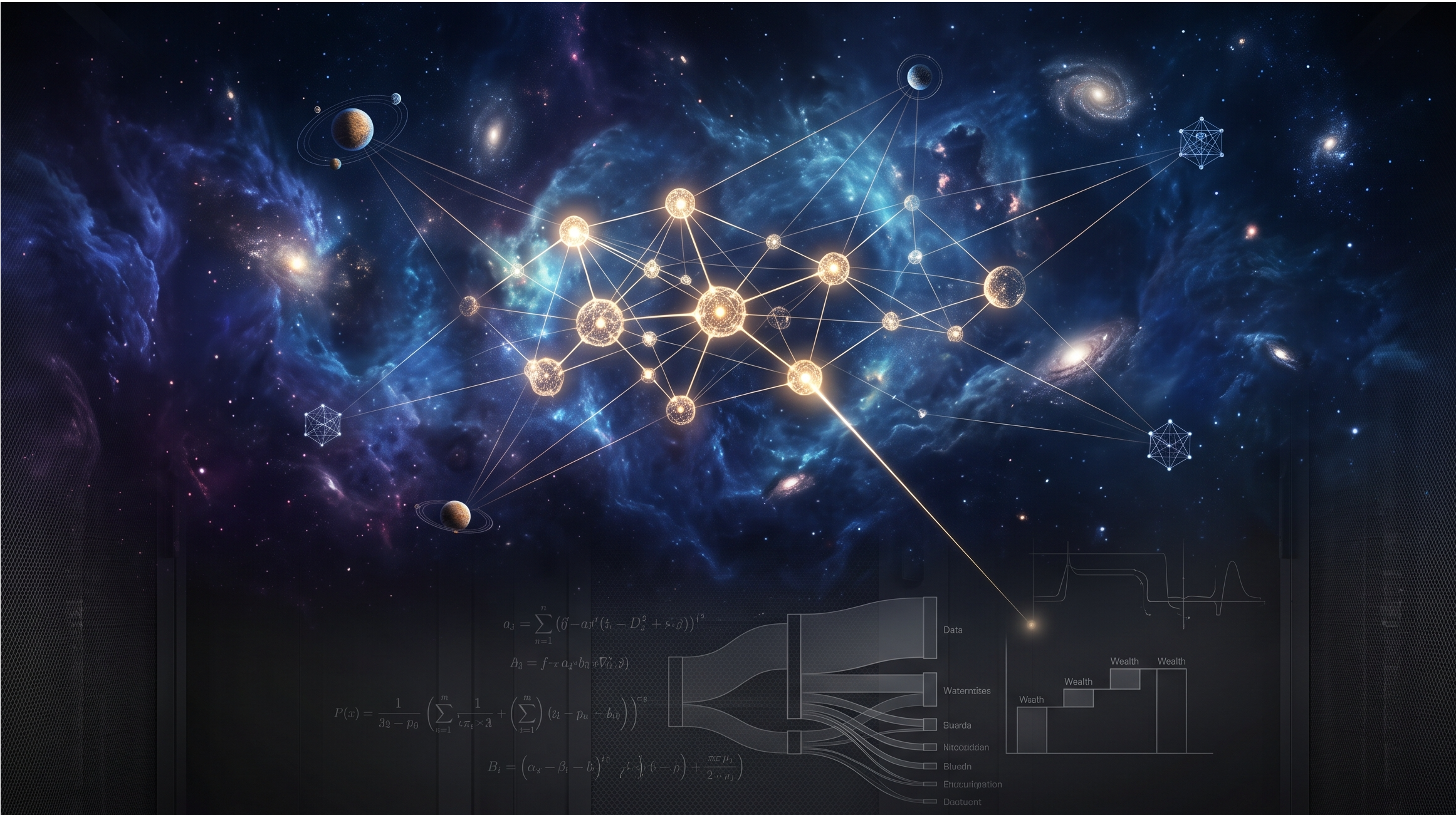
Have you ever marveled at how a seemingly simple set of instructions can lead to complex, intelligent behavior? It’s a question that touches upon the very essence of our work here at Explore the Cosmos, where we aim to demystify complex systems through data. When we talk about deep learning, we’re not just talking about fancy algorithms; we’re talking about a powerful approach that, at its core, helps us understand and interact with the world in new ways. But why does it work so profoundly? It’s not magic, and it’s not just about brute-force computation. The intuition behind deep learning lies in its ability to learn from data, to identify patterns, and to make predictions or decisions with remarkable accuracy. We’ll delve into the core reasons why these systems are so effective, drawing parallels to our own everyday learning and exploring how this understanding applies to everything from financial dashboards like our FinFortress to analyzing cycling performance.
The Power of Layers: Mimicking Biological Inspiration
At its heart, deep learning is a subset of machine learning that utilizes artificial neural networks with multiple layers. The “deep” in deep learning refers to the depth of these layers. Think of it like learning to identify an object, say, a bicycle. Your brain doesn’t process this in one go. First, you might recognize basic shapes and lines (edges, curves). Then, you combine those into more complex features (wheels, handlebars, frame). Finally, you assemble these features into the concept of a “bicycle.” Deep learning networks operate on a similar hierarchical principle. Each layer in the network takes the output from the previous layer and transforms it into a slightly more abstract representation. The initial layers might detect very simple patterns, like edges or colors in an image, while deeper layers combine these to recognize more complex structures, like a wheel or a face.
This layered approach is biologically inspired, drawing parallels to how our own brains process information. We don’t just have one massive processing unit; we have specialized areas that handle different aspects of sensory input and cognitive function. For instance, when we analyze financial data for our FinFortress tool, we’re not just looking at raw numbers; we’re identifying spending categories, tracking trends, and understanding cash flow. Each step refines our understanding, much like the layers in a neural network refine data into actionable insights. As of 2026, advancements are continuing to push this hierarchical learning further, with models becoming even more adept at breaking down complex problems into manageable, sequential learning steps.
From Raw Data to Meaningful Features
The magic happens in how these layers learn to extract features from raw data. Initially, the network might have no idea what constitutes a “feature” relevant to the task. However, through a process called training, where the network is exposed to vast amounts of labeled data (data with known outcomes), it begins to adjust its internal parameters. Each connection between neurons in the network has a weight, and during training, these weights are fine-tuned. If a particular feature detected by a layer consistently leads to a correct outcome, the weights associated with that feature are strengthened. Conversely, if it leads to an incorrect outcome, they are weakened.
This iterative adjustment, often guided by algorithms like backpropagation, allows the network to automatically discover the most relevant features for a given task. This is a significant departure from traditional machine learning, where domain experts often had to manually engineer features. Imagine trying to manually define every possible combination of transaction details that signifies “groceries” for our FinFortress. Deep learning automates this, learning not just what “groceries” are, but also variations like “supermarket visit” or “organic produce,” all based on the patterns in your spending data. This ability to learn features directly from data is a cornerstone of why deep learning is so powerful. Recent breakthroughs in 2026 continue to refine this feature extraction process, making models more efficient and capable of understanding nuanced patterns.
The Role of Data and Scale
Deep learning models are incredibly data-hungry. The more high-quality data they are exposed to, the better they become at identifying complex patterns and making accurate predictions. This is why we emphasize the importance of robust datasets, whether it’s for analyzing cycling performance with our Apple Health Cycling Analyzer or understanding financial trends. Large datasets allow the neural network to encounter a wider variety of examples, helping it to generalize better and avoid overfitting (where a model performs well on training data but poorly on new, unseen data).
The sheer scale of modern datasets, coupled with advancements in computing power, has been a primary driver of deep learning’s success. As of 2026, the availability of massive datasets and sophisticated hardware, like next-generation AI computing platforms, are crucial enablers for large-scale model experimentation and deployment. This enables models to learn more intricate relationships that would be impossible to discern with smaller datasets or less computational power. For example, a deep learning model trained on millions of mammograms can achieve a remarkable accuracy rate in detecting breast cancer, surpassing human radiologists in some instances. This scale allows the models to learn from subtle, often imperceptible, patterns that are indicative of disease.
Learning from Mistakes: The Optimization Process
The “learning” in deep learning isn’t arbitrary; it’s a carefully optimized process. When a neural network makes a prediction, it calculates an error or “loss” based on how far off its prediction was from the actual outcome. This error is then propagated backward through the network, guiding the adjustments to the weights mentioned earlier. The goal is to minimize this error function, effectively making the network more accurate over time.
This optimization process is akin to how we learn from our mistakes. If you’re learning to cycle, and you fall, you adjust your balance and steering based on that negative feedback. Deep learning algorithms do something similar, but at a scale and speed that is unfathomable for humans. By continuously minimizing the error, the network hones its ability to map inputs to outputs. In 2026, there’s a significant push towards making AI systems more “agentic,” meaning they can make decisions and carry out tasks independently, which is built upon this robust optimization process. This iterative refinement is a core reason why deep learning systems become progressively better with more data and training.
Generalization: The Key to Real-World Application
A truly effective deep learning model doesn’t just memorize the data it was trained on; it must be able to generalize to new, unseen data. This is where the intuition becomes particularly powerful. By learning underlying patterns and relationships rather than memorizing specific examples, a deep learning model can make accurate predictions or classifications on data it has never encountered before.
This ability to generalize is what makes deep learning so applicable to diverse fields. For instance, a model trained to recognize different types of vehicles in images can then identify a new car model it hasn’t seen, or even a truck, if it has learned the general features of “wheeled vehicles.” This principle is fundamental to how we can build privacy-centric tools that offer real-world utility. Our FinFortress tool, for example, uses a local machine learning script (LinearSVC) to auto-categorize bank CSVs. It’s not just memorizing your past transactions; it’s learning the patterns associated with categories like “dining,” “utilities,” or “groceries” so it can classify new, incoming transactions accurately. In 2026, the focus is increasingly on creating AI that can perform complex tasks independently, a feat that relies heavily on robust generalization capabilities.
Beyond Pattern Recognition: The Move Towards Reasoning
While early deep learning was exceptional at pattern recognition – identifying objects, translating text, or predicting outcomes – a significant trend in recent years, and particularly in 2026, is the move towards enabling AI to reason. This means not just recognizing a bike in an image, but understanding *why* someone might be using it, or what actions might follow. It’s about moving from correlation to causation, from answering “what” to understanding “why” and “how.”
Researchers are developing models that can explain their reasoning and validate results in real-time. This is a crucial step towards more sophisticated AI that can act as true collaborators, rather than just passive tools. Imagine an AI assistant that doesn’t just tell you your financial health is declining but can explain the contributing factors based on your spending habits and projected income. This development is pivotal for building more trustworthy and useful AI systems. For instance, the rise of “agentic AI” in 2026 signifies a move towards systems that can make decisions and carry out multi-step tasks independently, a capability deeply rooted in enhanced reasoning abilities.
The “Why” for Us at Explore the Cosmos
At Explore the Cosmos, our mission is to bring clarity to complex systems through data-driven analysis and local-first software. Deep learning, when demystified, is a powerful tool that aligns perfectly with this mission. It allows us to build practical, privacy-centric tools like FinFortress and the Apple Health Cycling Analyzer.
Our approach is always to ground these powerful concepts in plain English, offering clear explanations and practical applications. We believe that understanding *why* deep learning works – its reliance on layered learning, data-driven feature extraction, optimized learning processes, and generalization – empowers you to better understand the technology shaping our world. Whether it’s categorizing your finances locally without uploading sensitive data, or analyzing your cycling metrics for peak performance, the intuition behind deep learning is what makes these discoveries possible. As AI continues to evolve, becoming more powerful and integrated into our lives, understanding its fundamental principles will be more important than ever. The journey of understanding deep learning is, in itself, a journey of discovery, much like exploring the cosmos.
Leave a Reply