
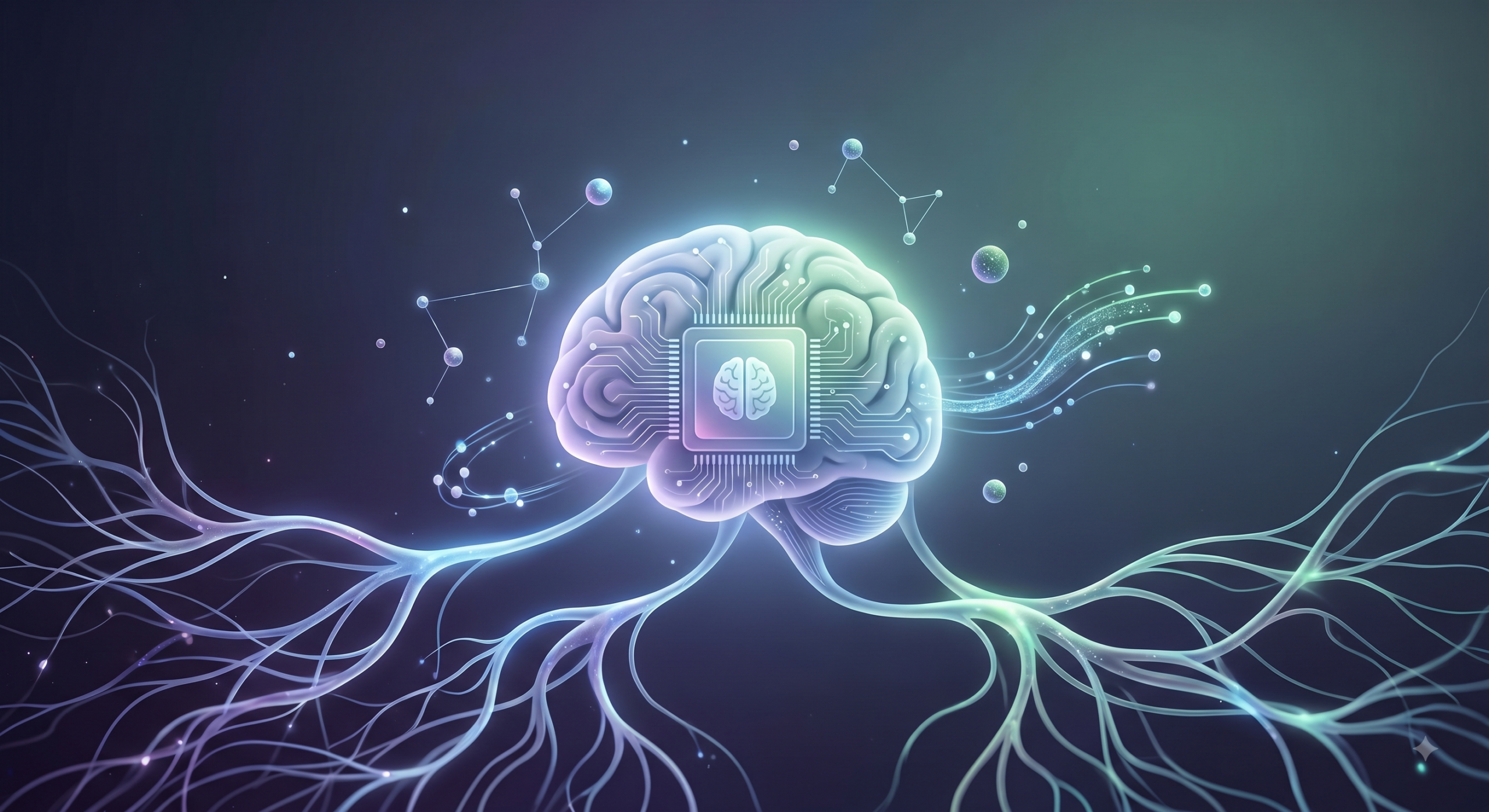
In a world increasingly shaped by artificial intelligence, the term “neural network” often conjures images of futuristic robots, sentient machines, or perhaps an impenetrable “black box” making decisions we can’t understand. Yet, at Explore the Cosmos, we believe true discovery comes from demystifying complex systems, not fearing them. Neural networks are not magic, nor are they sentient beings – they are powerful, elegant computational tools designed to recognize patterns and make sense of vast amounts of data.
Our mission is to explore space science, human performance, and complex systems through data-driven analysis and local-first software. This includes understanding the very foundations of technologies that empower us. In this article, we’ll cut through the hype to reveal what neural networks really are, how they function, and why they are indispensable for everything from understanding the universe’s intricacies to safeguarding your financial privacy with tools like our FinFortress suite. We’ll also dive into the exciting trends shaping their future in 2026 and beyond, focusing on how they’re becoming more accessible, explainable, and privacy-centric.
Beyond the Hype: Defining Neural Networks in Plain English
So, what exactly is a neural network? Picture the human brain with its billions of interconnected neurons. A neural network is a computational model inspired by this biological structure, designed to learn and identify complex patterns in data. It’s not a replica of a brain, but rather a system that mimics its ability to process information through a series of interconnected nodes, often called “neurons” or “perceptrons.”
Think of it like this: imagine you’re trying to decide what kind of fruit something is. You look at its color, shape, size, and texture. Each of these features is an “input.” Your brain processes these inputs through layers of interconnected neurons, each firing based on certain criteria, until it arrives at a “decision” – “that’s an apple!” A neural network works similarly, taking in data, processing it through layers, and then outputting a prediction or classification.
At its core, a neural network consists of three main types of layers:
- Input Layer: This is where your data enters the network. For instance, if our FinFortress tool is analyzing your bank transactions, the input layer might receive a transaction description like “Whole Foods Market” and the transaction amount.
- Hidden Layers: These are the “thinking” layers between the input and output. Each “neuron” in a hidden layer receives inputs from the previous layer, applies a mathematical operation (a weighted sum, plus a ‘bias’), and then passes the result through an “activation function” to decide whether to “fire” or not. These layers are where the network learns to identify increasingly complex patterns.
- Output Layer: This is where the network delivers its final prediction or decision. In the FinFortress example, the output layer might classify “Whole Foods Market” as “Groceries.”
The strength of these connections, known as “weights,” and the thresholds, or “biases,” are what the network adjusts during its learning process. The network essentially learns by tweaking these weights and biases until it consistently makes accurate predictions.
The Architecture of Learning: How Neural Networks Process Information
The true power of neural networks lies in their ability to learn from data. This learning process, often referred to as “training,” involves several key steps:
- Forward Propagation: Data moves from the input layer, through the hidden layers, to the output layer, generating a prediction.
- Loss Function: The network’s prediction is compared to the actual correct answer using a “loss function,” which calculates how far off the prediction was. The goal is always to minimize this “loss.”
- Backpropagation: This is the clever part. The error calculated by the loss function is “propagated backward” through the network. This process tells each neuron how much it contributed to the error and how to adjust its weights and biases to make a more accurate prediction next time.
Imagine teaching a child to identify different animals. Initially, they might mistake a cat for a dog. You correct them, explaining the distinguishing features. Over time, with repeated examples and corrections, they learn to differentiate reliably. Backpropagation is the network’s way of “correcting” itself, iteratively refining its internal parameters to improve accuracy.
While some of our Privacy-First Suite tools, like FinFortress, utilize simpler, highly efficient local classifiers such as LinearSVC for tasks like auto-categorizing bank CSVs, the fundamental principle of pattern recognition through iterative learning remains consistent. These local-compute solutions demonstrate that powerful machine learning doesn’t always require massive, complex neural networks; it requires thoughtful, data-driven design.
The 2026 Horizon: Evolving Trends in Neural Network Application
As we navigate 2026, the landscape of neural networks is dynamically evolving, driven by innovation and a growing emphasis on practical, ethical, and privacy-conscious applications. Here are three key trends shaping their future:
1. The Rise of Edge AI and On-Device Processing: Prioritizing Privacy and Performance
One of the most significant shifts we’re observing is the increasing deployment of neural networks directly on “edge” devices – from your smartphone and smart home devices to industrial sensors and even desktop applications. This movement, often called Edge AI, is a game-changer for privacy, performance, and efficiency. Rather than sending all your data to distant cloud servers for processing, the intelligence now lives where your data is generated.
This trend is driven by several factors: faster responses due to reduced latency, enhanced data privacy as sensitive information never leaves your device, and the ability for systems to function offline. For us at Explore the Cosmos, this aligns perfectly with our “Anti-SaaS” philosophy and our commitment to local-first software. Our FinFortress financial dashboard, for example, exemplifies this commitment, running its machine learning scripts entirely on your local machine to auto-categorize transactions without ever uploading your financial telemetry to the cloud. The global privacy-preserving AI market is projected to surge from USD 5.32 billion in 2026 to USD 39.93 billion by 2035, underscoring this critical shift towards privacy-first solutions.
2. Explainable AI (XAI): Demystifying the “Black Box”
For years, one of the primary criticisms of complex neural networks has been their “black box” nature – the difficulty in understanding *why* a particular decision was made. As AI becomes more ubiquitous in critical applications like healthcare, finance, and autonomous systems, the demand for transparency and trustworthiness has soared.
In 2026, the focus in Explainable AI (XAI) is moving beyond simply trying to interpret a black box *after* it’s made a decision. Instead, researchers and developers are increasingly striving to design neural network architectures that are *intrinsically interpretable* from the outset. This means building models where the decision-making process is inherently transparent, allowing humans to understand the logic and factors influencing a prediction. This is crucial for building trust, debugging models, and ensuring regulatory compliance, especially in “human-centric” domains where model decisions have real-world impact. This commitment to clear explanations and understanding “what the numbers mean” is a cornerstone of our content and tools at Explore the Cosmos.
3. Efficiency and Sustainable AI: Smaller Models, Bigger Impact
As neural networks grow in complexity and size, so too does their computational footprint and energy consumption. In 2026, there’s a significant drive towards developing more efficient and sustainable AI models. The focus is shifting from simply building larger models to creating lighter, optimized neural networks that deliver high accuracy without consuming excessive resources.
Techniques such as model compression, adaptive learning, and the development of task-specific architectures are enabling neural networks to run effectively on resource-constrained devices, further boosting the Edge AI trend. Innovations like Asynchronous Neural Turing networks (ANT), which update only necessary neurons, promise to reduce energy consumption by orders of magnitude, making AI more sustainable and adaptive for energy-tight environments like edge-computing devices. This pursuit of efficiency resonates deeply with our philosophy of building practical tools that are optimized for local-first compute, minimizing overhead and maximizing user control.
Why Neural Networks Matter for Data-Driven Discovery (And Your Privacy)
Neural networks are not just abstract academic concepts; they are foundational to modern data-driven discovery and have profound implications for practical applications, including those focused on data sovereignty and personal privacy.
- Unparalleled Pattern Recognition: Their core strength lies in their ability to detect subtle, non-linear patterns in vast datasets that humans or traditional algorithms might miss. This makes them indispensable for tasks like image recognition, natural language processing, and predictive analytics across various domains.
- Handling Complexity: From analyzing astronomical data to understanding complex biological systems or deciphering human performance metrics, neural networks can process intricate relationships and provide actionable insights. This aligns directly with our mission at Explore the Cosmos to explore complex systems.
- Empowering Local-First Software: By enabling robust pattern recognition on local devices, neural networks are key to the “Anti-SaaS” movement. With FinFortress, our local-compute desktop financial dashboard, a machine learning script uses neural network principles (even if a simpler LinearSVC classifier is employed for efficiency) to categorize your bank CSVs. This allows you to generate powerful Sankey cashflow diagrams and Wealth Waterfalls entirely offline, ensuring your sensitive financial data remains 100% on your machine. This is a stark contrast to cloud-based solutions that often scrape your financial telemetry, posing significant privacy risks.
- Advancing Human Performance and Health: While our Apple Health Cycling Analyzer provides privacy-first insights into cycling performance (efficiency factor, HR drift, VAM) without cloud uploads, the principles of pattern detection learned from neural networks can inspire future advancements in local analysis for anomaly detection or predictive performance in physical activities.
- Space Science Exploration: True to our name, neural networks play a vital role in space science. They are used to analyze colossal amounts of astronomical data, identify exoplanets, classify galaxies, and even detect gravitational waves, pushing the boundaries of cosmic discovery.
Common Misconceptions and Limitations
Despite their power, it’s crucial to approach neural networks with a clear understanding of their limitations and to dispel common misconceptions:
- Not General Artificial Intelligence (AGI): Neural networks are specialized tools designed for specific tasks. While impressive, they are not conscious, sentient, or capable of general intelligence like humans. Even advanced systems using neural networks, like the local text classifiers we use in our demonstrations for FinFortress, are highly effective at their designated tasks (like categorizing text) but are not “thinking” in a human sense.
- Data Dependency: Neural networks are only as good as the data they are trained on. Biased or insufficient training data can lead to biased, inaccurate, or brittle models. Ensuring data quality and diversity is paramount.
- Computational Cost: Training large, complex neural networks can be incredibly resource-intensive, requiring significant computing power and energy. This is precisely why the push for Edge AI and more efficient “Green AI” techniques is so critical, especially for local-first applications where resources are more constrained.
Conclusion
Neural networks, far from being mystical “black boxes,” are sophisticated computational models that form the backbone of modern data science and AI. They empower us to uncover hidden patterns, tackle complex problems, and make informed decisions across a vast spectrum of fields – from understanding the cosmos to optimizing your personal finances.
As we move through 2026, the evolution towards more privacy-centric Edge AI, transparent and explainable architectures, and energy-efficient designs promises to make these powerful tools even more accessible and trustworthy. At Explore the Cosmos, we are committed to demystifying these technologies, offering clear explanations, and providing practical, privacy-centric tools that empower you to take control of your data, foster deeper understanding, and embark on your own journey of data-driven discovery, whether it’s in your finances, your fitness, or the far reaches of space.
Leave a Reply