
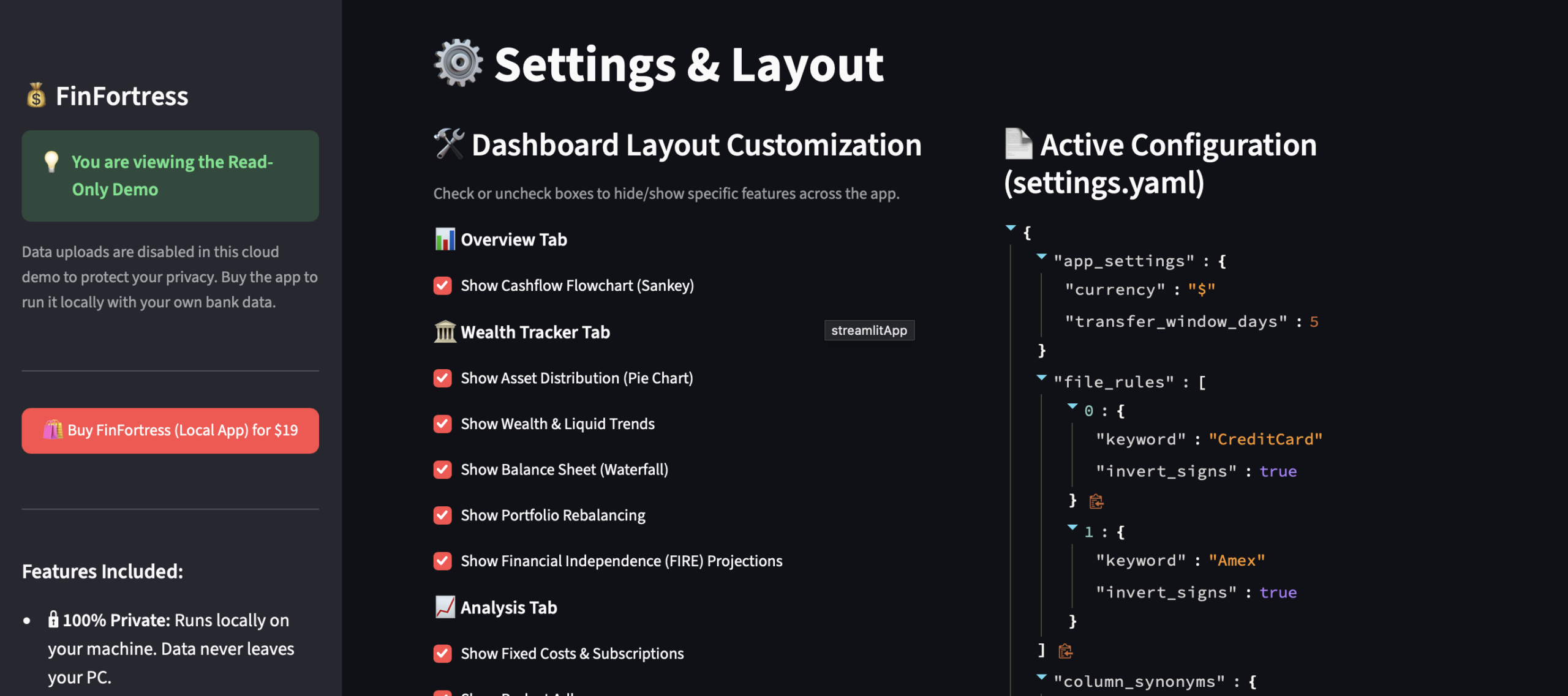
Launching version 1.0 of FinFortress was a massive learning experience. When you build a 100% offline, privacy-first personal finance dashboard, you are deliberately stepping away from the standard SaaS playbook. There are no cloud APIs, no Plaid integrations, and no $10/month subscriptions.
Taking this architecture to builder communities like r/SideProject and IndieHackers sparked some incredible technical debates. The feedback highlighted the unique challenges of building local-first software.
Here is a breakdown of the core challenges the community pressure-tested, and how the architecture is evolving to meet them.
1. The “First-Run” Paradox and Onboarding Friction
One of the sharpest critiques from Reddit was about setup friction. There is a fundamental paradox when building for a privacy-conscious audience: the exact users who refuse to hand their banking credentials to a cloud server are also the ones most suspicious of running a start.bat file downloaded from the internet.
Furthermore, dropping users into an empty dashboard and asking them to immediately map their custom budget categories to train a local machine-learning model is daunting.
The Solution: First, transparency is the ultimate feature. FinFortress ships as uncompiled Python. It is not a black-box .exe file. Anyone can open app.py or processor.py in a text editor to verify the LinearSVC model and confirm there are zero external network calls. Additionally users will get a sample .csv with 10 fake transactions, allowing them to instantly test the UI, see the local AI classifier categorize strings in milliseconds, and play with the Sankey diagrams before they ever touch their real financial data.
2. The Maintenance Trap of Local CSVs
Over on IndieHackers, the biggest architectural question was about the long-term maintenance burden of the one-time payment model. If the app relies on users importing raw bank .csv files, what happens when a bank randomly changes its export format from “Buchungstag” to “Datum”?
With a traditional SaaS, the developer patches the backend. With an offline app, a hard-coded parser means a broken app for the user and endless support tickets for the developer.
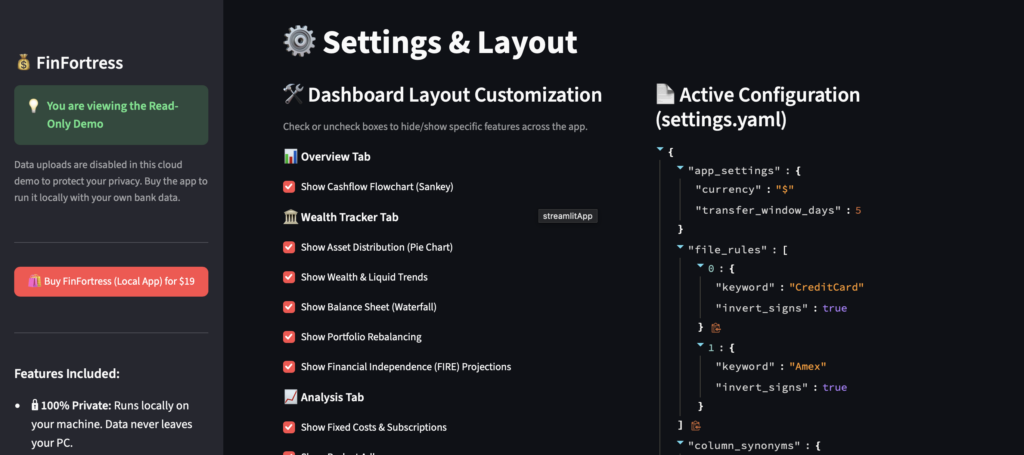
The Solution: The application uses a self-healing configuration architecture. The core logic relies on a settings.yaml file with a “synonym matching” system for column detection. If a bank alters its header format, the user doesn’t have to wait for a software patch. They simply open the YAML file, add the new column name to the list of synonyms, and the local processor instantly adapts. Pushing the configuration layer to the user is the only way offline software survives long-term.
3. Flashy Charts vs. Pragmatic UX
The interactive Plotly Sankey diagram is the centerpiece of the FinFortress UI, and it looks fantastic in screenshots. But as a Reddit developer correctly pointed out, opening an app to a massive web of cashflow isn’t always the most pragmatic daily experience.
The Solution: While the visual impact of a Sankey diagram is great for mapping FIRE (Financial Independence) trajectories, daily financial tracking requires immediate, actionable data. The UI is being updated to prioritize a “What Changed This Month” summary. Before digging into the beautiful charts, the default view will surface what is already spoken for (subscriptions), what needs manual review, and a quick check against the 50/30/20 budget limits.
4. The “Fairness Line” of Pricing
The most engaging discussion on IndieHackers centered around the revenue model. Why charge a $19 one-time fee when the entire industry defaults to MRR (Monthly Recurring Revenue)?
One commenter perfectly described it as the “fairness line.” If a developer is running cloud infrastructure, paying for APIs, and managing server compute, a monthly subscription is fair. However, when the value lives entirely on the user’s CPU, charging rent for software you aren’t hosting is dishonest.
Making the revenue model reinforce the trust model has been the strongest unique selling proposition of the app. It proves the cord to the cloud is fully cut.
Building in public is humbling, but it is the fastest way to pressure-test an architecture. A massive thank you to everyone who tore apart the code, questioned the UX, and helped shape the next iteration.
If you want to see the offline engine in action, you can test the demo version, or grab the full v1.0 source package on gumroad.
Leave a Reply