Imagine waking up to nights without moonlight and coastlines that no longer follow familiar rhythms. You would lose the steady tug that helps shape tides, stabilizes Earth’s tilt, and keeps many biological clocks in sync. Without the Moon, you would face weaker tides, more chaotic seasons over long timescales, and gradual changes to day length that reshape ecosystems and human life.
This piece shows how those changes unfold—from immediate effects on ocean behavior to slow, planet-scale shifts in axial tilt and climate—and why human culture and nighttime landscapes would feel fundamentally altered. Stay with this exploration to see how each link in the Earth–Moon relationship matters to your daily world.
The Earth-Moon Connection
You rely on stable rhythms set by Earth’s rotation and the Moon’s pull: tides, a steady axial tilt, and a shared formation history that shaped both bodies. Those rhythms arise from concrete gravitational and angular-momentum exchanges stretching back billions of years.
Formation of the Moon
You inherited the Moon from a colossal impact about 4.5 billion years ago when a Mars-sized body struck the proto-Earth. The collision ejected molten and vaporized material into orbit; that debris coalesced into a satellite whose composition matches Earth’s mantle in key isotopes.
This origin explains why the Moon is relatively depleted in volatile elements and why its average density and iron core are smaller than Earth’s.
Because the Moon formed so close, tidal heating and resonant interactions altered Earth’s rotation rate early on. Those processes slowed your planet’s spin and set the initial conditions for axial tilt and seasonal behavior you experience today.
Natural Satellite Dynamics
You feel the Moon’s gravity most noticeably through tides: the lunar pull raises bulges in Earth’s oceans and crust, producing twice-daily high and low tides. The Moon also exchanges angular momentum with Earth via tidal friction, which currently lengthens your day by roughly 1.7 milliseconds per century and drives the Moon slowly outward at about 3.8 cm per year.
This ongoing exchange stabilizes your planet’s obliquity; without the Moon’s torque, the tilt could wander chaotically under solar and planetary perturbations.
The Moon behaves as your primary natural satellite in a near-circular, low-eccentricity orbit that minimizes large seasonal swings. Its mass and distance together determine the strength of tides and the magnitude of axial-stabilizing torque, so changes in either would directly affect climate regularity and long-term rotational behavior.
Earth’s Tilt and Climate Instability
Losing the Moon would change how steadily Earth’s axis points in space and that would matter for where sunlight falls on your world. Small shifts in tilt can rearrange climate zones, alter growing seasons, and change which regions get long-term cooling or warming.
Axial Tilt and Seasons
The Moon stabilizes Earth’s axial tilt around 23.5°, so without the Moon your planet’s tilt could vary more widely over thousands to millions of years. Greater variation in tilt (obliquity) would shift the latitude that receives the most direct sunlight. You might see the temperate belt migrate north or south by several degrees, changing which regions experience mild conditions versus extreme polar or tropical climates.
If tilt swings toward higher angles, seasonal contrast intensifies: hotter summers and colder winters at mid-latitudes. If tilt damps toward near-zero, seasons would weaken and equatorial regions would dominate in warmth while poles remain much colder. Agricultural zones, animal migration routes, and freshwater availability would all move with these shifts, forcing communities to adapt planting calendars, water management, and infrastructure placement.
Potential for Extreme Weather Patterns
A variable tilt would alter large-scale atmospheric circulation that drives storm tracks and monsoons. You could see the jet streams wander more unpredictably, which tends to produce prolonged heat waves, cold snaps, and stalled storm systems.
Ocean heat distribution would also change. When tilt increases, seasonal heating at mid-latitudes strengthens, intensifying thermal contrasts that feed stronger cyclones and more energetic mid-latitude storms. When tilt decreases, reduced seasonal forcing can lead to more persistent pressure patterns and longer droughts or floods in the same locations. Coastal regions might face altered storm surge patterns as storm tracks shift, and fisheries would feel the effects through changing ocean currents and upwelling.
Ocean Tides Without the Moon
You would see much smaller, more regular daily tides and major changes to shoreline habitats and human uses of coasts. Solar-driven tides would replace lunar-dominated cycles, altering timing, amplitude, and coastal currents.
Tidal Forces Reduced
You would experience tidal ranges roughly half to one-third of today’s typical values in many locations because the Moon’s differential gravity produces the largest tidal bulges. The Sun would remain, but its tide-generating force is weaker at Earth’s scale, so high and low tides would be far less extreme. Tidal periods would lock to the solar day, producing a near-24-hour cycle rather than the current roughly 12.4-hour lunar-driven rhythm you’re used to. Regions that rely on resonance—such as the Bay of Fundy—would lose their amplified highs because the Moon’s timing and gravitational pattern shapes those local amplifications. Navigation windows that currently depend on large tidal swings would shrink, and tidal currents that mix coastal waters would weaken, changing sediment transport patterns.
Ecosystem Disruption in Coastal Zones
Intertidal plants and animals you see along shores depend on regular exposure and submersion intervals set by lunar tides. With reduced tidal range, intertidal zones would narrow and shift upward along shore profiles, squeezing habitat for species like mussels, limpets, and shore crabs. Salt marshes and mangroves that need periodic flooding for nutrient exchange would receive less frequent inundation, which could lower productivity and change plant community composition. Juvenile fish and invertebrates that use tidal creeks and flats as nurseries would find fewer accessible feeding and refuge areas, altering survival rates. You would also notice differences in coastal water quality: weakened tidal flushing can increase residence time, raising local temperature and nutrient concentrations and promoting algal blooms in some bays. For human communities, these ecological shifts mean altered fisheries, changed shoreline protection from habitats, and new management needs for ports and wetlands.
Changes in Earth’s Rotation and Day Length
You would see immediate shifts in how fast Earth spins and how long each day lasts. Tidal braking from the Moon currently removes angular momentum from Earth and transfers it to the Moon’s orbit; without that pull, those dynamics change quickly and over deep time.
Shorter Days and Nights
Without the Moon’s tidal drag, Earth’s rotation would speed up slightly at first. The Moon currently slows Earth’s spin through tidal friction; that process lengthened days over the past 4.5 billion years. Remove the Moon and you remove the dominant long-term brake on rotation.
Expect day length to shorten by fractions of a second to several seconds over the first years and decades as the ocean tides reorganize and atmospheric angular momentum readjusts. Coastal tidal ranges would collapse toward the smaller solar-only tides, reducing the largest tidal bulges that most strongly applied torque on Earth’s rotation. Wind and ocean circulation would continue to shift day-to-day length-of-day by milliseconds, but the net effect would be a modest, measurable shortening rather than a night-time or day-time collapse.
You would notice small changes in sunrise and sunset timing; most civil timekeeping (UTC) would remain intact, but scientists would track increasing divergence between atomic time and solar time until adjustments were made.
Long-Term Rotational Effects
Over millions to billions of years the absence of the Moon would alter secular trends in Earth’s spin and axial behavior. The Moon has been moving outward for ~4.5 billion years as it gains orbital angular momentum; without it, that transfer stops and the Earth–Moon angular momentum balance changes permanently.
Your planet’s axial tilt (obliquity) would become less stable. The Moon damps large axial excursions; without it, gravitational perturbations from the Sun and other planets could push Earth into larger tilt swings over geological timescales. Those wobble increases would change seasonal extremes and could indirectly affect rotational rate through mass redistribution (ice sheets, mantle convection).
Over very long periods, Earth’s rotation rate would settle to a new equilibrium dictated by solar tides, internal friction, and interactions among atmosphere, oceans, and core. Those equilibria are slower and weaker than lunar tidal effects, so the long-term evolution of day length would follow a different, less predictable path than the past 4.5 billion years.
Impact on Life and Biological Rhythms
You would face widespread biological shifts as tidal forces vanish and nocturnal light patterns change. Many species tied to lunar cycles would lose timing cues for feeding, breeding, and migration.
Marine Life Adaptations
You would see immediate habitat loss in intertidal zones where moon-driven tides recede. Organisms like mussels, barnacles, and many crustaceans rely on predictable high and low tides to access food and avoid predators; without the Moon their foraging windows collapse, forcing rapid behavioral or range shifts. Some species might migrate to remaining tidal refuges or deeper coastal shelves, but those areas already host competitors and different predators.
Consider reproductive timing: many fish and invertebrates spawn on spring tides. Altered tidal amplitude would scramble spawning cues and reduce larval dispersal, lowering recruitment success. You might also notice changes in nutrient upwelling near coasts; weaker tidal mixing would reduce plankton productivity, impacting food webs from zooplankton to filter-feeding fish.
- Immediate effects: loss of intertidal habitat, disrupted spawning cues.
- Medium term: range shifts, increased competition, reduced larval survival.
- Longer term: possible population declines for tide-dependent species.
Disturbed Animal Behaviors
Your local wildlife patterns would shift when nights grow darker and lunar timing disappears. Sea turtles that use moonlight to orient hatchlings would misdirect toward inland lights more often, increasing mortality. Nocturnal predators that time hunts by moon phase—owls, some sharks, cuttlefish—would lose reliable windows and either hunt less efficiently or shift active periods to different nights.
Bird migration and coral spawning tied to lunar phase would face mistimed departures and reproductive events. Even human-related rhythms—fisheries that plan by spring/neap tides—would need new calendars. Some species might re-entrain to solar or internal circadian clocks, but many evolved with a lunar component; you would expect mismatches between life stages (e.g., juvenile arrival versus food peak), producing population stress.
- Examples of disrupted behaviors: nesting orientation, breeding synchrony, predator-prey timing.
- Likely outcomes: increased mortality during life-stage transitions, altered community interactions.
Loss of Lunar Light and Human Culture
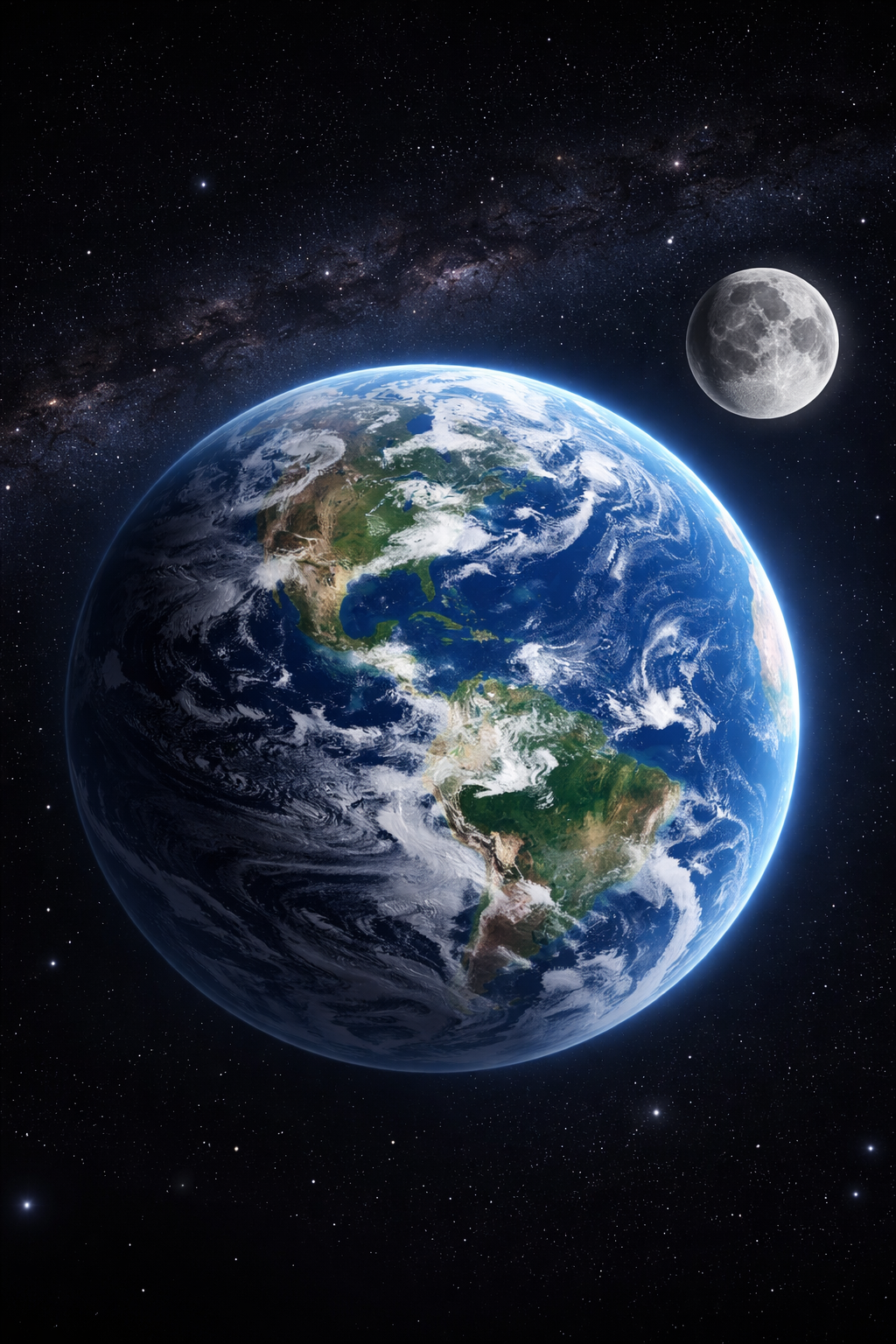
Nighttime on Earth would grow significantly darker, removing a steady source of natural illumination and altering how you experience evenings, coastal life, and nocturnal activities. You would notice immediate changes in animal behavior, coastal visibility, and the cultural practices tied to the Moon.
Darker Nights for Earth
Without the Moon’s reflected sunlight, nights would lose a reliable glow that currently brightens about half the nights each month. Full-moon nights now provide roughly as much light as a dim streetlamp in many rural areas; losing that light would make rural and suburban nights far darker and reduce visibility for humans and animals.
Nocturnal species that depend on moonlight for hunting, navigation, or mating cues—such as some seabirds, coral spawning events near moonlit tides, and certain insects—would face disrupted rhythms. You would also see fewer low-light behaviors like coastal fishing at night and traditional nighttime ceremonies that require natural illumination.
Moonlight currently helps observers spot lunar landmarks and collect moon rocks during missions; its absence would change both amateur stargazing and some practical aspects of fieldwork near shorelines where moonlit tides aid navigation.
Cultural and Scientific Significance
The Moon anchors calendars, festivals, and artistic motifs across cultures; you would lose a central cultural touchstone that shapes holiday timing, poetry, and visual arts. Many calendars still align months with lunar phases; removing the Moon would force adjustments in religious observances and agricultural timing that rely on predictable lunar cycles.
Scientifically, the Moon has been a classroom and laboratory—landing sites, moon rocks, and tidal observations advanced geology and planetary science. You would lose the immediate visual cue that inspired early astronomy and the tangible sample record in museum collections. Space programs that use the Moon as a stepping stone for crewed missions would face strategic and inspirational losses, altering public interest and funding priorities tied to lunar exploration.
Leave a Reply