
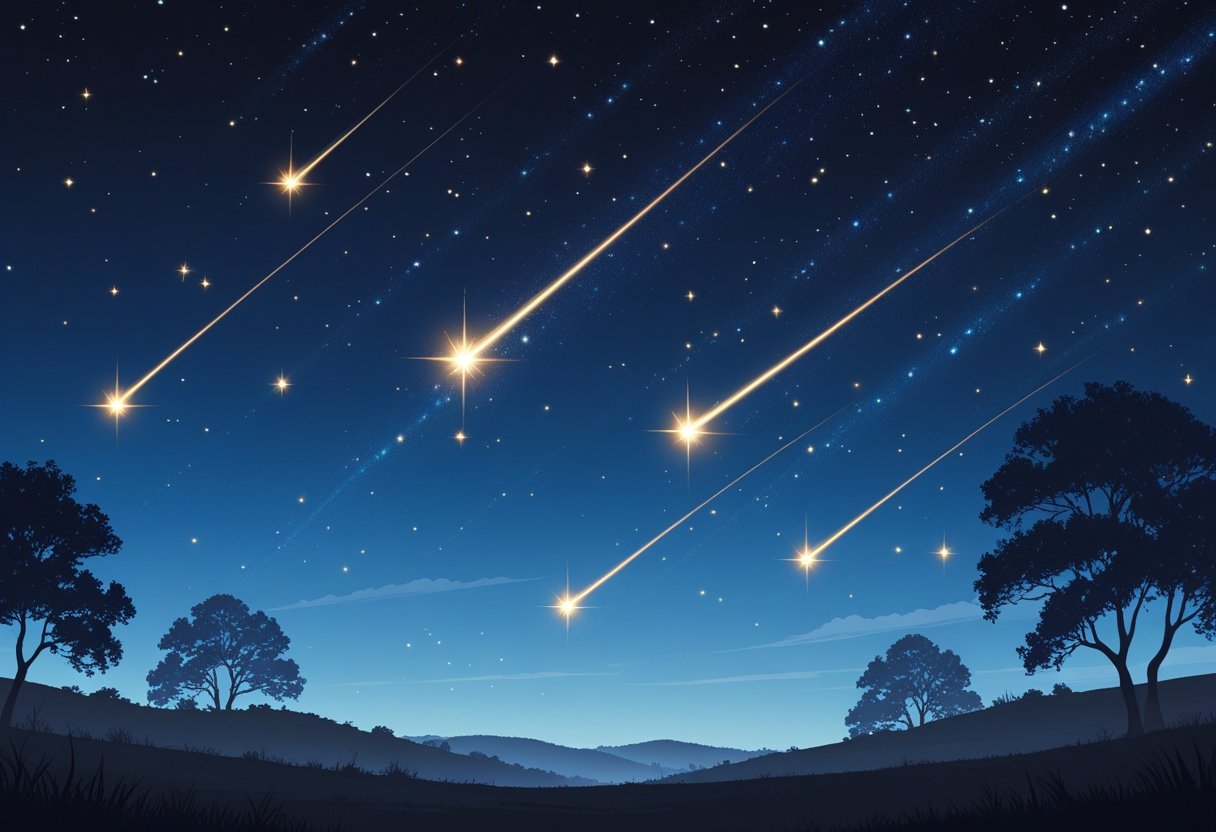
You look up and spot a streak of light—what you call a shooting star is not a star at all but a fast-moving piece of space rock or dust burning in Earth’s atmosphere. I’ll show you exactly what a shooting star is, why it glows, and how those brief streaks relate to comets, asteroid debris, and predictable meteor showers.
When you want to know where shooting stars come from or how to catch them, knowing the difference between meteoroids, meteors, and meteorites makes the sky make sense. I’ll break down the types of meteors you might see, explain why some nights produce dozens of visible streaks, and point out what affects visibility so you can plan a better viewing.
Key Takeaways
- Shooting stars are glowing meteors caused by space debris heating in the atmosphere.
- Meteor showers happen when Earth crosses debris streams left by comets or asteroids.
- Knowing meteor types and viewing conditions helps you spot more events.
Shooting Stars Explained
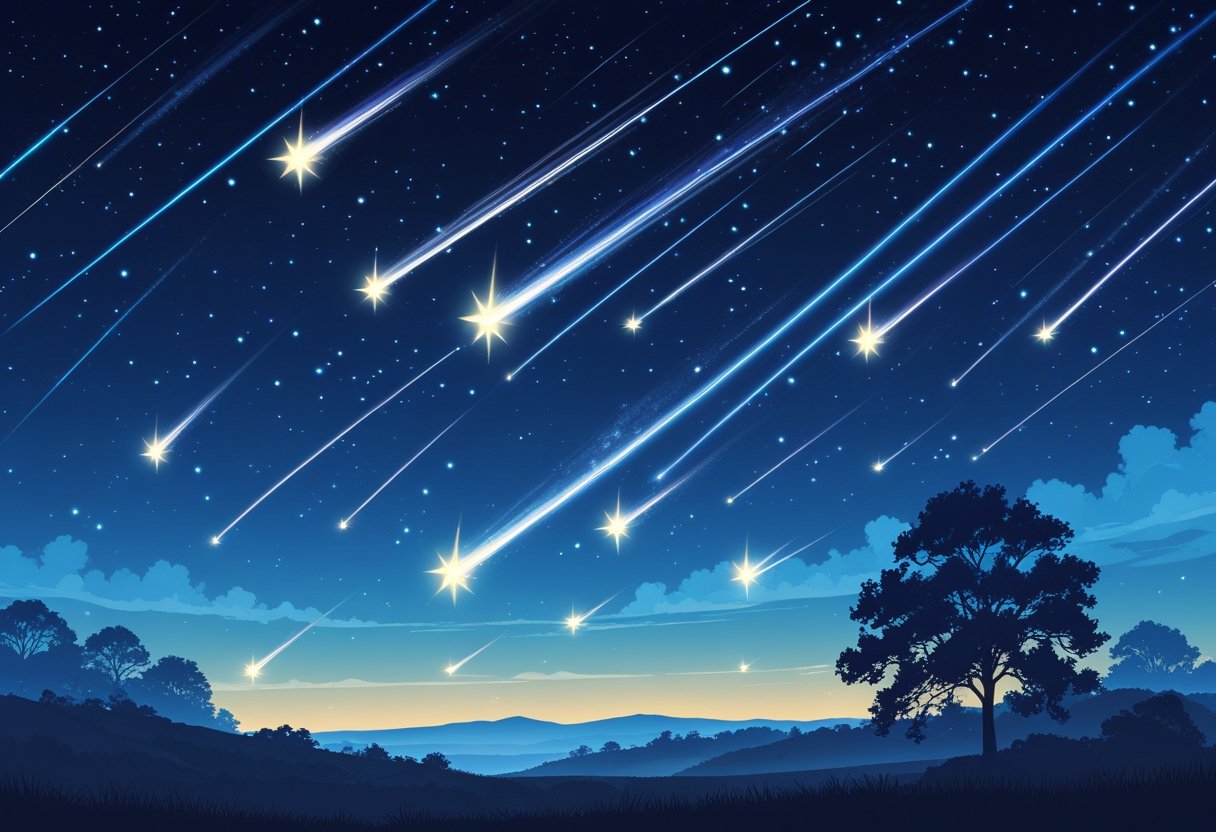
I’ll explain what a shooting star actually is and how the bright streak forms in Earth’s atmosphere. Read the short explanations and the focused technical details that follow.
Why Shooting Stars Are Not Actually Stars
A shooting star is not a star; it’s a meteoroid that becomes a meteor when it lights up in our atmosphere. I identify the object as a solid fragment—typically millimetres to metres across—originating from comets or asteroids rather than from stellar fusion.
Stars produce light through nuclear fusion and sit light-years away. By contrast, meteors occur within about 75–100 kilometres of Earth, so their appearance is a passing glow, not sustained luminosity. When a meteoroid survives and reaches the ground, I call the remnant a meteorite.
Key distinctions:
- Origin: stars = stellar cores; shooting stars = space debris.
- Distance: stars = astronomical units to light-years; meteors = tens of kilometres.
- Lifespan: stars persist for millions to billions of years; meteors flash for seconds.
The Science Behind the Streak of Light
I describe the streak as thermal and ionisation effects produced by high-speed entry. A meteoroid enters at 11–72 km/s; friction and compression heat the surrounding air, producing temperatures high enough to vaporise material and excite atmospheric atoms. That produces the visible plasma trail we call a shooting star.
Brightness depends on speed, mass, composition, and entry angle. Iron-rich meteoroids tend to glow longer and more brightly than porous, icy fragments. I note that meteor showers happen when Earth crosses debris streams; those increase the number of visible meteors per hour. For practical viewing, darker skies and the shower’s peak produce the best rates of visible shooting stars.
Further technical points:
- Light source: heated air and vaporised meteoroid, not the solid itself.
- Trail persistence: ionised gas can persist briefly, forming trains.
- Survivability: objects larger than ~1 metre may drop meteorites; smaller ones burn up completely.
For more on meteors and how they form, see this guide to what is a shooting star.
Meteoroids, Meteors, and Meteorites: Key Differences
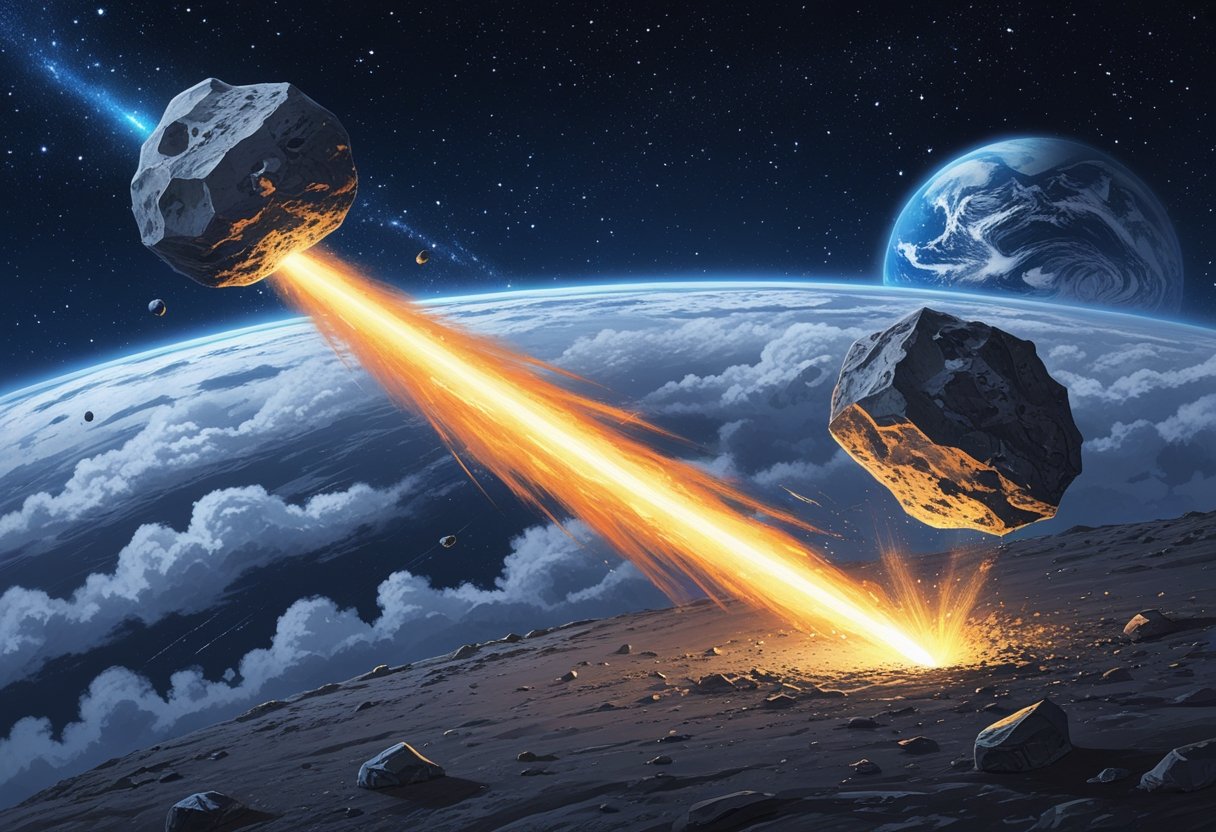
I distinguish between three stages of the same object: a small space rock traveling between planets, the bright streak it makes in the atmosphere, and any fragment that survives to reach the ground. Each stage has different physical behavior, detection methods, and scientific value.
What Is a Meteoroid?
I call a meteoroid a small body of rock or metal moving through space, typically ranging from millimeter dust to objects a few meters across. These are smaller than asteroids and often originate as fragments from asteroids or comets, or as collision debris in the inner solar system.
I focus on composition because it determines what happens later: stony (silicate-rich), iron (metal-dominated), and stony-iron types behave differently during atmospheric entry. I note that most meteoroids are centimeter-scale or smaller and are usually called space debris when discussing artificial fragments.
I track meteoroids with radar and space-based telescopes when they’re large or produce detectable dust. Their orbital paths tell me whether they came from the asteroid belt, a Jupiter-family comet, or another source.
How Meteoroids Become Meteors
When a meteoroid hits Earth’s atmosphere at tens of kilometers per second, friction and compression heat the surrounding air; that heated air emits light and creates the visible streak called a meteor. I observe meteors across a wide brightness range: faint “shooting stars” from pea-sized grains to bright fireballs or bolides from larger meteoroids.
I emphasize speed and angle: a shallow entry spreads heating over longer time while a steep angle concentrates energy and can produce fragmentation. Fragmentation creates multiple glowing fragments and sometimes sonic booms detectable on the ground.
I monitor meteor showers as predictable encounters with streams of cometary dust; individual meteors from showers share nearly identical orbits. Professional networks use all-sky cameras and radar to measure trajectories, which lets me reconstruct the original meteoroid orbit and estimate mass loss during flight.
Meteorites and Their Impact on Earth
I call any surviving fragment that reaches Earth’s surface a meteorite; most are pebble- to fist-sized, but larger falls occur. Meteorites fall into three broad classes—stony, iron, and stony-iron—and each yields different scientific information about the early solar system.
I consider impact effects: small meteorites pose negligible hazard, while rare large impacts can cause local to regional damage. Recovery relies on trajectory data, eyewitness reports, and systematic searches. Laboratory study of meteorites reveals isotopic ages, mineralogy, and sometimes presolar grains that document solar system formation.
I treat meteorites as value-rich scientific samples; they provide direct physical evidence of extraterrestrial material, help calibrate remote-sensing of asteroids, and occasionally contain organic compounds relevant to studies of prebiotic chemistry. For further background on meteors and meteorites, NASA maintains a concise overview of these distinctions (https://science.nasa.gov/solar-system/meteors-meteorites/).
Where Do Shooting Stars Come From?
I trace shooting stars to a few distinct kinds of objects and events in space. Each produces meteoroids—small rocky or icy fragments—that burn in Earth’s atmosphere and appear as meteors.
Asteroids as a Source of Meteoroids
Asteroids are rocky bodies mostly in the main belt between Mars and Jupiter. Collisions and slow fragmentation eject fragments that become meteoroids. I note that these fragments range from dust grains to meter-sized rocks; when they intersect Earth’s orbit at high speed they heat and glow, producing the bright streaks we call shooting stars.
Meteorites recovered on Earth often match asteroid compositions, linking many meteors to specific asteroid families. I monitor orbital data: when a meteoroid’s trajectory and composition match an asteroid’s, we gain a clear origin story. Asteroid-born meteoroids typically produce slower, reddish meteors compared with cometary material because they are denser and less volatile.
Comets and Their Debris Trails
Comets shed dust and ice as they near the Sun, leaving trails of debris along their orbits. I study debris streams from comets like 109P/Swift–Tuttle, whose trail causes the Perseid meteor shower each August. When Earth crosses these streams, we see concentrated meteor showers with many fast, bright meteors.
Cometary meteoroids are often smaller and more fragile than asteroid fragments, so they ablate higher in the atmosphere and frequently produce fast, sodium- and magnesium-rich spectra. I check annual shower calendars to predict when comet debris will intersect Earth. These predictable intersections explain most major meteor showers.
Other Origins: Space Debris and Celestial Events
Not every shooting star comes from natural small bodies. I recognize artificial space debris—defunct satellites, rocket bodies, and fragments from collisions or breakups—can re-enter and glow like meteors. These typically travel at lower relative velocities and can be identified by their slower, often tumbling light patterns.
Rarely, larger celestial events contribute meteoroids: asteroid breakups, comet fragmentation, or collisions in the inner solar system can inject fresh debris into Earth-crossing orbits. I monitor surveys and telescopic observations for such events because they can temporarily increase meteor rates or produce unusual fireballs.
Meteor Showers: The Best Time to See Shooting Stars
I focus on predictable annual meteor showers, where dozens to hundreds of meteors per hour can appear when conditions align. Good timing, low light pollution, and knowing a shower’s peak let you plan practical stargazing sessions.
How Meteor Showers Occur
Meteor showers happen when Earth crosses streams of debris left by comets or sometimes asteroids. I track the parent body’s orbit and the dense dust trail it leaves; each intersection produces a concentrated rain of meteors that radiates from a specific constellation.
Meteoroids enter the atmosphere at high speed and vaporize, creating visible streaks. Shower meteors share similar orbits, so they seem to come from a single point called the radiant. The radiant’s position in a constellation gives the shower its name, such as the Perseids from Perseus or the Leonids from Leo.
Shower activity peaks when Earth passes the densest part of the trail. I watch for predicted peak dates and hourly rates (often called the zenithal hourly rate, ZHR) to estimate how many meteors I might see under ideal dark-sky conditions.
Major Annual Meteor Showers
Some showers repeatedly produce high rates and are easy to plan for. I prioritize the Perseids (mid-August) for bright, frequent meteors and the Geminids (mid-December) for broad visibility and high ZHR. The Quadrantids (early January) and Lyrids (late April) also offer strong displays but sometimes depend on a narrow peak window.
Other reliable showers include the Orionids (late October) and Leonids (mid-November), each with distinctive speeds and occasional outbursts. I check calendars and local predictions to match peak nights with moon phase and weather. When the moon is new or below the horizon, ZHR translates more directly into visible meteors.
- Perseids: mid-August — bright, fast, high ZHR
- Geminids: mid-December — steady, numerous, good early-night observing
- Quadrantids: early January — short, sharp peak
- Lyrids: late April — moderate rate, sometimes bright
- Orionids & Leonids: autumn shows with variable intensity
The Role of Light Pollution and Viewing Tips
Light pollution drastically reduces visible meteors. I travel to Bortle 1–3 skies when possible; even suburban skies can cut observed rates by half. I use dark-sky maps to find nearby darker observing sites and aim to be at least 30–60 minutes away from major city lights.
For field technique, I lie back on a reclining chair or blanket to use peripheral vision across a wide patch of sky. I face the radiant early in the night but shift toward the anti-radiant or the sky near the zenith to catch faster, longer trails. Bring warm clothing, a red flashlight, and an app or chart showing constellations so I can identify the radiant (e.g., Perseus, Leo, Gemini, Orion).
Timing matters: many showers are strongest in the hours before local dawn because the hemisphere is facing the incoming meteoroid stream. I check moon phase, local peak times, and predicted ZHR from trusted calendars to pick the best nights for observation. For planning, I consult up-to-date meteor shower calendars and observing guides online to match specific dates to my location.
Types of Meteors and Observational Phenomena
I explain how single meteors differ from organized meteor showers, why some streaks become fireballs or bolides, and what controls the colors and brightness you see in the sky.
Sporadic Meteors vs. Meteor Showers
I distinguish individual, random meteors from predictable meteor showers by origin and frequency. Sporadic meteors come from isolated space debris—tiny dust or rock fragments not associated with a recent comet passage. They appear at random points in the sky and usually produce only one or two visible streaks per hour under normal conditions.
Meteor showers occur when Earth crosses a trail of debris left by a comet or sometimes an asteroid. During a shower, many meteors originate from a common radiant and can produce rates from a few per hour to over a hundred per hour during strong peaks. I watch the radiant to identify which shower I’m seeing; for example, Perseids appear from near Perseus, while Geminids trace back to Gemini. Moonlight, local light pollution, and the shower’s zenithal hourly rate (ZHR) determine how many meteors I actually observe.
Fireballs and Bolides
I reserve “fireball” for meteors brighter than about magnitude −4, roughly as bright as Venus. Fireballs result from larger meteoroids—centimeter to decimeter scale—that deposit far more energy as they ablate. They often leave persistent trains (ionized gas trails) visible for seconds to minutes after the flash.
A bolide describes an exceptionally bright fireball that either explodes in the atmosphere or reaches peak brightness with fragmentation. Bolides can produce sonic booms and, on rare occasions, drop meteorites to the ground. I monitor reports from photographic networks and infrasound detectors to confirm a bolide event and to help locate potential meteorite fall areas. Observers should note direction, duration, color, and any sound when reporting a fireball or bolide.
Colors and Brightness of Shooting Stars
I explain color and brightness as direct consequences of composition, speed, and atmospheric interaction. Brightness depends primarily on meteoroid mass and velocity; kinetic energy determines how much light the meteoroid releases while decelerating in the atmosphere. Faster or larger particles yield brighter meteors and increase the chance of fireball classification.
Color comes from heated minerals and ionized atmospheric gases. Sodium-rich grains produce yellow-orange trails, magnesium and iron yield white, and traces of copper or nickel can produce greenish hues. High temperatures can excite atmospheric oxygen and nitrogen, adding bluish or green tints. I use color notes to infer composition when reporting observations, but I avoid definitive mineral identification without spectroscopic data.
Relevant reading on meteor showers, meteors, and fireballs can be found at the National Park Service’s guide to shooting stars.
Significance and Fascination of Shooting Stars
I focus on why shooting stars matter both to people who study the sky and to everyone who looks up on a clear night. I emphasize their scientific value and the ways they shaped stories, calendars, and navigation.
Shooting Stars in Astronomy and Stargazing
I treat shooting stars as practical probes of the solar system. When a meteoroid becomes a meteor in the atmosphere, its light and spectrum reveal composition, speed, and entry angle. Astronomers use meteor spectra to identify minerals and volatile content, which helps classify parent bodies like comets or asteroids.
Observationally, I recommend watching during predictable meteor showers—like the Perseids or Geminids—because rates rise when Earth crosses cometary debris streams. I also note how moon phase and local light pollution control visibility; a new moon and dark site maximize counts.
For amateur stargazers, I suggest simple tools: a reclining lawn chair, warm clothing, and wide-field binoculars or a DSLR for time-lapse captures. Tracking meteor radiant positions ties the event to constellations and aids identification of which shower produced each streak.
Cultural and Historical Impact
I show how meteor sightings influenced calendars, myths, and navigation across cultures. Ancient observers recorded prolific showers and rare fireballs; those records now cross-check modern orbital models and help date historical events.
Many cultures attached meaning to falling stars—omens, souls in transit, or prompts for wishes—shaping folklore and ritual timing. Mariners and desert travelers sometimes used persistent bolide activity as a remembered landmark when celestial navigation relied on constellations.
Museums and public planetariums use meteorites and outreach programs to connect visitors with tangible space material, making meteor phenomena a bridge between scientific data and everyday human experience.
Leave a Reply