You can use AI to turn complex weather, light-pollution, and satellite data into reliable night sky forecasts that help you pick the best nights for stargazing and astrophotography. AI-powered platforms can analyze real-time telemetry and atmospheric models to predict visibility, optimal observing windows, and when the Milky Way or a meteor shower will be most visible.
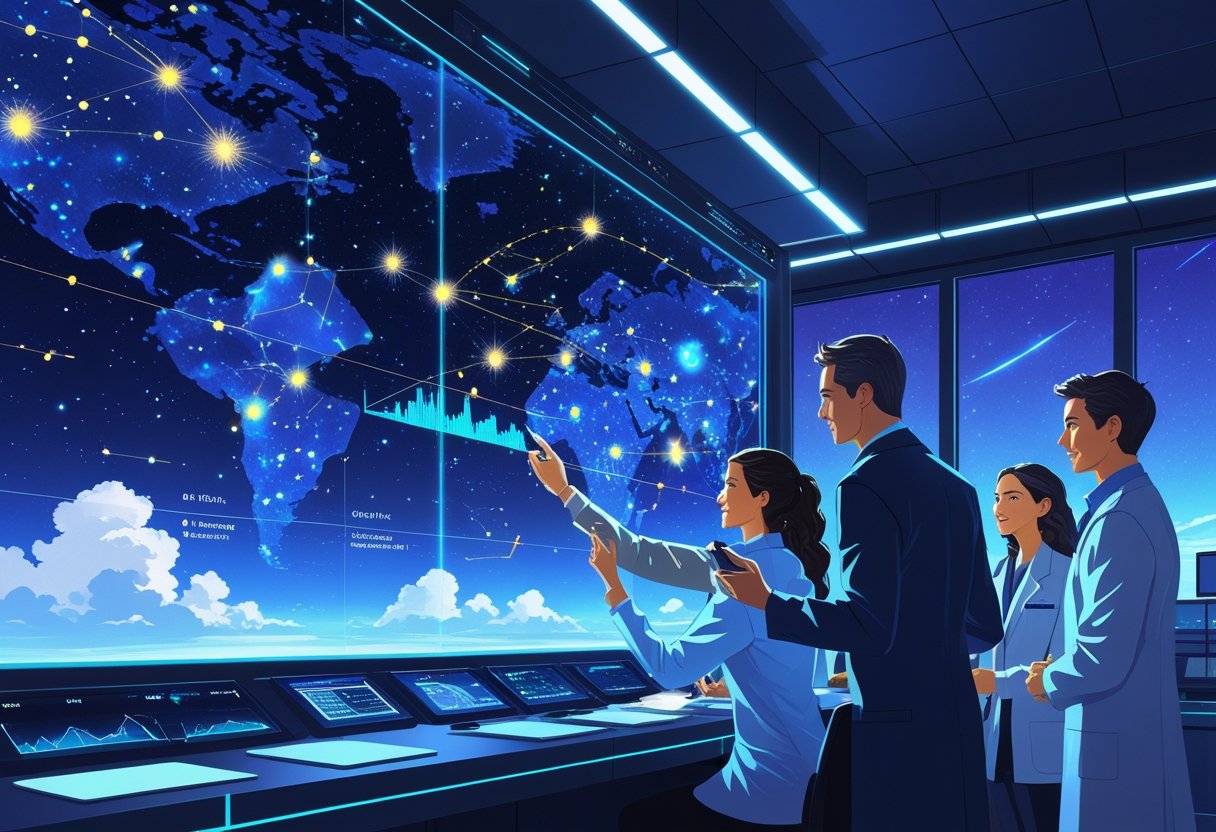
Imagine planning an outing with confidence because your tools estimate cloud cover, moon phase, and seeing conditions for specific targets and locations. The article explores how AI is changing night sky forecasting, the techniques and tools behind it, ways to enhance AI-generated visuals for creative projects, and how scientists and educators apply these forecasts for learning and research.
How AI Is Revolutionizing Night Sky Forecasting
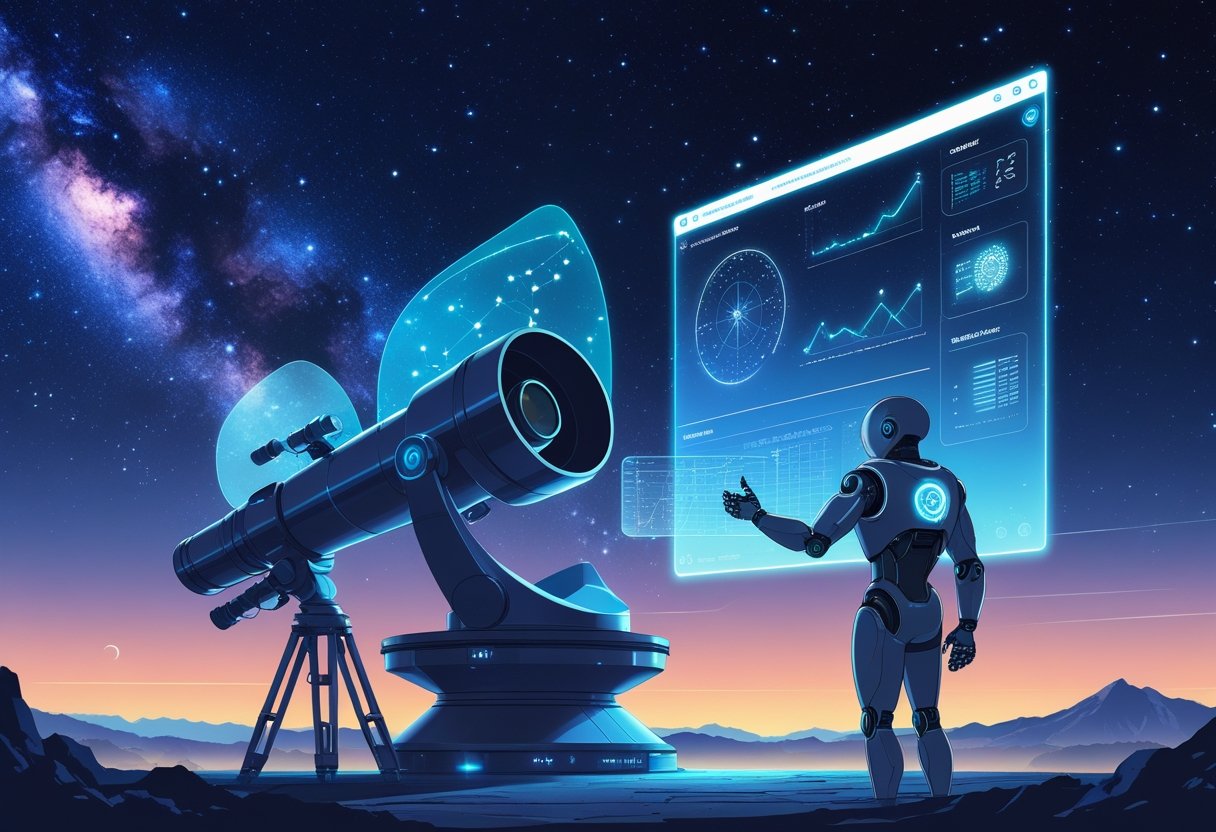
AI now turns raw measurements into specific, actionable predictions for observable sky features. You get faster detection of transient events, clearer visibility forecasts, and tools that scale from backyard observing to professional surveys.
From Data to Celestial Insights
AI ingests telescope logs, all-sky camera feeds, satellite atmospheric profiles, and historical light-curve archives to produce targeted forecasts. You benefit when machine learning models fuse sensor data with weather models to estimate sky transparency and seeing at precise coordinates and times.
Models trained on labeled events—novae, meteor showers, or variable-star flares—flag likely occurrences hours or minutes before they peak. That lets you plan imaging sessions for nebulae or time exposures to capture star formation regions with minimal wasted telescope time.
Generative techniques can synthesize visible-light imagery from infrared baselines, helping you preview how faint galaxies or dust-rich nebulae might appear under current conditions. For example, diffusion-based models reconstruct probable visible structure from thermal maps so you know whether a target’s spiral arms or emission lines will be detectable.
AI Versus Traditional Night Sky Prediction
Traditional forecasts rely on coarse meteorological grids and manual catalog cross-checks, which can miss localized cloud microstructures and short-timescale transients. You get higher spatial and temporal resolution with AI because models learn patterns of cloud evolution and instrument noise directly from historical observations.
AI systems also score candidate detections against known catalogs of constellations, galaxies, and nebulae, reducing false positives. This matters when automated surveys scan billions of sources: machine classifiers separate real supernovae from cosmic-ray hits or electronic artifacts.
At the same time, AI keeps probabilistic outputs—confidence intervals and ranked candidate lists—so you know when to trust a prediction and when human vetting is required. That balance preserves scientific rigor while increasing discovery speed.
Access for Hobbyists and Professionals
You can use consumer-facing apps that translate AI forecasts into simple observing windows, target lists, and exposure recommendations for DSLR or small-telescope setups. These tools tap public all-sky feeds and open telescope data so you can chase auroras, meteor bursts, or a faint nebula on a clear night.
Professional observatories integrate AI into scheduling pipelines to prioritize time on kilosecond exposures of distant galaxies or follow-up of transient alerts. Your observatory can reduce idle time, automatically switch to backup targets based on predicted seeing, and queue observations of star formation regions when conditions peak.
Open-source models and cloud APIs make it practical for you to run custom classifiers, cross-match candidate transients with external catalogs, and contribute discoveries to citizen-science platforms.
Key AI Techniques for Generating Night Sky Forecasts
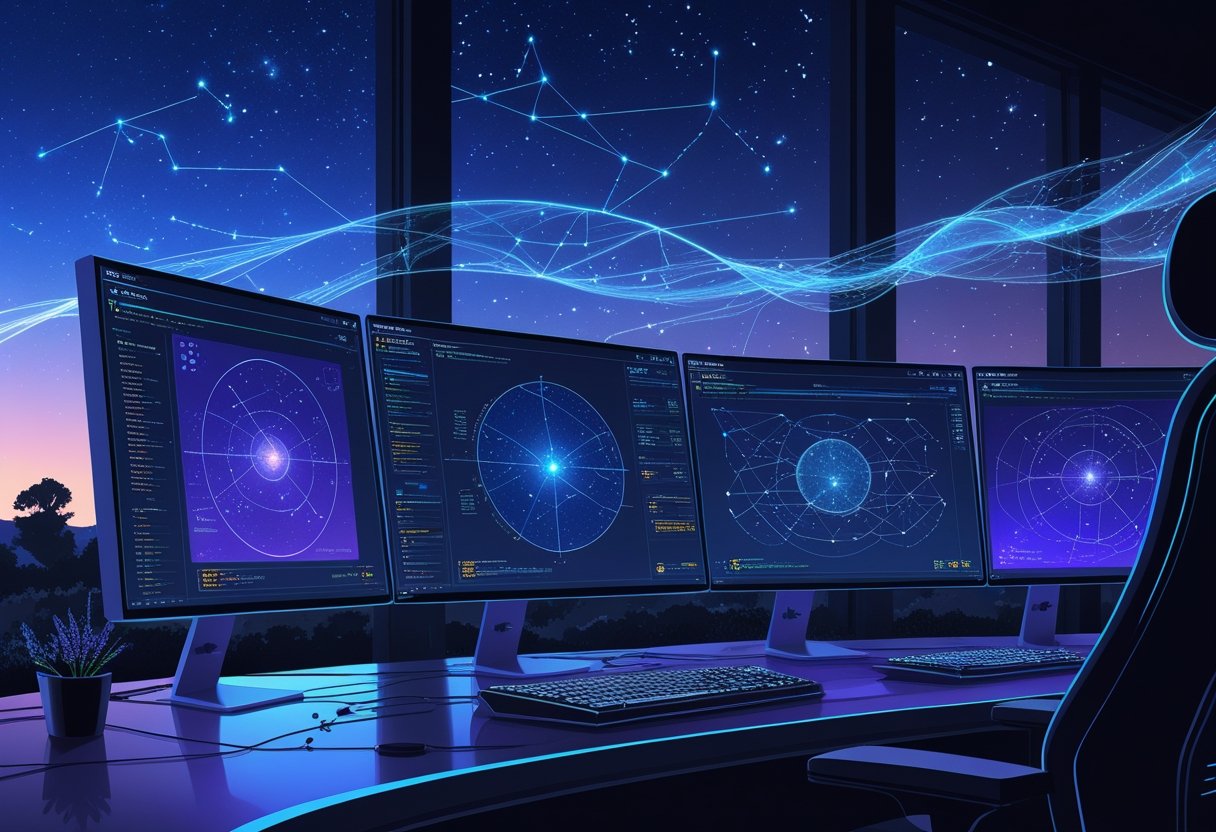
You will learn which AI methods actually improve night-sky predictions, how to combine multiple images and data types, and when to include physics so your forecasts match real celestial geometry and atmospheric behavior.
Deep Neural Networks and Machine Learning
You train convolutional neural networks (CNNs) or transformer variants to map inputs like all-sky camera frames, cloud-ceilometer readings, and recent meteorological observations to short-term sky visibility and star-field clarity. Focus on architectures that preserve spatial detail—U-Net and encoder–decoder models work well when you need to predict where the Milky Way or bright planets will be visible through gaps in cloud cover.
Include planet ephemerides and sidereal time as explicit input channels so the model learns how planetary positions and seasonal sky rotation affect what’s observable. Supervise with labeled outcomes such as star-count metrics, limiting magnitude, or binary clear/obstructed masks. Use data augmentation (rotations, simulated light pollution) to generalize across sites and sensors.
Prioritize temporal models—ConvLSTM or attention-based time models—if you predict minutes-to-hours ahead. Calibrate probabilistic outputs so you can say, for example, there’s a 70% chance the Milky Way core will be visible in the next two hours.
Multi-Image Fusion for Improved Accuracy
Fuse images from different sensors and times to reduce false negatives and improve small-gap detection. Combine wide-field all-sky camera frames with higher-resolution fixed-point exposures and thermal/infrared frames to reveal thin clouds that hide faint stars. Align and register frames using star-matching algorithms or astrometric solutions before fusion.
Use model-level fusion (ensemble predictions from separate CNNs) or data-level fusion (stacking channels into a single network input). Temporal stacking—weighted averages or attention across recent frames—helps track cloud motion and preserves transient clear windows where the Milky Way or planets briefly appear. Implement confidence-weighted fusion so infrared confidence raises the weight of a frame showing thermal gaps.
For practical pipelines, automate rejection of saturated or streaked frames, and apply photometric normalization so stacked images preserve limiting magnitude estimates. This improves your ability to forecast not just cloud cover but usable astrophotography windows.
Physics-Based Sky Simulation
Integrate forward models of sky radiance and planet/star positions to ground AI predictions in physical reality. Use ephemeris libraries (e.g., JPL DE or similar) to compute accurate planetary positions and sidereal rotation for given date, time, and location so predicted visibility aligns with celestial geometry. Couple that with radiative-transfer or empirical sky-brightness models to estimate background light from moon phase, airglow, and light pollution.
Blend physics outputs with ML predictions through hybrid architectures: provide simulated sky radiance maps as auxiliary inputs, or constrain outputs with a differentiable radiative-transfer layer. This prevents the model from predicting impossible events (like Jupiter located inside the Milky Way core) and improves extrapolation to unseen conditions. Validate using real-sky observations—compare predicted limiting magnitude and star patterns against calibrated exposures to tune turbulence and scattering parameters.
AI Tools and Platforms for Night Sky Generation
You’ll find tools that generate realistic star fields, composite celestial imagery, and interactive forecasts. Pick platforms that match your goal—art creation, scientific plotting, or real-time observation planning.
Overview of Popular Night Sky AI Tools
Several AI art platforms specialize in night sky imagery. StarryAI turns text prompts into detailed celestial scenes with adjustable style sliders for realism or fantasy. Reelmind.ai focuses on hyper-realistic starscapes and can generate image-to-video sequences, which helps when you need animated skies for presentations or social posts. MyAIArt and NightCafe provide quick sky replacement and style templates for photos and wallpapers, useful when you want a fast, polished result without deep prompt tuning.
Compare tools by output type (still image, video, sky replacement), export formats, and control over astronomical detail. For image-to-video workflows, prioritize platforms that accept layered inputs and offer frame-coherent rendering. If artistic control matters, choose an editor with prompt presets, negative prompts, and seed locking to reproduce consistent skies.
AI Assistants for Stargazing and Astronomy
AI assistants bridge art and science. AstrBot processes live telemetry and ephemerides to generate accurate sky maps and event alerts for eclipses or meteor showers, so you can plan observation sessions with reliable timings. These assistants also analyze camera parameters (ISO, exposure, focal length) to recommend astrophotography settings tailored to your target object and location.
When you need educational context, pick assistants that annotate charts with constellation names, rise/set times, and object magnitudes. Look for integrations with NASA datasets or local weather APIs to improve prediction accuracy. Use these assistants to convert observational needs into concrete capture instructions or to overlay scientifically accurate star positions onto creative composites.
Features of Interactive Forecasting Platforms
Interactive forecasting platforms combine AI generation with live data feeds and editing tools. Key features to evaluate: real-time ephemerides, customizable sky overlays (constellations, grid, labels), and exportable observation plans. Platforms that offer both generation and editing let you replace skies in photos, tweak color grading, and export for social or print without switching apps.
Advanced platforms let you animate transitions through time, simulate light pollution levels, and layer AI-generated nebulae while preserving correct star positions. If you plan to publish or present, ensure the platform supports high-resolution exports and video codecs. For scientific or mixed-use projects, choose a platform that documents data sources and lets you adjust parameters like date, time, and geographic coordinates so your generated forecasts match real-world conditions.
Customizing and Enhancing AI-Generated Night Sky Visuals
You’ll learn how to craft prompts for believable skies, apply artistic style transfers without breaking realism, and finish images with targeted post-processing. Practical tips focus on controlling star density, color grading, and integrating ethereal or photoreal elements.
Prompt Engineering for Realistic Scenes
Write prompts that state measurable details: date, time, moon phase, location, and exposure intent (e.g., “30s tracked exposure” or “single-frame smartphone 5s exposure”). Specify star density and Milky Way orientation, such as “dense Milky Way core over the southern horizon at 23:00.” Include atmospheric conditions: “Bortle 4, thin cirrus” or “no light pollution.” If you want photoreal output, add camera and lens hints — sensor size, focal length, aperture — for accurate star size and field of view. Use negative prompts to exclude artifacts: “no halos, no oversaturated colors, no floating foreground edges.” Iterate with short variations and keep a small controlled set of antonyms (e.g., “sharp stars” vs “soft stars”) to test the model’s sensitivity. When blending AI-generated sky with your photo, call out matching exposure and white balance: “match foreground WB 3200K, exposure +1/3 EV.” These specifics produce more believable, reproducible results than vague terms alone.
Style Transfer and Artistic Night Skies
Decide whether you want an ethereal or realistic aesthetic before applying style transfer. For painterly effects, name the style and its intensity: “Van Gogh-inspired swirls at 30% strength” or “low-intensity pastel aurora, 15% opacity.” Preserve astronomical cues when you need realism by locking star positions and relative brightness in the transfer step. Blend modes like Luminosity or Color can keep star detail while applying palette shifts to skies. Use local masks to protect the foreground and keep natural-looking edges where the horizon meets the sky. If you aim for color grading toward cinematic teal-and-orange or cool, desaturated midnight blues, specify target hex ranges or Kelvin temperatures. Test a small crop before processing the full image to avoid heavy artifacts. This controlled approach keeps your creative vision intact while preventing style transfer from destroying photoreal detail.
Post-Processing with Editing Software
Use raw-aware editors (Lightroom, Capture One) or pixel editors (Photoshop) to finalize grading and compositing. Start by matching exposure and noise characteristics between sky and foreground: adjust exposure, shadows, and grain to create a unified look. Apply selective color grading: lift midtones toward deep blues, push highlights toward warm nebula tones, and use HSL panel to increase star contrast without oversaturating. Use masks and feathering to blend edges; apply a subtle vignette to draw attention to the celestial center. For ethereal glow, duplicate the sky layer, apply Gaussian blur (3–12 px), set blend to Screen or Soft Light, and reduce opacity to taste. Remove unnatural artifacts with healing brushes and check at 100% for star shapes. Export in 16-bit where possible to retain color grading headroom for prints and high-resolution displays.
Creative Applications and Artistic Possibilities
You can turn night-sky forecasts into visuals that serve marketing, storytelling, and personal art projects. Focus on composition, color palettes, and specific effects so each image matches the intended mood and medium.
Night Sky Art and Digital Posters
Use high-resolution star fields and arranged star clusters to give posters realistic depth. Combine a crescent moon or a bright moonlit forest silhouette with a layered starry sky to create focal contrast.
Pick a clear central element—crescent moon, lone tree, or distant mountain—and surround it with a dense Milky Way band or a spread of star clusters to guide the viewer’s eye.
Color choices matter: muted indigo for calm pieces, teal and magenta for dramatic posters. Add watercolor-style brush textures for printed posters to mimic hand-painted art while keeping the night sky’s sharp pinpoints of light.
Export at 300 DPI for print and include layered PSD or PNG versions so you can swap backgrounds, change star density, or adjust the moon’s phase for different editions.
Cinematic and Surreal Night Scenes
You can craft cinematic frames with streetlights, neon signs, and a broad aurora borealis overhead to create atmosphere. Place neon signs and wet street reflections in the foreground; let a sweeping aurora and starry sky fill the upper two-thirds for scale.
Mix realistic lighting with surreal elements—floating star clusters, a moonlit forest that appears to glow, or a crescent moon larger than life—to nudge the scene toward dreamlike territory without breaking visual coherence.
Use camera-like composition: shallow depth for foreground neon, long exposure glow for auroras, and selective focus on a subject silhouette. Subtle haze or fog integrates streetlights and fireflies naturally, while color grading (teal shadows, warm highlights) unifies neon and natural light.
Incorporating Effects: Bokeh, Neon, and Fireflies
Bokeh adds magic: render out-of-focus star points and streetlights as soft circles to simulate lens blur. Target bokeh sizes to match plate scale; larger circles for close streetlight sources, tiny pinpoints for distant starry sky.
Layer neon sign glows with bloom effects; place chromatic fringes near bright edges to emulate LED and gas-tube signage. Balance neon saturation so it complements an aurora borealis sweep or watercolor wash without overpowering the stars.
Fireflies function as animated or static light flecks. Scatter small, warm-toned emissive spots near ground elements like a moonlit forest edge or beside a wet cobblestone street. Animate intensity and drift for motion pieces, or add grain and watercolor bleeds if you want a painterly poster feel.
Combine these effects in layers—bokeh, neon bloom, firefly emissives—so you can toggle each for web, print, or animation versions.
Scientific and Educational Uses of AI Night Sky Forecasts
AI forecasts give you precise timing for visible events, predict best viewing windows based on local weather and light pollution, and translate complex data into clear visual cues for learning and outreach.
Learning About Celestial Events
You get exact rise/set times, planetary positions, and transit schedules computed for your coordinates.
AI models combine orbital mechanics with atmospheric seeing predictions so you know when Jupiter’s moons or a faint nebula will be highest and clearest.
Interactive timelines let you scrub forward to see when constellations rotate, when the Milky Way core clears local horizon obstructions, or when a galaxy like Andromeda reaches optimal altitude.
Use predictive brightness estimates for variable stars or supernova candidates to plan observations.
AI can flag likely nights for nebulae visibility by comparing expected sky background, moon phase, and predicted aerosol scattering.
This helps you decide whether to use wide-field binoculars, a small refractor, or a long-exposure CCD for a target.
Classroom and Museum Experiences
You can design lesson plans tied to real-time predictions: schedule a lab where students measure a planet’s apparent motion over nights.
AI-driven forecasts supply classroom-ready data tables for planetary positions, constellation visibility windows, and target altitude vs. time charts.
Museums can run live displays that update which nebulae, galaxies, or constellations are currently observable from the exhibit’s location.
You can deploy curated playlists that guide visitors through “Tonight’s Top Five” — one planetary target, one bright galaxy, one emission nebula, one moving object, and one seasonal constellation.
These provide tangible learning: students compare AI predictions to telescope images and learn error sources like light pollution or seeing.
Augmented Reality for Stargazing
AR apps overlay AI-predicted labels and trajectories on your phone view, showing exact planetary positions and projected paths of major constellations.
When you point your device, real-time forecasts highlight observable nebulae or galaxies and estimate required exposure times for astrophotography.
You can enable layers that show predicted best viewing times, sky transparency, and moon interference levels.
AR guides let you tap a labeled object to see its rise/set times, distance, and recent variability.
For outreach events, this makes stargazing accessible: attendees follow visual prompts to locate targets and understand why a given night is good for viewing a galaxy or poor for faint nebulae.
Challenges and Future Trends in AI Night Sky Prediction
AI systems now blend satellite data, weather models, and user preferences to predict visibility, cloud cover, and transient events. Expect technical limits, collaboration opportunities, and growing personalization that will change how you plan observations and create images.
Model Limitations and Realism
You will face realism gaps when AI tries to simulate the night sky from imperfect inputs. Training sets often lack high-resolution, labeled examples of thin cirrus, urban light domes, and localized aerosols, so models misestimate star visibility and contrast. That produces forecasts that look plausible but can be off by hours or by key visual metrics like limiting magnitude.
Computational constraints also matter. Running deep models that fuse geostationary and polar-orbit satellite imagery, ground sensors, and telescope telemetry requires edge compute or cloud credits. Latency can delay predictions for fast-moving events such as meteors or rapid cloud changes.
You can improve realism by incorporating calibrated photometric measurements, using adversarial training to penalize unrealistic sky renders, and validating against time-stamped astrophotography. Tools that let you inspect model confidence per-pixel will help you judge which forecasts to trust.
Opportunities for Community Collaboration
You benefit when amateur astronomers, observatories, and app developers share observations and metadata. Crowdsourced uploads of raw exposures, timestamps, and GPS-tagged light measurements can fill training gaps for specific regions and night-sky regimes.
Open APIs and standardized formats let you connect ai-powered platforms with local editing tools and telescopes. For example, a community feed of clear-sky confirmations can gate automated imaging schedules or trigger live stacking in capture software.
Organized campaigns — coordinated observing nights, labeled datasets for cirrus detection, and challenge tasks — accelerate model improvement. Community moderation and simple validation badges keep contributed data reliable and reduce bias from urban-heavy submissions.
The Future of Personalized Sky Forecasts
Personalization will let you set priorities: deep-sky imaging, wide-field Milky Way scenes, or aurora hunting. Models can weight forecasts by your gear (aperture, mount, sensor), your exact location, and your tolerance for partial clouds to deliver recommendations that match your goals.
Expect integration between prediction engines and editing tools that auto-tag frames with predicted sky quality and suggest processing pipelines. This will shorten post-processing time because the AI can highlight frames captured during predicted optimal seeing windows.
Privacy-aware profiles will store equipment and location preferences locally or with end-to-end encryption. That keeps your observing habits secure while allowing models to learn from aggregated, anonymized trends across the cosmos of users.
Leave a Reply