
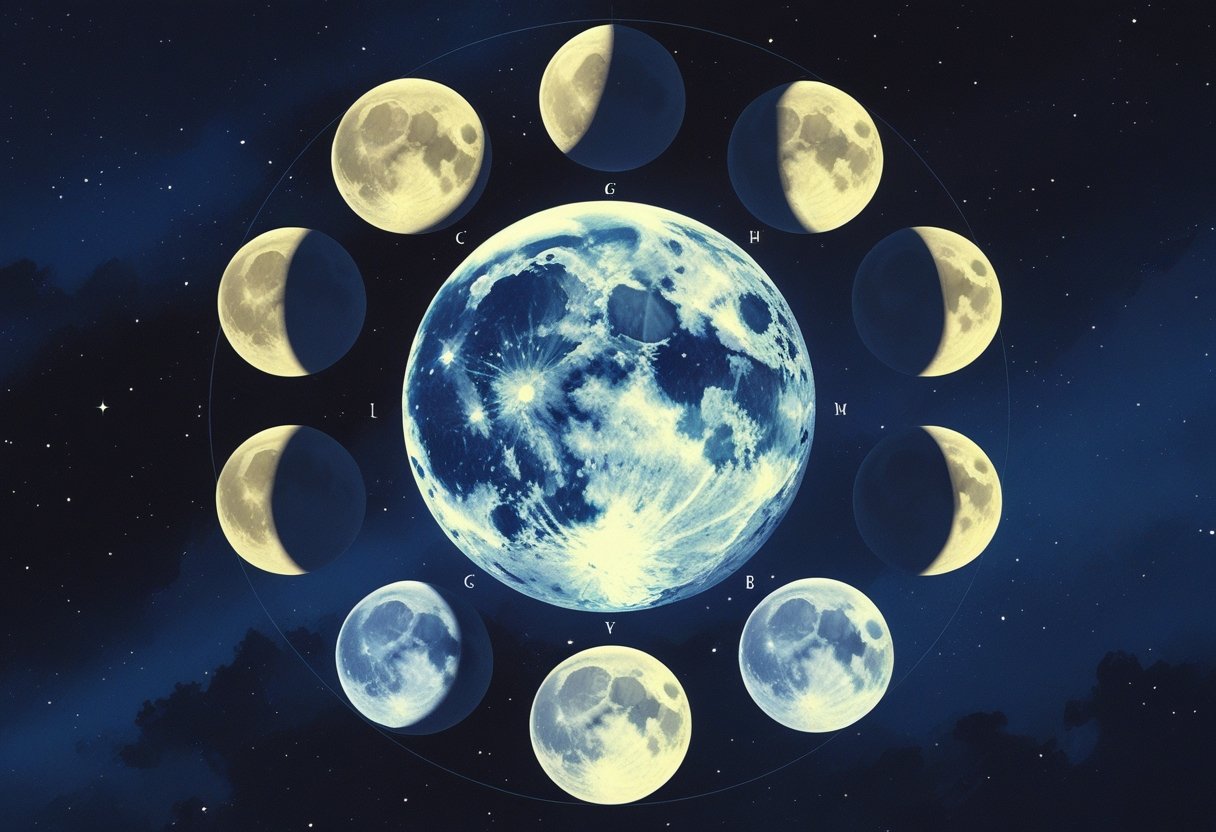
You already notice the Moon change shape across the month and wonder why it follows the same pattern. I explain how the phases of the Moon result from the Moon’s orbit and sunlight, and I show you the eight familiar stages so you can recognize them and understand what each stage tells you about the Moon’s position.
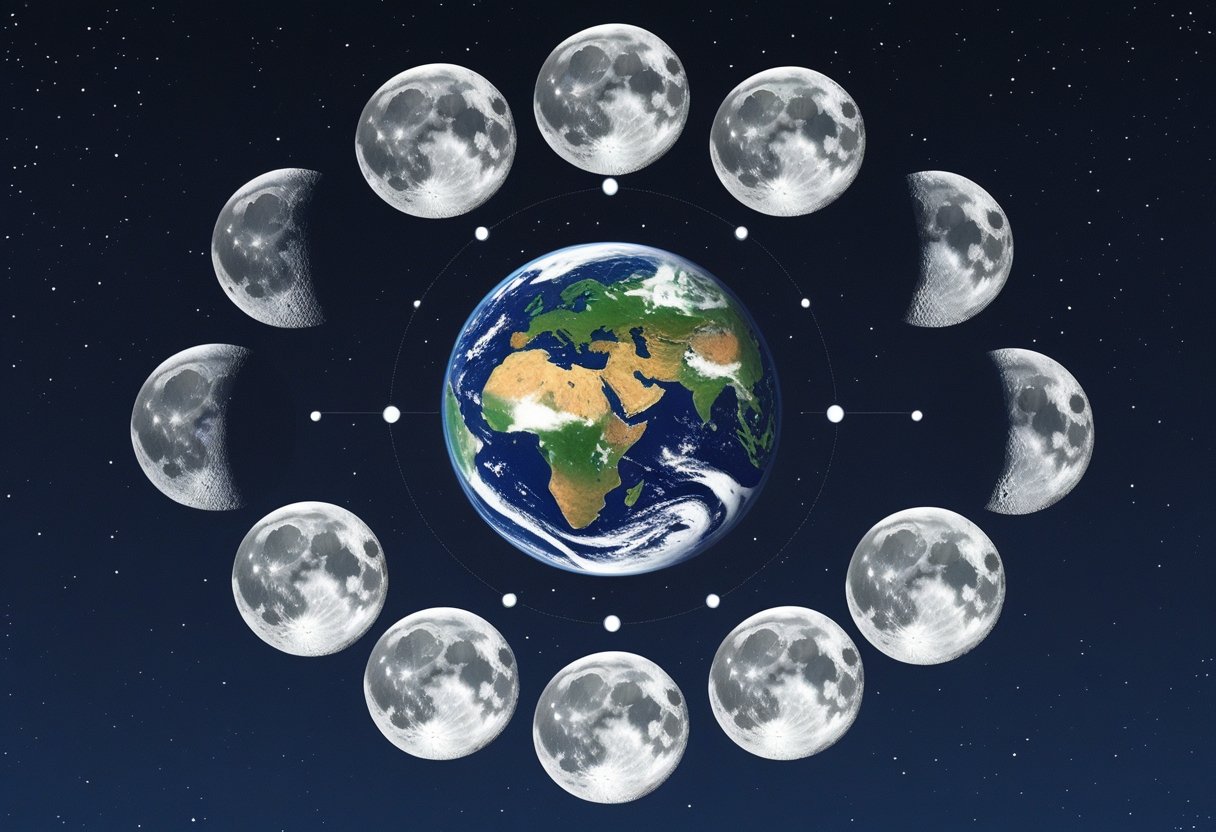
You will leave this article able to identify each lunar phase and explain why the Moon looks different at each point in its cycle. I keep the explanation practical and focused so you can apply it the next time you step outside and see a sliver, a half, or a full globe overhead.
I also point out the key mechanics that create those shifts, how the lunar cycle’s timing works, and which phases matter during eclipses and other notable events, so you gain a clear, accurate picture without unnecessary detail.
Key Takeways
- The Moon’s visible shapes come from its orbit and sunlight geometry.
- The lunar cycle repeats roughly every 29.5 days and includes eight main stages.
- Certain alignments produce eclipses and other notable lunar events.
What Are the Phases of the Moon?
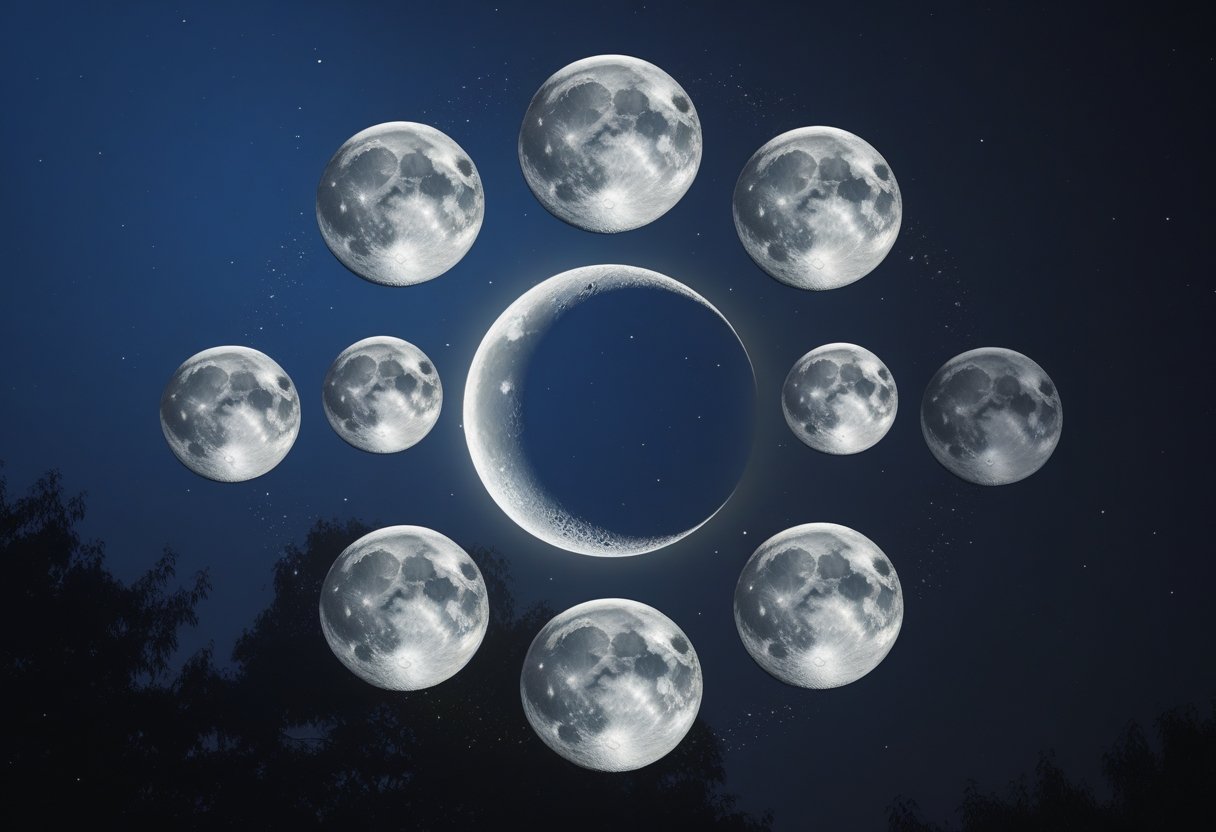
I explain how the Moon’s visible shape changes, why those shapes repeat in a predictable cycle, and how people across time have recorded and used those changes.
Definition of Moon Phases
I define moon phases as the changing portion of the Moon’s sunlit surface that is visible from Earth. The Moon is always half illuminated by the Sun; phases arise because of the relative positions of the Sun, Earth, and Moon as the Moon orbits Earth. The main named stages form an eight-step sequence: new Moon, waxing crescent, first quarter, waxing gibbous, full Moon, waning gibbous, third (or last) quarter, and waning crescent.
Key measurable facts I use:
- Synodic month (new Moon to new Moon): ~29.5 days.
- Illumination changes continuously; phase names mark conventionally recognized shapes.
- The Moon is tidally locked, so one hemisphere faces Earth during the entire orbit, affecting which lit portion we see.
How Moon Phases Are Observed
I describe practical observing details and what to expect at different phases. A full Moon rises at sunset and sets at sunrise; a first quarter is highest at evening; a new Moon is near the Sun and generally invisible. Moonrise and moonset times shift roughly 50 minutes later each day.
I list simple observing tips:
- Use the phase name to predict rise/set: new (daytime), first quarter (evening), full (night), last quarter (early morning).
- For daytime viewing, try first or last quarter when the Moon is ~90° from the Sun.
- Note “earthshine” on thin crescents—faint illumination of the dark side caused by sunlight reflected from Earth.
I mention equipment and measurements briefly. Naked-eye viewing shows phase shape clearly. A small telescope or binoculars reveals terminator detail (shadows along the lit/dark boundary), which highlights craters and mountains for education or imaging.
Historical and Cultural Context
I outline how lunar phases guided calendars, navigation, and rituals. Many traditional calendars use lunar months or lunisolar adjustments; for example, religious and agricultural festivals often anchor to full or new moons. Mariners historically used the Moon for night navigation and estimating tides.
I include cultural naming and record-keeping practices. Different cultures named monthly full moons for seasonal events; astronomers later standardized definitions for precise observation. Scientific study of phases also supported understanding of tidal forces, orbital mechanics, and the concept of tidal locking, linking practical cultural use to modern astronomy.
Relevant reading on the standard eight-phase sequence appears in NASA’s explanation of Moon phases.
Understanding the Lunar Cycle
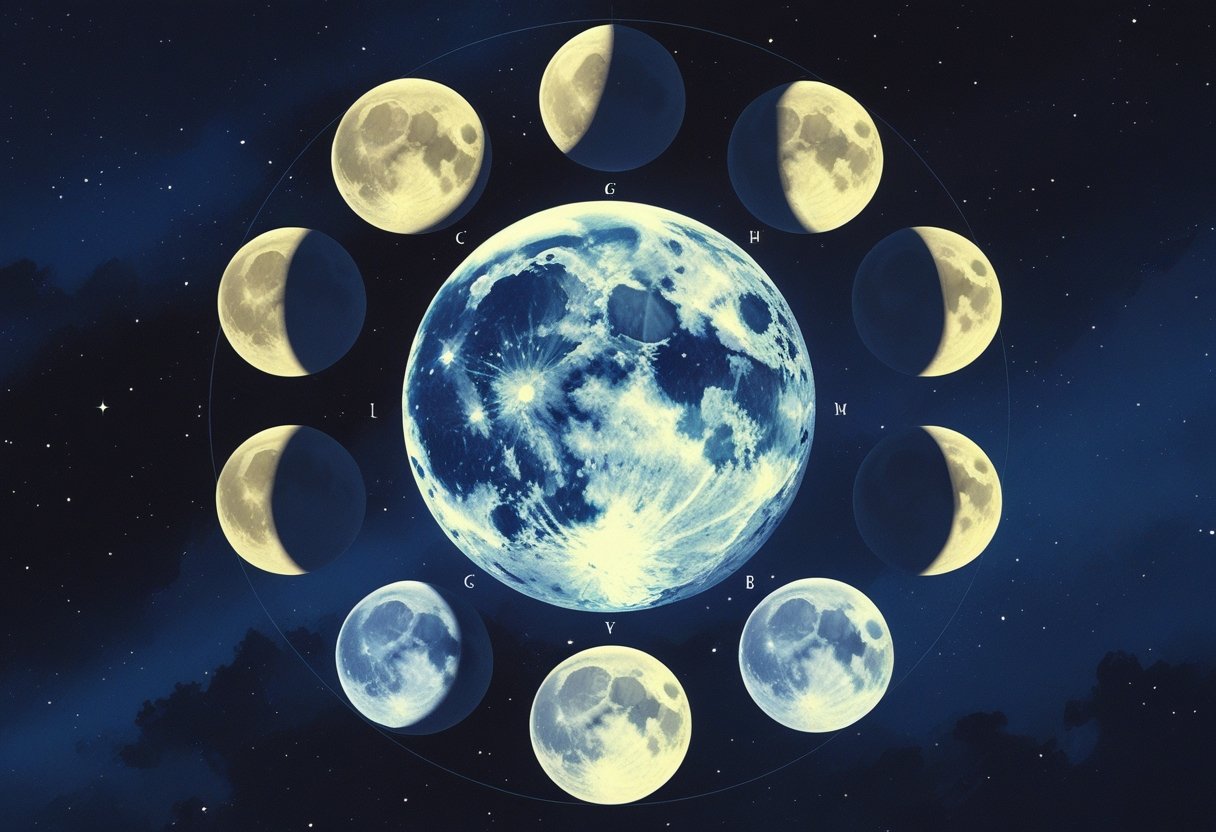
I focus on how the Moon’s appearance changes as it orbits Earth, how long each full cycle takes, and how that timing ties to calendars and daily observation. You will get specific, measurable definitions and a clear sequence of phases you can track week to week.
The Synodic Month Explained
I define a synodic month as the interval from one New Moon to the next, which averages 29.53 days. This period measures the Moon’s phase cycle as seen from Earth because it accounts for Earth’s motion around the Sun as well as the Moon’s orbit. The synodic month differs from the sidereal month (about 27.32 days), which is the Moon’s orbital period relative to the fixed stars; the extra ~2.2 days come from Earth’s movement around the Sun that changes the Sun–Moon–Earth geometry.
I note practical consequences: phase predictions, tide planning, and traditional calendars use the synodic month. Modern ephemerides give exact New Moon times to the minute. If you observe nightly, you’ll see the illuminated fraction increase from New to Full over ~14.8 days, then decrease back to New across the next ~14.8 days.
The Sequence of Moon Phases
I list the standard eight phases in order so you can identify them visually: New Moon → Waxing Crescent → First Quarter → Waxing Gibbous → Full Moon → Waning Gibbous → Third (Last) Quarter → Waning Crescent. Each named phase describes both the illuminated fraction and the Moon’s elongation from the Sun. For example, First Quarter occurs at ~90° elongation and shows half the lunar disk illuminated as seen from Earth.
I emphasize timing: the Moon moves eastward about 12–13° per day, causing the observable shape to change noticeably every night. I also point out useful observational rules: a Full Moon rises near sunset; a New Moon is near the Sun and invisible at night; quarters rise roughly six hours offset from the Sun. These simple rules let you predict rise/set behavior without instruments.
Relationship to the Lunar Calendar
I explain how lunar calendars count months by synodic months, typically alternating 29- and 30-day months to approximate the 29.53-day mean. Many traditional calendars—such as the Islamic calendar—use strictly lunar months tied to New Moon observations, which shifts seasons relative to the solar year. Other systems, like lunisolar calendars, insert an extra month (an intercalary month) periodically to keep months roughly aligned with the solar year.
I mention practical implications: a purely lunar year is about 354 days, so festivals tied to lunar months move roughly 11 days earlier each solar year. I link modern calculation to observation: astronomers use precise synodic month values to compute New Moon instants, while many communities still rely on first-visibility rules for the crescent to start a month.
The Mechanics Behind the Moon’s Phases
I explain how the Moon’s position, sunlight, and the Moon’s rotation combine to produce the visible cycle of phases. You will see why the same side of the Moon faces Earth, how illumination and shadow change, and how faint Earth-reflected light alters what we observe.
The Moon’s Orbit Around Earth
I focus on geometry: the Moon completes an orbit around Earth roughly every 27.3 days (sidereal) but the phase cycle — the synodic month — averages about 29.5 days because Earth moves around the Sun as well. The Moon travels eastward relative to the stars about 13° per day, so its phase shifts noticeably night to night.
The Moon’s orbital plane is tilted about 5° relative to Earth’s orbital plane (the ecliptic). That tilt explains why we don’t get a solar or lunar eclipse every month; alignments must also match node crossings. The orbit is slightly elliptical, changing the Moon’s apparent size and orbital speed (perigee/apogee effects) but not the basic pattern of phases.
Key practical points:
- Synodic month ≈ 29.5 days determines repeat of phases.
- Daily eastward motion causes rise times to delay by ~50 minutes.
- Orbital tilt (~5°) prevents monthly eclipses.
Illumination: Sunlight and Shadows
I describe illumination as a straightforward geometry problem: sunlight always hits the Moon from the Sun’s direction, and we see the fraction of the Moon’s near side that is lit. When the Moon lies between Earth and Sun, the near side faces darkness (new Moon). When Earth lies between Sun and Moon, the near side is fully lit (full Moon).
Phase names correspond to measured illumination: crescent (<50%), first/third quarter (~50%), gibbous (>50%). The terminator — the boundary between day and night on the Moon — moves across the lunar disk and reveals surface relief; shadows near the terminator enhance crater contrast and are valuable for telescopic observing.
Useful visual cues:
- Waxing = illuminated portion growing; waning = shrinking.
- First quarter rises near noon, sets near midnight; full Moon rises at sunset.
- Illumination fraction follows a predictable geometric progression each day.
Tidal Locking and Earthshine
I explain tidal locking: the Moon’s rotation period equals its orbital period, so the same hemisphere faces Earth. This 1:1 spin-orbit resonance stems from tidal torques early in the Moon’s history and remains stable. Tidal locking makes the phases primarily about changing illumination, not rotation.
Earthshine occurs when sunlight reflects off Earth and faintly illuminates the Moon’s dark portion. I see it most clearly during thin crescent phases, when the bright crescent is visible and the rest of the disk shows a dim, bluish glow. Earthshine intensity varies with Earth’s cloud cover and surface brightness; a mostly cloud-covered Earth produces stronger diffuse reflection.
Practical notes:
- Tidal locking means we can map the “near side” features consistently.
- Earthshine provides information about Earth’s reflectivity and is an observational aid for low-phase lunar detail.
- Both tidal effects and earthshine link lunar observations to broader topics in astronomy and planetary science.
The Eight Main Phases of the Moon
I describe how the Sun’s illumination and the Moon’s orbit produce visible shapes, timing, and observational cues that matter for planning observations or understanding cycles. Expect practical details on appearance, timing, and what each phase reveals about position relative to the Sun and Earth.
New Moon
I define the new moon as the moment the Moon sits nearly between Earth and the Sun, so the Sun lights the far side and the near side is dark to us. The Moon’s ecliptic longitude aligns with the Sun, producing a conjunction that makes the lunar disk essentially invisible in ordinary sky conditions.
Visibility is effectively zero for casual observers; twilight or daylight spotting requires careful optics and precise timing. New-moon timing marks the start of the synodic month (about 29.53 days). Solar eclipses can only occur near this phase when the orbital tilt allows exact alignment; otherwise the new moon simply passes unseen.
Astronomically, the new moon is useful for calibrating lunar calendars and scheduling dark-sky observations because it provides the darkest nights near the phase. I note the interval from new to first quarter spans roughly one week and corresponds to the Moon moving eastward about 90° from the Sun.
Waxing Crescent Moon
The waxing crescent appears after new moon when a slim illuminated arc grows on the right (northern hemisphere) or left (southern hemisphere). The Sun–Moon elongation increases from roughly 0° to about 90°, and the illuminated fraction climbs from near 0% to about 50%.
This phase is best seen low in the western sky after sunset. The crescent’s thickness and angle change night-to-night, offering clear cues about the Moon’s age in days. The illuminated portion forms a narrow curve; earthshine can make the darkened part faintly visible, which helps estimate how many days have passed since new moon.
For planning: the waxing crescent is ideal for early evening observations and for photographers aiming to capture both the bright crescent and earthshine. It signals the Moon’s transition toward the first quarter, and its predictable timing helps map the lunar month.
First Quarter Moon
I call the first quarter the “half moon” because we see roughly half the Moon’s near side illuminated. This occurs when the Moon’s elongation from the Sun approaches 90°, meaning the Sun–Earth–Moon angle is right for half illumination from our viewpoint.
The first quarter rises near noon and is highest around sunset, making it prominent in the evening sky. Surface features cast long shadows along the terminator, improving contrast and detail for telescopic observation; this is often the best time for amateur lunar observing of craters and ridges.
People often confuse “quarter” with 25% illumination; the term refers to the Moon’s orbital quarter, not the fraction lit. The first quarter marks about one week after new moon and precedes the waxing gibbous phase as illumination continues to increase.
Waxing Gibbous Moon
The waxing gibbous phase follows first quarter and extends until full moon, with the illuminated fraction between about 50% and nearly 100%. The Moon appears as a bulging disk, with most of the near side lit and the terminator moving toward the far limb.
This phase is visible in late afternoon through much of the night; it rises mid to late afternoon and remains prominent until after midnight. Shadows near the terminator still reveal terrain relief but gradually reduce as the Moon approaches full illumination.
For observers, waxing gibbous offers bright, nearly full views while retaining enough shadowing for contrast along the terminator early in the phase. It indicates the final stretch toward full moon and is useful for timing events that require a bright night sky without complete loss of topographic contrast.
From Full Moon to Waning Crescent
I describe how the Moon’s illumination shrinks after peak fullness, how the terminator moves across familiar features, and what to expect visually and practically during each waning phase.
Full Moon
I treat the full moon as the moment when the near side of the Moon receives maximum sunlight from Earth’s perspective. The lunar disk appears fully illuminated because the Moon lies approximately opposite the Sun; that geometry makes prominent features—rays from Tycho, maria contrasts, and large craters—stand out under low-angle limb shading during rise and set. Full moons occur once each synodic month, about every 29.5 days, and are candidates for lunar eclipses when orbital tilt aligns. Photographically, a full moon yields high overall brightness but low surface relief near center; I expose shorter to preserve crater detail and use moonrise or moonset for better texture.
Waning Gibbous Moon
I watch the waning gibbous moon immediately after full when illumination decreases but more than half the disk remains bright. The terminator shifts westward across the near side, progressively revealing crater shadows that give surface relief lost at full. This phase lasts several days as the Moon moves from full toward last quarter. Observationally, the waning gibbous is excellent for binocular study of bright highlands and prominent features like the crater Copernicus near the terminator; contrast improves each night. Tides remain near their full-moon amplitude, and casual observers notice the Moon rising later each night.
Last Quarter Moon (Third Quarter)
I call the last quarter or third quarter the half-illuminated phase where the left (in northern hemisphere view) or right (in southern hemisphere view) half of the Moon is lit. This marks roughly three-quarters of the way through the synodic cycle and produces the sharpest terminator lighting for night-by-night topographic study. Crater shadows along the terminator are long, which helps measure relief and spot smaller features. The last quarter also signals the transition to the final waning crescent stage; lunar rise and set times shift so the Moon is highest around dawn, and tidal effects move away from full-moon extremes.
Waning Crescent Moon
I describe the waning crescent as the final waning phase when only a slim arc of the Moon remains illuminated before the new moon. Illumination shrinks to a narrow crescent that rises shortly before sunrise and becomes difficult to see in bright twilight. This phase emphasizes the rugged limb near the terminator; low-angle sunlight skims crater rims, producing dramatic shadows on the crescent’s edge. Observers seeking the faint earthshine on the dark portion of the disk should choose clear, low-humidity mornings; earthshine is strongest a few days before new moon and provides one of the best opportunities to view the whole disk faintly lit by sunlight reflected from Earth.
Eclipses and Special Moon Phases
I explain how Earth’s shadow and the Moon’s orbit create observable events, and I identify when a full Moon becomes a “blue moon” or other rare occurrence. Read these specifics to know what to expect, when, and why appearances change.
Lunar Eclipse
I describe a lunar eclipse as occurring only at full Moon when Earth sits between the Sun and Moon and casts its shadow across the lunar surface. The deeper the Moon moves into Earth’s umbra, the darker and redder it appears; that red comes from sunlight refracted through Earth’s atmosphere. Total, partial, and penumbral eclipses differ by how much of the Moon enters the umbra versus the faint penumbra.
Visibility is broad: about half of Earth can see a lunar eclipse at once, so timing depends on local night hours. I note that atmospheric dust and clouds affect the exact color and brightness, and scientists use thermal measurements during eclipses to study lunar surface properties. For upcoming dates and global visibility, consult NASA’s lunar eclipse listings for accurate timing and maps.
Solar Eclipse
I explain that a solar eclipse happens only at new Moon when the Moon positions between Earth and Sun and casts a shadow on Earth. A total solar eclipse requires the Moon’s apparent size to cover the Sun; an annular eclipse occurs when the Moon is slightly farther away and leaves a bright ring. Partial eclipses occur when only part of the Sun is obscured for an observer.
Solar eclipses are visible from a narrow path on Earth’s surface—the Moon’s umbra—so planning travel to that path is often necessary. Never look at the Sun during a partial or annular eclipse without proper eye protection; only during brief totality is it safe to view without filters. For precise path and timing of future solar eclipses, I recommend checking NASA’s solar eclipse maps.
Blue Moon and Rare Events
I define a “blue moon” in the common modern sense as the second full Moon in a single calendar month. Another technical definition calls a blue moon the third full Moon in a season that has four full Moons; this is the older, astronomically based meaning. Either way, a blue moon is a timing artifact of the 29.5-day synodic month against our calendar or seasonal divisions.
Blue moons are uncommon but predictable: the second-in-month variety happens roughly every 2–3 years. Rare atmospheric conditions can also tint the Moon blue in color when large volcanic eruptions or wildfires inject fine particles into the stratosphere. I point out that “blue moon” rarely means a literal blue color; it primarily signals an extra full Moon in a calendar period.
Leave a Reply