
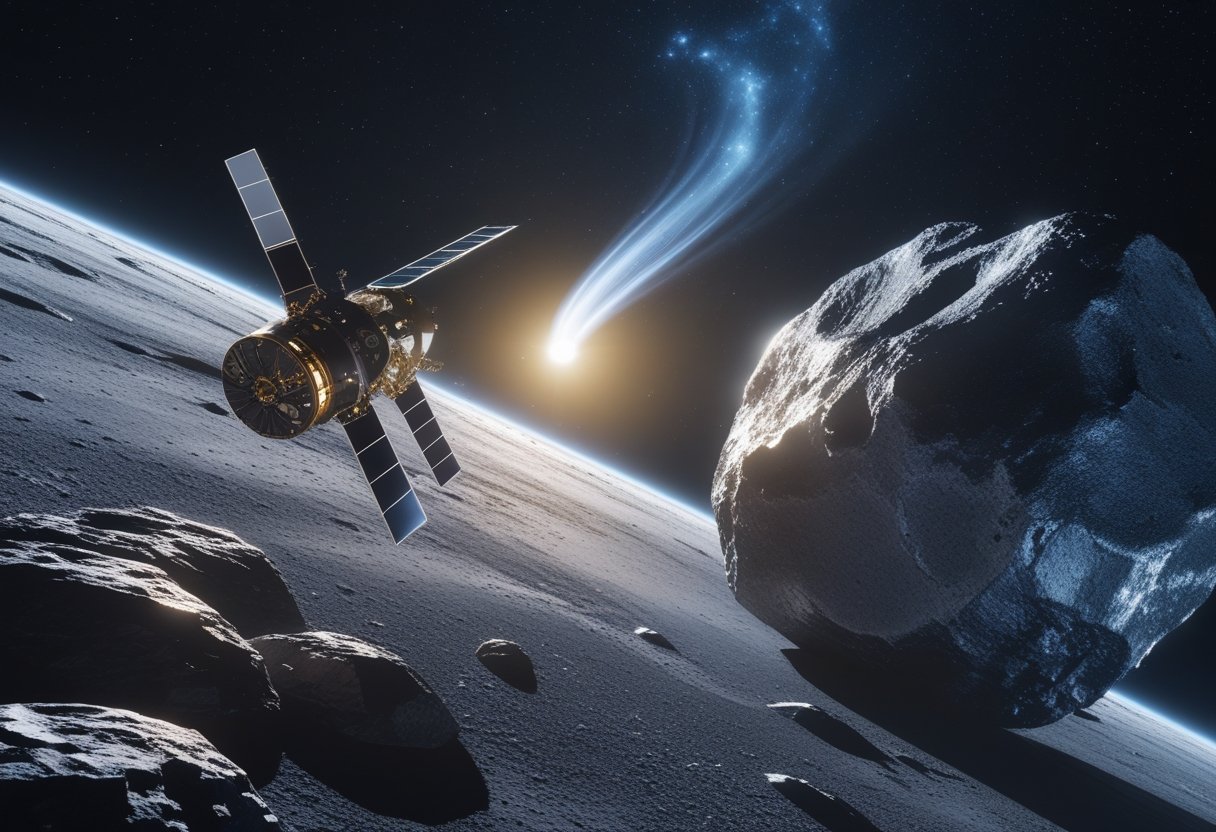
You’re about to follow a decade of missions that will reshape where humans go, what we can do off Earth, and what we know about the universe. From lunar landers and commercial stations to asteroid sample returns and deep-space voyagers, these missions will deliver new data, test critical technologies, and open pathways for future human presence beyond Earth.
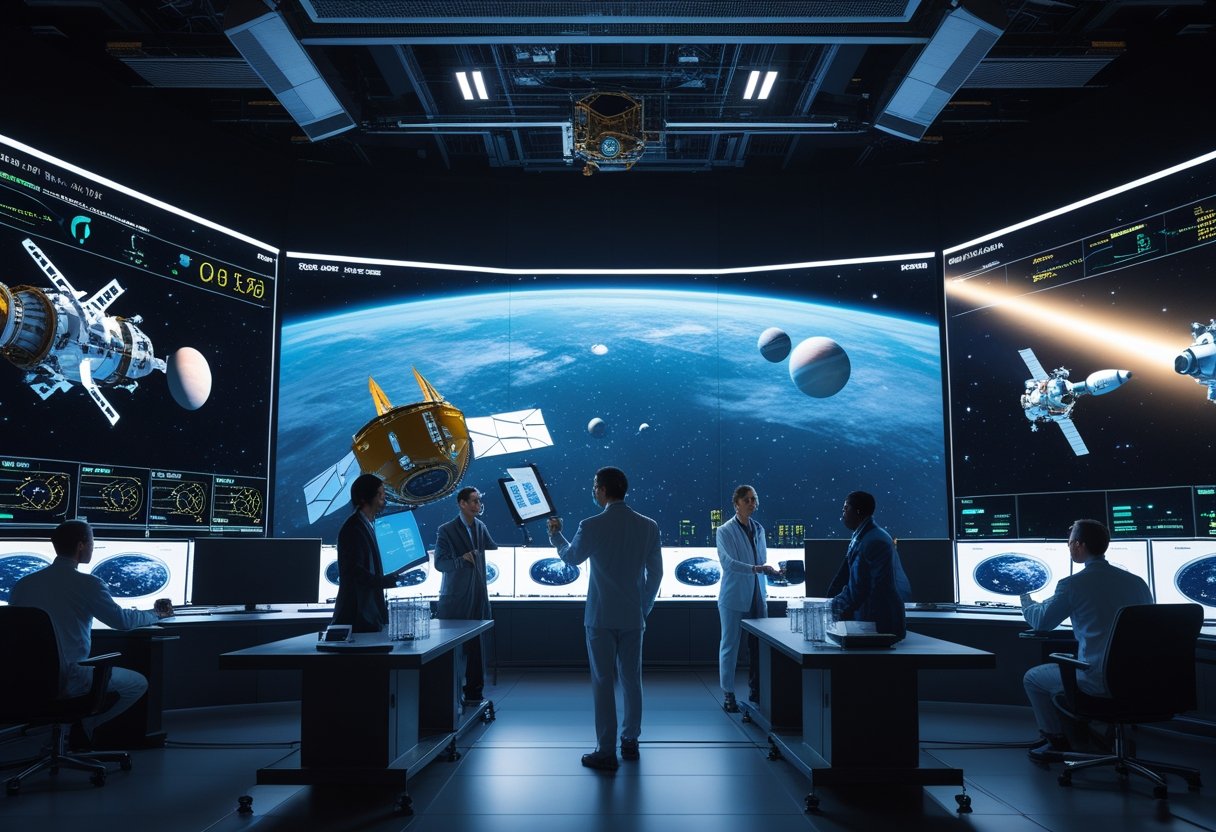
Expect focused coverage of lunar advances, asteroid and comet exploration, orbital infrastructure and commercial ventures, bold flybys and outer-planet probes, hardware demonstrations, and next-generation observatories that will rewrite parts of astronomy. The article maps what each mission aims to achieve, which ones matter most for science and exploration, and how their successes or failures will steer the next wave of human and robotic activity in space.
You’ll get concise mission highlights, clear explanations of why they matter, and timelines to watch so you can track breakthroughs as they happen. Follow along to see how individual missions link together into a broader push toward sustained lunar operations, deeper planetary science, and new cosmic discoveries.
Pioneering Lunar Missions
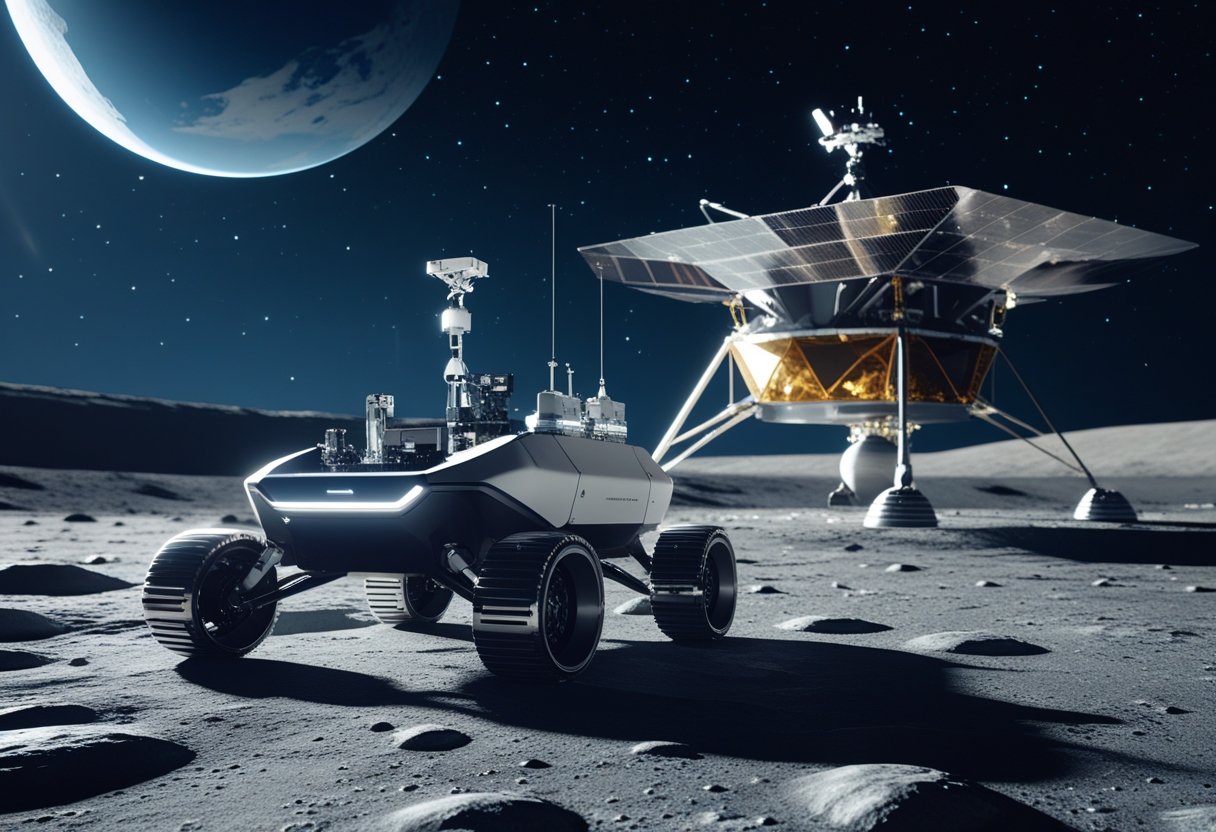
You will read about crewed return plans, commercial cargo and science deliveries, and international sample-return and technology demonstrations that aim to map lunar resources and test new landing systems. Expect details on timelines, key hardware, and the scientific or operational goals that matter for future exploration.
Artemis Program and Artemis III
Artemis III intends to land astronauts near the lunar south pole, returning humans to the surface for the first time since 1972. NASA plans to use Orion for transit and a Human Landing System (HLS) to descend to the surface; SpaceX’s Starship HLS is the current contractor selected to provide the lander element for the mission.
You should note schedule sensitivity: Artemis III slipped beyond initial targets and now depends on Starship orbital and in-space refueling demonstrations before a crewed lunar landing can proceed.
Primary mission goals emphasize a sustained presence: conducting long-duration surface operations, deploying science instruments to study lunar geology, and prospecting for water ice at permanently shadowed regions.
Artemis III will also test surface systems that support later missions, including mobility, power, and habitat precursors to help you understand how NASA plans to scale lunar exploration.
Commercial Lunar Payload Services (CLPS) Endeavors
CLPS buys recurring cargo and science deliveries from private companies to place instruments on the Moon. You’ll see multiple providers—Intuitive Machines, Firefly Aerospace, and Astrobotic among them—each offering landers that carry science payloads, technology demos, and site surveys.
Intuitive Machines’ IM-2 targets the lunar south pole with the PRIME-1 prospecting experiment and micro-rover technology to search for water ice and test sampling hardware. Firefly’s Blue Ghost aims for mare regions with payloads focused on surface composition and environment measurements. Astrobotic’s Griffin will deliver science and rovers near polar shadowed zones.
CLPS missions prioritize frequent, lower-cost access to the surface so you can get more data on lunar geology and resource distribution faster than with traditional government-only missions.
Expect CLPS deliveries to provide crucial ground truth—ground-penetrating radar, spectrometers, and prospecting drills—that directly inform future human operations and commerce.
International Lunar Expeditions: M2/Resilience and Chang’e 6
The M2/Resilience mission (also called Hakuto-R Mission 2) is an international commercial-led landing that carries the Resilience lander and small rovers to target scientifically interesting lunar terrain. You should pay attention to payloads focused on geology and technology validation, including rovers intended for mobility in challenging regolith and instruments to characterize local volatiles.
China’s Chang’e 6 plans to return samples from the lunar far side, targeting material that offers contrast to previous returned samples. Chang’e 6 will advance your knowledge of lunar heterogeneity and impact history by delivering new rock and regolith to Earth laboratories.
Both missions push sample-return and remote-site access capabilities: M2/Resilience demonstrates commercial partnerships and payload diversity, while Chang’e 6 showcases national capability in complex sample-return operations.
The outcomes will directly affect where you might prospect for water ice and which landing sites offer scientifically valuable and operationally safe terrain.
Innovative Lunar Landers and Rovers
New lander designs—from large crew-capable systems like Starship HLS to smaller commercial craft such as Intuitive Machines’ Nova-C and Firefly’s Blue Ghost—show how varied lunar delivery approaches will be. You will see differences in payload capacity, precision-landing tech, and surface endurance that determine mission types.
Rovers accompanying these landers range from micro-rovers to medium-class explorers. Some will test drilling and sample caching; others will map subsurface ice with spectrometers and ground-penetrating radar. The canceled VIPER ride-along highlighted how program changes affect payload assignments, but CLPS and commercial firms continue to design rovers that directly support resource prospecting.
Technical innovations to watch include autonomous hazard avoidance, compact coring drills for volatile sampling, and low-power heat management for operations near permanently shadowed regions.
These platforms will provide the practical data you need on lunar resources, helping determine where to place habitats, power systems, and future ISRU demonstrations.
Groundbreaking Asteroid and Comet Exploration
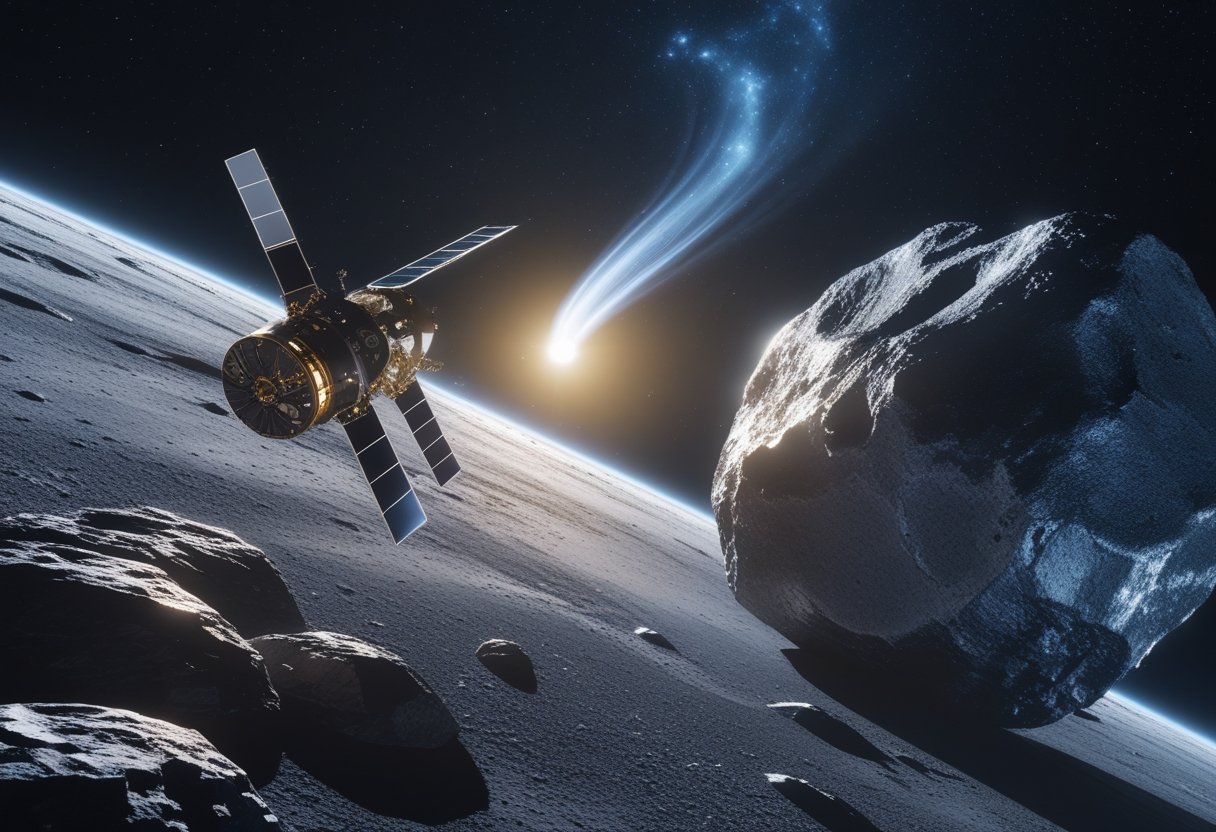
You will see missions that collect samples, test planetary defense techniques, and study small bodies that bridge asteroids and comets. These projects aim to reveal solar system origins and reduce impact risk while demonstrating new technologies.
Tianwen-2 Asteroid Sample Return
China’s Tianwen-2 targets asteroid 2016 HO3 then comet 311P/PANSTARRS, with a primary goal of returning asteroid samples to Earth around 2027. The probe carries instruments for remote sensing, in-situ analysis, and a sample-return capsule designed for weak-gravity surface sampling.
You should note the mission emphasizes autonomous navigation and deep-space orbit transfers to handle complex rendezvous and sampling from a small, low-gravity body. Tianwen-2 plans multiple mission phases: approach, touch-and-go sampling, sample stowage, and a trajectory to return samples for laboratory study.
Returned material will let you compare primitive asteroid composition with meteorites and other returned samples, improving models of early solar-system chemistry and volatile delivery.
Planetary Defense and Asteroid Deflection
Planetary defense in 2025–2030 centers on testing kinetic impact and characterizing targets to inform real deflection decisions. You will follow experiments that measure how impacting a small body changes its orbit and momentum transfer efficiency.
Key activities include precise tracking of target orbits, high-resolution mapping of surface properties, and post-impact ejecta measurement to quantify deflection. These measurements inform the delta-v needed to steer a hazardous near-Earth asteroid and reduce uncertainty in real-world response.
Work on planetary defense also tightens collaboration between agencies, improves ground-based detection networks, and develops decision frameworks so you can expect faster, evidence-based mitigation planning.
Didymos and Dimorphos Binary Asteroid Studies
The Didymos–Dimorphos system serves as the primary natural laboratory for kinetic deflection tests. Dimorphos, a ~160-meter moonlet orbiting Didymos, hosted the DART impact and will be observed by follow-up missions such as ESA’s Hera.
You will get high-fidelity post-impact data: orbit period change, ejecta mass, and surface disruption levels. Hera will map craters, measure internal structure with radar, and deploy small landers to take in-situ measurements.
These observations let you connect impact conditions to orbital response directly, validating models you would use if a real hazardous object threatened Earth and improving predictions for different asteroid types and sizes.
Exploring Main-Belt Comets and Near-Earth Asteroids
Studying main-belt comets and objects like 469219 Kamoʻoalewa bridges cometary activity and asteroidal composition. You will learn how volatile-rich bodies behave in asteroid-like orbits and how activity affects surface evolution and transport of water and organics.
Missions sampling or remotely sensing main-belt comets (including targets such as 311P/PANSTARRS in mission plans) and near-Earth asteroids gather data on dust production, ice distribution, and regolith properties.
That data helps you assess resources for in-space utilization and refines models of how small-body populations delivered volatiles to Earth.
Expanding Space Stations and Commercial Orbital Ventures
You will see sustained research aboard a long-running orbital laboratory, faster private-built stations aiming to replace it, and increasing commercial crew flights and tourist visits that test the business case for low Earth orbit.
International Space Station: Ongoing Research
You can still use the International Space Station as a microgravity testbed through at least 2030. NASA plans continued science operations, crew rotations, and technology demonstrations that support human health studies, materials processing, and orbital servicing techniques. Expect experiments in long-duration biology and radiation mitigation that directly inform Artemis and Mars mission planning.
Operational logistics matter: the station’s manifest, cargo deliveries, and docking windows will constrain experiment timelines. You should note that the ISS also serves as a platform for commercial payloads and private astronaut missions, so research priorities will increasingly intersect with commercial partners’ objectives.
Rise of Commercial Space Stations and Tourism
You will see multiple commercial station designs moving toward in-orbit demonstration and eventual crewed operations to replace the ISS platform. NASA’s Commercial LEO Destinations strategy supports industry development through phased Space Act Agreements and competitive selections. Those agreements aim to reduce transition gaps and enable NASA and private customers to purchase station services.
Commercial stations target science, manufacturing, and multi-day tourist stays. Companies emphasize modularity, upgradability, and private-sector business models to host researchers, national labs, and paying visitors. This shift expands opportunities for short-stay tourism while keeping research continuity in low Earth orbit.
Axiom Missions and the Future of Private Astronaut Flights
You can expect Axiom to continue flying private missions that blend tourism, corporate research, and film or outreach activities. Axiom Mission 3 and follow-on flights will demonstrate commercial mission ops, private crew training pipelines, and integration of commercial modules with the ISS before free-flying transitions. Those missions validate life-support logistics, payload integration, and crew-rotation procedures for private stations.
Axiom’s approach establishes operational precedents: commercial mission planning, liability frameworks, and on-orbit hospitality standards. For you as a researcher, entrepreneur, or tourist, those precedents lower barriers to booking a stay, flying experiments, or contracting station time once private habitats achieve independent operations.
Deep Space Exploration and Ambitious Flybys
You will see missions that probe ocean worlds, study Jupiter’s neighborhood, and use precise gravity assists to reach distant goals. Expect detailed instruments, timed flybys, and risky maneuvers that aim to answer whether habitable environments exist beyond Earth.
Europa Clipper and Jupiter’s Icy Moons
Europa Clipper will perform repeated close passes of Europa to map the ice shell, characterize subsurface water, and search for biosignatures. You’ll follow dozens of targeted flybys from a long, elliptical Jupiter orbit; instruments like the ice-penetrating radar, mass spectrometer, and plasma analyzer will measure ice thickness, plume composition, and surface chemistry.
The mission emphasizes atmosphere and plume detection. If you want evidence of exchange between Europa’s ocean and surface, Clipper’s plume searches and high-resolution imaging matter most. The dataset will also guide future lander concepts by identifying safe landing zones and accessible materials for in-situ analysis.
JUICE and Jupiter Trojan Asteroids
JUICE (JUpiter ICy moons Explorer) will focus on Ganymede, Callisto, and Europa from a European perspective, culminating in a long Ganymede orbit that lets you study its magnetosphere and ice-shell structure in depth. JUICE’s payload — including radar, spectrometers, and a magnetometer — will probe internal oceans and surface composition across multiple moons.
Nearby, missions and observations of Jupiter Trojan asteroids will inform your understanding of Solar System formation. JUICE’s comparative approach helps you place Trojan composition and dynamics in context, revealing how primitive bodies contrast with the icy Galilean moons. Expect combined results to refine models of volatile delivery and early planetary migration.
Solar System Flybys and Gravity Assists
Solar system flybys and gravity assists remain crucial tools to send spacecraft far with limited fuel. You’ll see carefully plotted Earth, Venus, and Jupiter gravity assists used to change speed and inclination without heavy propellant costs. These maneuvers let missions reach outer-planet targets and perform high-energy flybys you couldn’t otherwise afford.
For mission planning, timing and alignment matter more than raw delta-v. You’ll note trade-offs: longer cruise times versus higher payload mass, and the need for radiation-tolerant design when using Jupiter assists. Precise navigation during flybys also enables close observations of small bodies and opportunistic science at planets and moons along the trajectory.
Juno’s Final Act and Outer Planets
Juno’s extended mission will continue characterizing Jupiter’s gravity field, interior structure, and polar magnetosphere while providing context for Clipper and JUICE. You’ll get refined gravity and magnetic maps that help interpret how Jupiter’s formation influenced its moons’ evolution.
Beyond Jupiter, planned outer-planet flybys and proposed missions aim to visit Uranus, Neptune, and their moons in the late 2020s and 2030s. These campaigns rely on earlier gravity-assist paths and the lessons you’ll learn from Juno, Clipper, and JUICE about instrumentation, radiation shielding, and long-duration operations in deep space.
Transformative Spacecraft, Vehicles, and Technology Demonstrations
You’ll see systems that aim to cut launch costs, enable sustained lunar access, and expand robotic capability across airless and atmospheric bodies. Expect major tests of full reusability, uncrewed spaceplanes for routine cargo, and precision landers with advanced mobility and sampling gear.
SpaceX Starship and Reusable Vehicles
You’ll track Starship as it pursues orbital reusability and long‑duration propellant transfer tests. Key near‑term goals include staged orbital flights, an orbital refueling demonstration where two Starships dock and transfer propellant, and an uncrewed lunar Starship test that validates the Starship Human Landing System architecture for crewed Artemis missions.
Your interest should focus on three performance metrics: rapid turnaround of the first stage and second stage, successful cryogenic propellant transfer in orbit, and precision guidance for high‑energy lunar insertion. Those capabilities together determine whether Starship can deliver large payloads to the Moon, Mars, or low Earth orbit at dramatically lower cost.
You’ll also watch other reusable designs (smaller reusable boosters and capsules) that complement Starship by servicing crews, cargo, and commercial stations until Starship’s cadence stabilizes.
ESA Space Rider and Uncrewed Spaceplanes
You’ll follow Space Rider as Europe’s reusable, unmanned spaceplane intended for routine low Earth orbit missions. Space Rider will return payloads autonomously to Earth using a lifting body and parachute‑assisted landing, giving you low‑cost, frequent access for microgravity experiments and satellite servicing technology demonstrations.
Pay attention to payload accommodation (several hundred kilograms), on‑orbit duration targets, and the reusable service module’s refurbishment cycle. Those factors determine turnaround time and cost per flight for institutional and commercial users.
Uncrewed spaceplanes from other providers aim for similar capabilities: rapid reuse, gentle reentry for sensitive experiments, and runway or soft‑landing recovery. They’re positioned to bridge short‑term cargo demands ahead of larger commercial stations.
Robotic Exploration Tools and Advanced Landers
You’ll notice precision landers and mobile robots improving sample return and in‑situ science. Expect landers with pinpoint navigation, autonomous hazard avoidance, and small hoppers or rovers that extend reach from a single touchdown site. Instruments increasingly include drills, miniaturized mass spectrometers, and acoustic/thermal sensors for subsurface detection.
China’s Zhuque‑3 and other heavy‑lift rockets enable larger payloads and complex landers; watch how payload capacity translates into multi‑instrument suites and sample‑return architecture. Robotic tools now emphasize modularity: swap sensors or mobility elements without rebuilding the whole lander.
These advances let you obtain targeted samples, map volatile deposits, and scout human landing sites with greater confidence, reducing mission risk for subsequent crewed operations.
Revolutionary Astronomy and Cosmic Discoveries
You will learn how near-infrared all-sky mapping, targeted deep-field spectroscopy, and new spectro-photometer techniques will reshape what we know about galaxy formation, cosmic ice, and star birth. Expect precise measurements that link the universe’s large-scale structure to environments where stars and planets form.
SPHEREx Mission: Mapping the Universe’s History
SPHEREx will perform a near-infrared all-sky spectroscopic survey that measures low-resolution spectra for hundreds of millions of galaxies and millions of Milky Way stars. You get a 3D map of large-scale structure useful for constraining inflation-era physics and tracking where cosmic ice — including water-bearing ices — concentrates across galactic environments.
The mission’s spectral bands target 0.75–5.0 µm, letting you detect broad molecular signatures and redshifted features out to high z. SPHEREx’s uniform survey strategy complements deep but narrow missions by providing statistical samples needed for population-level studies.
Because SPHEREx returns spectrophotometry rather than single-band photometry, you can separate stellar populations, dust emission, and ices across billions of sources. That improves models of how and when galaxies built their stars and where volatile-rich material — the feedstock for planetary systems — accumulates.
James Webb Space Telescope’s Next Era
JWST continues to deliver targeted deep spectroscopy and high-resolution imaging across 0.6–28 µm, letting you probe the first galaxies, chemical abundances, and protoplanetary disks with unmatched sensitivity. Your observations of rest-frame ultraviolet and optical lines at high redshift reveal star-formation rates, ionization states, and early metal enrichment.
For nearby objects, JWST resolves stellar nurseries and protoplanetary disks, revealing dust grain growth, disk substructure, and molecular lines that trace planet-forming chemistry. You benefit from JWST’s synergy with wide surveys: it follows up SPHEREx-selected targets for detailed chemical and kinematic study.
Planned observation campaigns will push JWST into systematic surveys of early galaxy mass assembly and the conditions inside dense star-forming clumps, giving you direct constraints on how the first generations of stars and black holes shaped their environments.
Spectro-Photometer Innovations and Stellar Nurseries Insights
Spectro-photometers like SPHEREx combine low-resolution spectra with wide-area coverage to bridge surveys and deep-pointed instruments. You gain photometric precision across dozens of narrow spectral channels instead of broad filters, improving redshift estimates and molecular identification for faint sources.
In star-forming regions, these instruments detect key ice and molecular absorption features that indicate dust temperature and composition. That helps you map where stellar nurseries harbor icy grains versus thermally processed dust, which in turn affects planetesimal formation.
New detector technology and calibration strategies reduce systematic errors, letting you compare populations across the sky. Coupling this with JWST’s high-resolution spectra creates a workflow: identify statistically interesting targets with spectro-photometry, then characterize physical conditions and chemistry with JWST.
The Future of Space Exploration and Human Endeavors
You will see rapid growth in private launch services, commercial stations, and lunar resource efforts that change mission planning, funding, and crew roles. Expect specific technologies—refueling in orbit, reusable spaceplanes, and commercial landers—to determine which missions scale and which remain one-offs.
Space Accessibility and the Commercial Revolution
You can book cargo and crew flights more often as companies lower per-launch costs with reusable rockets and competitive small-launch markets. Firms like SpaceX test in-orbit refueling to extend Starship range, while commercial space stations (e.g., Haven-1) and vehicles such as Dream Chaser increase cadence for research and tourism.
Your access depends on regulatory approvals, FAA and international licensing, and commercial partnerships with agencies that buy rides or science payloads. Watch for service offerings: short-duration tourist missions, dedicated microgravity labs, and mission-specific rideshare contracts that let universities and startups fly experiments at lower cost.
Key mechanics you should track:
- reusable first stages and spaceplanes that cut marginal cost;
- in-orbit refueling demonstrations enabling long-range cargo and crew missions;
- commercial lunar payload services (CLPS) that buy lander capacity to place instruments on the Moon.
Next Steps for Lunar Resources and Sustainability
You should expect CLPS-style deliveries to increase sample returns and prospecting for water ice in permanently shadowed regions. Landers like Griffin and Nova-C variants aim to deliver rovers and instruments to map volatiles and measure regolith properties relevant to water extraction and construction.
Your future lunar bases will rely on three practical advances: reliable prospecting (ground truth of ice concentration), ISRU demonstrations (water extraction and oxygen production), and construction tests (3D printing regolith into habitats). Companies and agencies will run incremental experiments—drilling, heating regolith, and making oxygen—that validate processing rates and energy needs for local propellant and life support.
You should monitor commercial contracts and payload manifests because private deliveries determine how quickly technology moves from lab to field. Tools that prove resource yield per ton of regolith will directly affect mission architectures and logistics.
Long-Term Vision: Mars and Beyond
You will see Mars remain the strategic long-term goal, with near-term activity focused on communications, sample return groundwork, and propulsion advances. Nuclear thermal and advanced electric propulsion work could shorten transit times and reduce propellant mass for crewed missions.
Your path to Mars will use staged capabilities: reliable Earth-to-orbit transport, orbital refueling, validated ISRU on the Moon, and long-duration life-support tech tested on commercial stations. Autonomous precursor missions will refine entry, descent, and landing systems and test habitats for radiation shielding and closed-loop life support.
Watch for milestones that shift feasibility: successful nuclear propulsion tests, scalable ISRU demonstrations, and repeated long-duration human operations in cislunar space. Each confirmed capability lowers risk and cost for sustained human presence beyond Earth.
Leave a Reply