
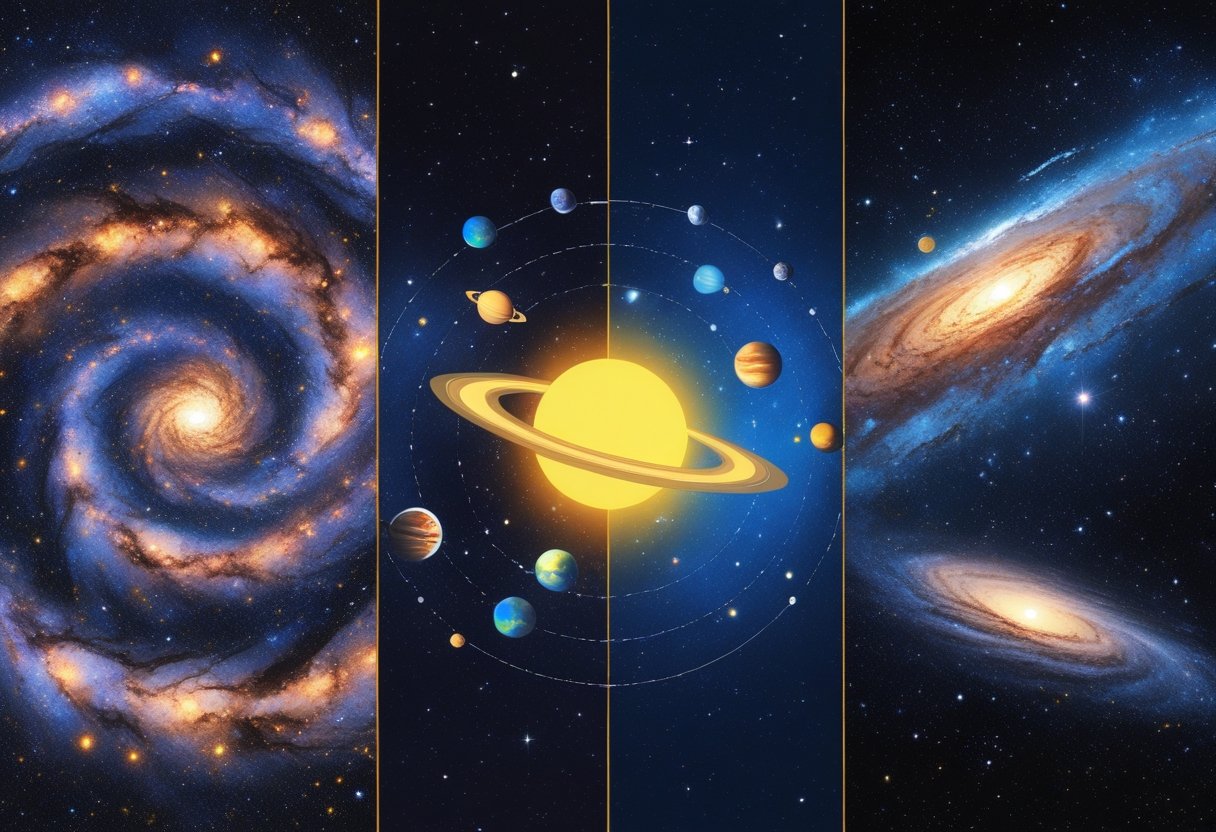
You already know the night sky sparks curiosity, but you might not know how small the Solar System is compared to a galaxy or the universe. I’ll show you the clear differences so you can point to the right scale and meaning when you look up tonight. The Solar System is the Sun and its orbiting bodies, a galaxy is a vast collection of stars (including many solar systems), and the universe contains all galaxies and everything in space and time.
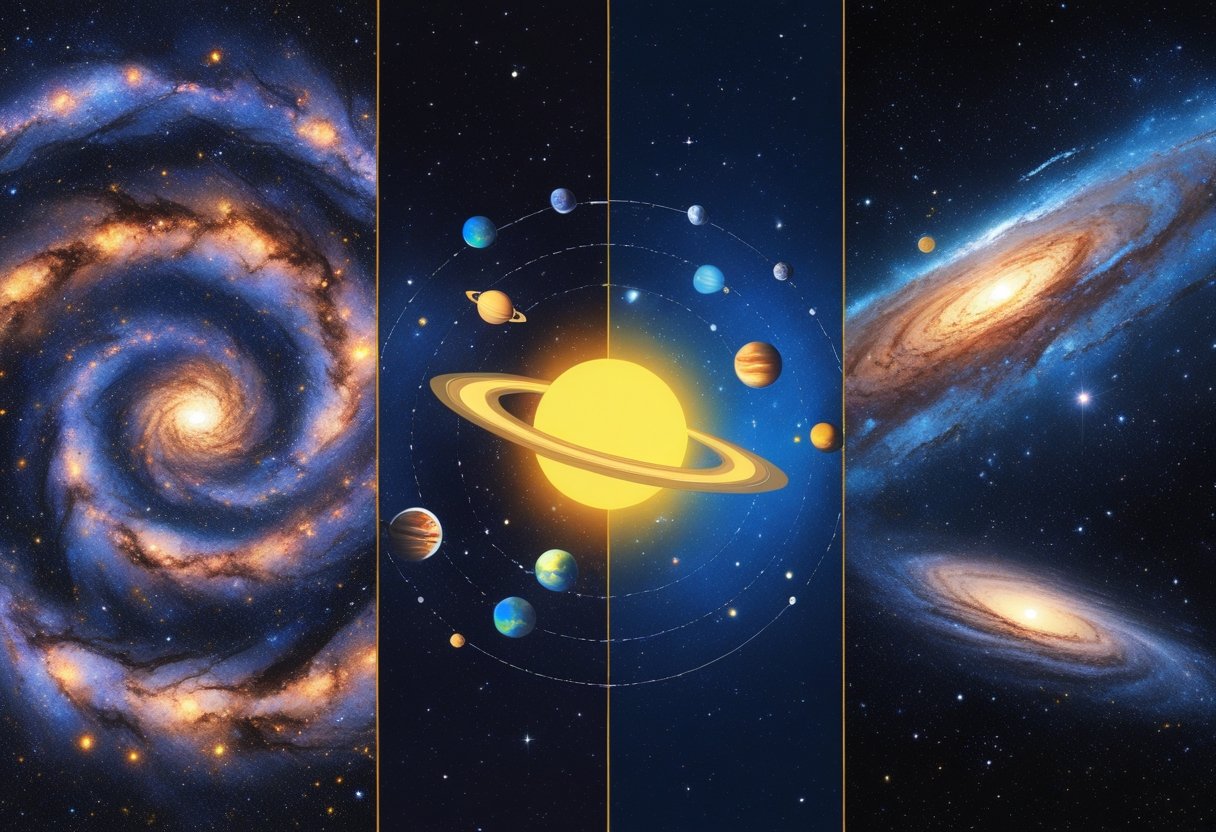
I’ll walk you through how each level fits inside the next and why that ordering matters for everything from planetary motion to the limits of what we can observe. Expect concrete size comparisons and simple analogies that make the distances and structures feel understandable without oversimplifying.
Key Takeaways
- I define the three cosmic scales and how they relate.
- I explain where the Solar System fits inside a galaxy.
- I clarify what makes the universe larger than any single galaxy.
Understanding the Fundamental Differences
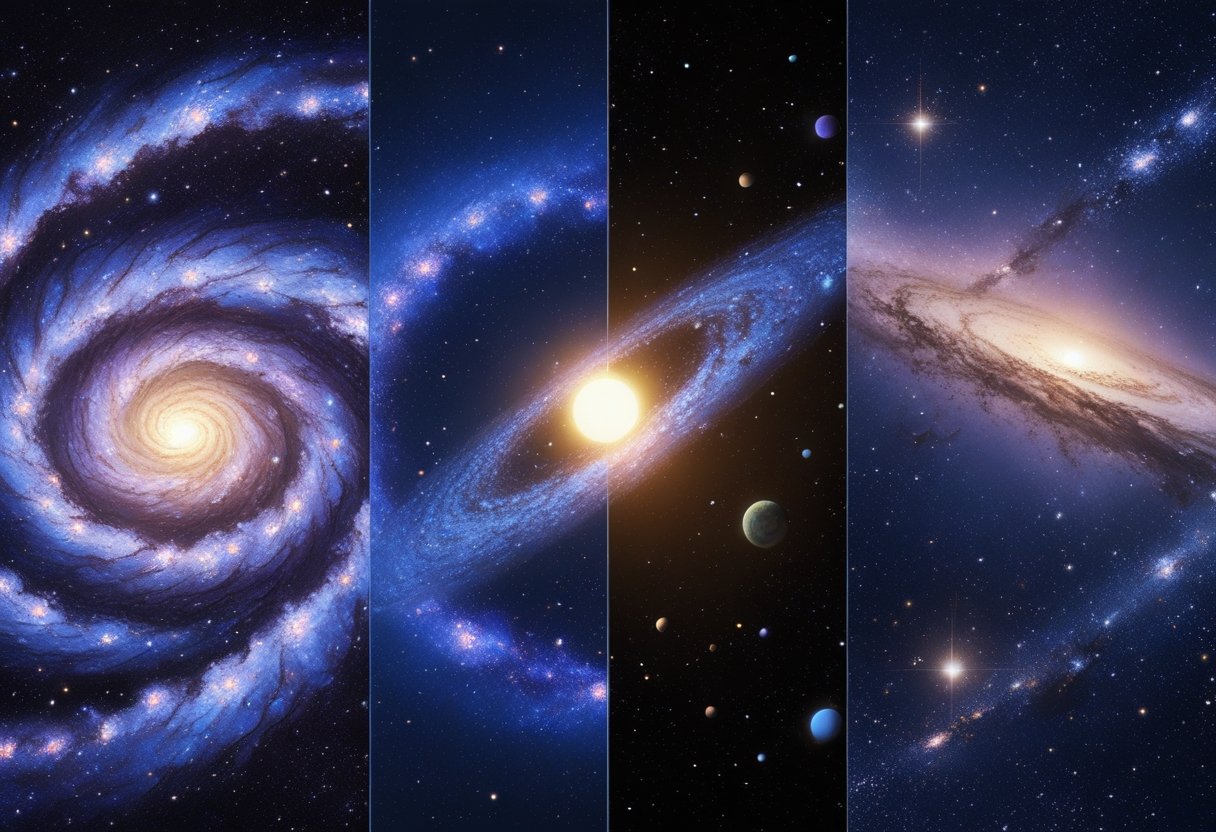
I will define each term precisely, compare their sizes with concrete examples, and show how they nest inside one another to form a clear cosmic hierarchy.
Definition of Terms
I define a solar system as a star and all objects gravitationally bound to it: planets, moons, asteroids, comets, dust, and gas. Our Solar System centers on the Sun and includes eight planets, dwarf planets like Pluto, and small-body populations such as the Kuiper Belt and Oort Cloud.
I define a galaxy as a gravitationally bound collection of billions of stars, their planetary systems, interstellar gas and dust, and dark matter. The Milky Way contains roughly 200–400 billion stars and many distinct stellar populations and gas clouds that form new stars.
I define the universe as the totality of space, time, matter, and energy — all galaxies, intergalactic gas, radiation, and dark components. When I use “astronomical system” I mean any organized gravitational system at a given scale: a solar system, star cluster, or galaxy.
Comparative Scale and Size
I compare sizes using familiar measures. The Solar System’s planetary zone (to Neptune) spans about 30 astronomical units (AU); including the distant Oort Cloud extends to ~100,000 AU (~1.6 light-years). That still sits well inside a single galaxy.
A typical galaxy spans tens of thousands to a few hundred thousand light-years across. The Milky Way is about 100,000 light-years in diameter and hosts hundreds of billions of stars and many solar systems. I note that galaxies vary hugely: dwarf galaxies contain millions of stars, while giants like Andromeda are larger than the Milky Way.
The observable universe reaches ~93 billion light-years in diameter. It contains hundreds of billions of galaxies. I avoid claiming knowledge beyond the observable portion; measurements rely on light travel time and cosmological models.
Hierarchical Structure
I lay out the nesting order clearly. At the smallest practical astronomical scale relevant here, planets orbit stars to form solar systems. Multiple solar systems reside in stellar neighborhoods, which in turn are components of a galaxy’s disk, bulge, or halo.
Galaxies cluster by gravity into groups and clusters; those groups form filaments and walls in the cosmic web, separated by voids. The universe comprises that entire network plus the background expansion of space and cosmological phenomena like the cosmic microwave background.
I emphasize that gravity governs structure formation at each level, while different physical processes dominate at different scales: planetary dynamics within solar systems, stellar evolution and gas dynamics inside galaxies, and cosmological expansion across intergalactic distances.
Links for further detail: a NASA primer on the differences between Solar System, Galaxy, and Universe and an overview of how solar systems and galaxies compare.
Exploring the Solar System
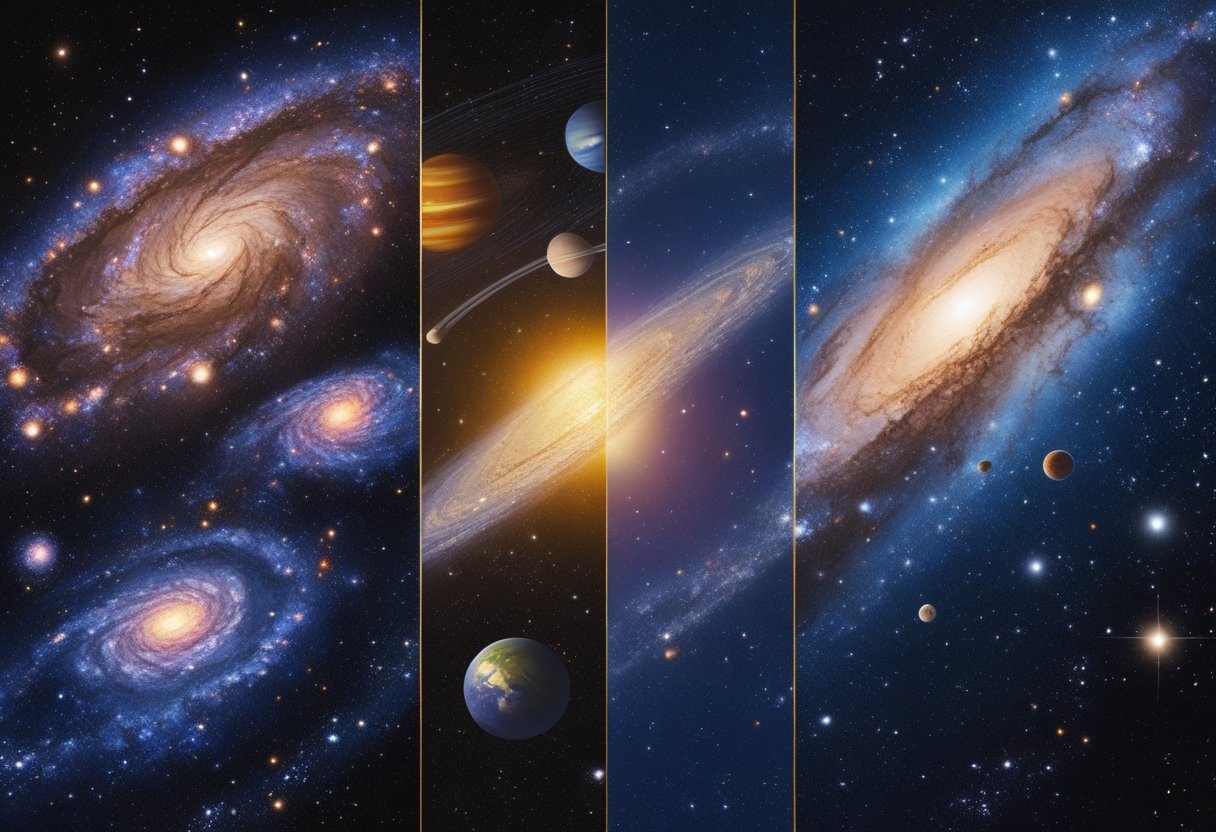
I describe the Solar System as a gravitationally bound family centered on the Sun, containing eight major planets, dozens of dwarf planets and moons, and countless small bodies. I focus on composition, the Sun’s role, the variety of planets and smaller objects, and how the system formed about 4.6 billion years ago.
Composition and Components
I list the Solar System’s main components: the Sun, eight planets, five recognized dwarf planets (including Pluto), moons, asteroids, comets, meteoroids, and reservoirs like the Kuiper Belt and Oort Cloud. The Sun contains about 99.8% of the system’s mass and is the dominant gravitational anchor; planets, moons, and small bodies orbit it.
Composition varies by region. Inner planets (Mercury, Venus, Earth, Mars) have rock and metal, thin atmospheres on some, and higher densities. Outer planets (Jupiter, Saturn, Uranus, Neptune) are gas or ice giants with thick hydrogen/helium envelopes or volatile-rich interiors. Asteroids concentrate in the main belt between Mars and Jupiter. The Kuiper Belt beyond Neptune holds icy bodies and dwarf planets. Comets originate from distant, cold reservoirs and release gas and dust when heated.
Key materials: rock, metal, ices (water, CO2, methane), hydrogen, helium, and minor organics. I highlight that meteoroids range from dust to meter-scale fragments and become meteors when entering Earth’s atmosphere.
The Sun and Its Influence
I describe the Sun as a G-type main-sequence star (Sol) powered by nuclear fusion in its core, converting hydrogen to helium and producing the energy that drives the Solar System. The Sun’s energy output sets planetary climates, powers weather systems on Earth, and controls photochemistry in atmospheres.
Gravity from the Sun defines orbits and keeps planets, comets, and asteroids bound. Solar wind and the heliosphere shape space weather; charged particles from the Sun interact with planetary magnetospheres and can cause auroras and radiation hazards for spacecraft. Solar activity varies in approximately 11-year cycles, affecting satellite operations and radio communications. I note solar luminosity has increased slowly over the Sun’s 4.6 billion-year lifetime, influencing long-term climate trends on Earth.
Planets, Moons, and Smaller Bodies
I cover the eight planets grouped by type: terrestrial (Mercury, Venus, Earth, Mars) and giant planets (Jupiter, Saturn, Uranus, Neptune). Earth is the only known world with stable surface liquid water and life; it has one large moon that stabilizes axial tilt. Jupiter and Saturn dominate the system’s dynamics; Jupiter’s gravity scatters and captures small bodies, influencing impact rates on inner planets.
Moons vary from tiny captured rocks to large worlds like Ganymede and Titan, which have complex geology and atmospheres. Dwarf planets (Pluto, Eris, Haumea, Makemake, Ceres) occupy orbits in the Kuiper Belt and asteroid belt. Asteroids are primarily rocky bodies; comets are ice-rich and develop comae and tails when near the Sun. Meteoroids striking Earth become meteors and, if they reach the surface, meteorites. I emphasize orbital parameters—semi-major axis, eccentricity, inclination—control where bodies reside and how they interact.
Formation and Age
I explain that the Solar System formed about 4.6 billion years ago from a collapsing molecular cloud. Conservation of angular momentum produced a rotating protoplanetary disk; solids condensed from cooling gas and stuck together through collisions to form planetesimals. Planetesimals accreted into protoplanets; in the outer disk, rapid gas accretion produced giant planets before the solar nebula dissipated.
I note processes that shaped final architecture: planetary migration (especially of giant planets), resonances, and late heavy bombardment-like events that delivered water and organics to terrestrial worlds. Radioisotope dating of meteorites yields the ~4.56 Ga age for the earliest solid material. I highlight that ongoing impacts, tectonics, and interior heat continue to evolve planets and moons, while distant reservoirs like the Kuiper Belt preserve primitive material from the Solar System’s formation.
Inside a Galaxy
I describe how galaxies hold stars, gas, dust, dark matter, and central black holes and how these components shape structure, motion, and star formation across tens to hundreds of thousands of light-years.
Structure and Types of Galaxies
Galaxies are gravitationally bound systems that come in main morphological classes: spiral, barred spiral, elliptical, and irregular.
Spiral and barred spiral galaxies show flattened disks with spiral arms where interstellar gas and dust concentrate, driving ongoing star formation.
Ellipticals are more spheroidal, dominated by older stars and far less cold gas, so new star formation is limited.
Irregular galaxies, like the Small Magellanic Cloud, lack ordered structure and often show disturbed gas from interactions.
Galaxy sizes vary widely; typical large spirals span ~100,000 light-years across, while dwarfs can be orders of magnitude smaller.
Interactions and mergers reshape morphology and can trigger starbursts or feed central black holes, altering a galaxy’s evolutionary path.
The Milky Way: Our Home Galaxy
I live in the Milky Way Galaxy, a barred spiral roughly 100,000 light-years in diameter with a central bar and several spiral arms.
The disk contains most of the galaxy’s interstellar gas and young stars; the bulge around the center hosts older stars and dense stellar populations.
Sagittarius A* sits at our galactic center as a supermassive black hole with a mass of about four million suns, influencing orbits in the inner parsecs.
The Milky Way belongs to the Local Group, which includes the Andromeda Galaxy and several dwarf companions.
Tidal streams and the Magellanic Clouds show past and ongoing interactions, which stir gas and can seed new star formation in the disk and halo.
Star Systems and Stellar Remnants
Within a galaxy, stars form in molecular clouds concentrated along spiral arms where gas density and cooling favor collapse.
Individual star systems — like our Solar System — orbit within the galactic potential and trace the rotation curve of the disk.
Massive stars end as supernovae, leaving neutron stars or black holes; low‑mass stars become white dwarfs.
Stellar remnants populate the bulge, halo, and disk, contributing to the galaxy’s mass and chemical enrichment through past explosions.
A table of common stellar endpoints:
- White dwarf: remnant of low‑mass stars
- Neutron star: remnant of 8–20 solar mass progenitors
- Stellar black hole: remnant of the most massive stars
These remnants, plus active star formation regions, determine a galaxy’s luminous and chemical evolution over billions of years.
Dark Matter and Galactic Dynamics
Dark matter provides most of a galaxy’s mass and dominates its gravitational potential despite being invisible in light.
Rotation curves of spiral galaxies remain flat at large radii, implying a massive dark matter halo extending well beyond the visible disk.
This halo shapes orbital motions of stars, satellite galaxies, and gas, and it stabilizes disks against tidal disruption.
Dark matter also guides galaxy assembly: halos merge and attract baryonic gas, setting sites for star formation and for growth of central black holes.
Understanding dark matter distribution remains crucial to explaining how galaxies like the Milky Way and the Andromeda Galaxy formed and evolved.
The Vastness of the Universe
I describe how space, time, matter, and energy combine across scales from singularities to superclusters. You will read about what the universe contains, how it began, how it grows, and the limits set by what we can observe.
What the Universe Encompasses
I mean the universe as the totality of space, time, matter, and energy — every galaxy, star, planet, and particle within the cosmic web. That includes not just visible matter but dark matter and dark energy, which together dominate the universe’s mass–energy budget and shape gravitational behavior on large scales.
Galaxies group into clusters and clusters into superclusters such as the Laniakea Supercluster that contains the Milky Way. Within galaxies are billions to hundreds of billions of stars, and each star can host its own solar system. I consider scales in concrete terms: individual solar systems (light-hours to light-days across), galaxies (tens to hundreds of thousands of light-years), and superclusters spanning hundreds of millions of light-years.
I track how matter and energy distribute: baryonic matter forms stars and planets; dark matter provides unseen mass that holds structures together; dark energy drives accelerated expansion. Together these components produce the cosmic web — filaments of galaxies separated by vast voids — which defines the universe’s large-scale architecture.
Origins: The Big Bang Theory
I refer to the Big Bang theory as the model that best explains the universe’s origin about 13.8 billion years ago. It describes an early hot, dense state that expanded and cooled, producing the cosmic microwave background and setting initial conditions for structure formation.
Early epochs included rapid particle interactions, nucleosynthesis that formed light elements, and recombination when atoms formed and photons decoupled. Tiny quantum fluctuations were stretched into the density variations that later grew into galaxies and clusters under gravity. The term singularity often appears in descriptions of the earliest moment; I note that physics there is incomplete — general relativity predicts infinite density, but quantum gravity effects should matter at that scale.
I emphasize testable evidence: the observed abundance of helium and deuterium, the uniform blackbody spectrum of the cosmic microwave background, and the large-scale distribution of galaxies all match predictions of the Big Bang framework. This makes the model central to modern cosmology.
Expansion and Structure
I explain that cosmic expansion means galaxies recede from one another as space itself stretches. Edwin Hubble’s measurements showed proportional recession speeds, now quantified by the Hubble constant, H0. Observations since the late 1990s revealed that expansion is accelerating, attributed to dark energy.
Structure forms hierarchically: small overdensities collapse first, merging into larger halos that host galaxies. Gravity sculpts the cosmic web of filaments, walls, and voids. I cite scale ranges: galaxy halos ~10^5–10^6 light-years, clusters ~1–10 million parsecs, superclusters like Laniakea extend ~100 million light-years or more.
Dark matter governs collapse on large scales; baryonic physics shapes visible features within galaxies. Dark energy acts uniformly to increase expansion rate, reducing the efficiency of gravity to assemble new large structures over time. This interplay of matter, energy, and expansion determines the universe’s evolving architecture.
Observable Universe and Limits
I define the observable universe as the spherical region from which light has reached me since the Big Bang, roughly 46.5 billion light-years in radius today. That limit arises from the finite speed of light and cosmic expansion, not from a physical edge to the universe itself.
Beyond the observable horizon may lie trillions more galaxies and possibly regions with different large-scale arrangements. I emphasize measurement limits: we infer matter and energy composition from radiation and gravitational effects, but we cannot directly observe regions beyond our particle horizon.
Practical consequences include cosmic variance — some large-scale features are unique to our observable patch — and uncertainties in global topology or total size. I note that ongoing surveys and missions refine parameters like H0 and dark energy’s equation of state, tightening but never fully removing the fundamental observational boundary set by light travel time.
Connections and Relationships
I explain how solar systems, galaxies, and the universe connect through location, scale, and gravity. I emphasize where each fits and how gravity controls motion and structure.
How Solar Systems Fit Within Galaxies
I place a solar system as a local arrangement of a single star and its orbiting celestial objects—planets, moons, asteroids, comets, and dust—bound primarily to their star’s gravity. In my Milky Way, the Sun and its planets occupy one of the galaxy’s spiral arms, roughly 26,000 light-years from the Galactic Center.
I note that solar systems are not evenly distributed; they cluster in star-forming regions and older stellar populations. Stellar density, nearby massive stars, and the local interstellar medium influence planet formation and long-term stability. Migrating stars and close encounters can perturb or even eject planets.
Key points:
- Solar systems are subunits of galaxies and share a galactic orbit.
- Local environment affects formation and evolution.
- Distances are measured in light-years; interactions are driven by gravity and occasional close stellar passes.
Galaxies as Building Blocks of the Universe
I treat galaxies as massive islands of stars, gas, dust, dark matter, and their embedded solar systems, spanning thousands to hundreds of thousands of light-years. My Milky Way contains hundreds of billions of stars; other galaxies can be smaller or far larger, and the universe contains billions of such galaxies.
Galaxies group into clusters and filaments, forming the cosmic web that structures the observable universe. Their distribution and motions record the history of cosmic expansion and dark matter influence. Collisions and mergers reshape galaxies, trigger star formation, and redistribute angular momentum and gas.
Important elements:
- Galaxies aggregate into clusters and superclusters across cosmic scales.
- Mergers drive morphological and star-formation changes.
- Understanding galaxies informs cosmic history and large-scale structure.
Gravitational Forces and Interactions
I focus on gravity as the primary force linking solar systems, galaxies, and the universe. Gravity binds planets to stars, holds galaxies together, and governs galaxy orbits within clusters. On different scales, gravity works with other factors—gas pressure, magnetic fields, and dark matter—to determine dynamics.
Interactions include:
- Planetary orbits and tidal effects within solar systems.
- Stellar encounters and perturbations altering planetary systems.
- Galactic tides, mergers, and cluster dynamics that redistribute mass.
I emphasize measurable consequences: orbital periods, tidal heating, galactic rotation curves, and merger-driven starbursts. These observables let me infer underlying mass distributions, including dark matter, and connect local celestial mechanics to cosmological structure.
Relevant reading on scale and definitions appears in the NASA overview of Solar System, Galaxy, Universe.
Observing and Studying the Cosmos
I focus on how astronomers use telescopes and measurements to map objects from planets to distant galaxies and how recent missions have changed what we can see.
Astronomers and Telescopic Discoveries
I watch professional and amateur astronomers use ground and space telescopes to gather light across wavelengths. Optical instruments reveal starlight and galaxy structure, while radio and infrared telescopes expose cold gas and dust that optical views miss. The Hubble Space Telescope produced deep-field images that resolved billions of galaxies in tiny patches of sky, changing estimates of galaxy counts and morphology.
I rely on diffraction-limited imaging and adaptive optics on large ground telescopes to resolve features in distant galaxies and exoplanet atmospheres. Spectrographs let me measure composition, velocities, and redshifts; those data reveal star formation rates and galaxy rotation curves.
Amateur sky surveys and coordinated networks continue to find transient events—supernovae, near-Earth asteroids—that professional teams then follow up with space-based assets like the James Webb Space Telescope for infrared detail.
Measuring Distances: Light-Years and Beyond
I use the light-year as a convenient unit: one light-year equals the distance light travels in one Julian year (about 9.46 trillion kilometers). For nearby stars I apply parallax — measuring apparent positional shifts over six months — to compute distances directly.
Beyond parallax I use standard candles such as Cepheid variables and Type Ia supernovae; their known luminosities let me infer distance from observed brightness. Redshift becomes the primary measure for distant galaxies: I measure spectral line shifts and convert them, using the speed of light, into recession velocity and then into cosmological distance under a chosen expansion model.
Distance ladders stack these methods so uncertainty at one rung propagates upward; improving calibration at each step, for example with precise parallaxes from space observatories, reduces errors in galaxy-scale and universe-scale measurements.
Recent Breakthroughs and Missions
I follow results from the James Webb Space Telescope, which delivers high-resolution infrared spectra and imaging of early galaxies, and from Hubble, which continues to provide optical deep fields and long time-baseline observations. Webb’s infrared sensitivity has revealed star-forming regions and galaxy structure at redshifts previously inaccessible to Hubble.
I also track missions that refine distance measurements: space astrometry missions provide microarcsecond parallaxes that tighten the lower rungs of the distance ladder. Ground-based surveys such as those using wide-field instruments supply transient alerts and population statistics.
Together these telescopes and surveys let me probe galaxy formation, measure expansion parameters, and identify targets for spectroscopic follow-up.
Leave a Reply