
You want a clear, compact introduction that helps you choose and compare propulsion options for any spacecraft mission. This guide gives you concise explanations of propulsion systems, the key metrics (thrust and specific impulse) that determine their trade-offs, and practical guidance to match engines to mission goals.
Expect straightforward coverage of chemical and electric propulsion, plus emerging methods and the engineering trade-offs that shape spacecraft design. By the end of the article you’ll know which propulsion concepts matter for short, high-thrust maneuvers versus long, efficient cruises, and how propulsion choices affect overall aerospace engineering decisions.
Fundamentals of Spacecraft Propulsion
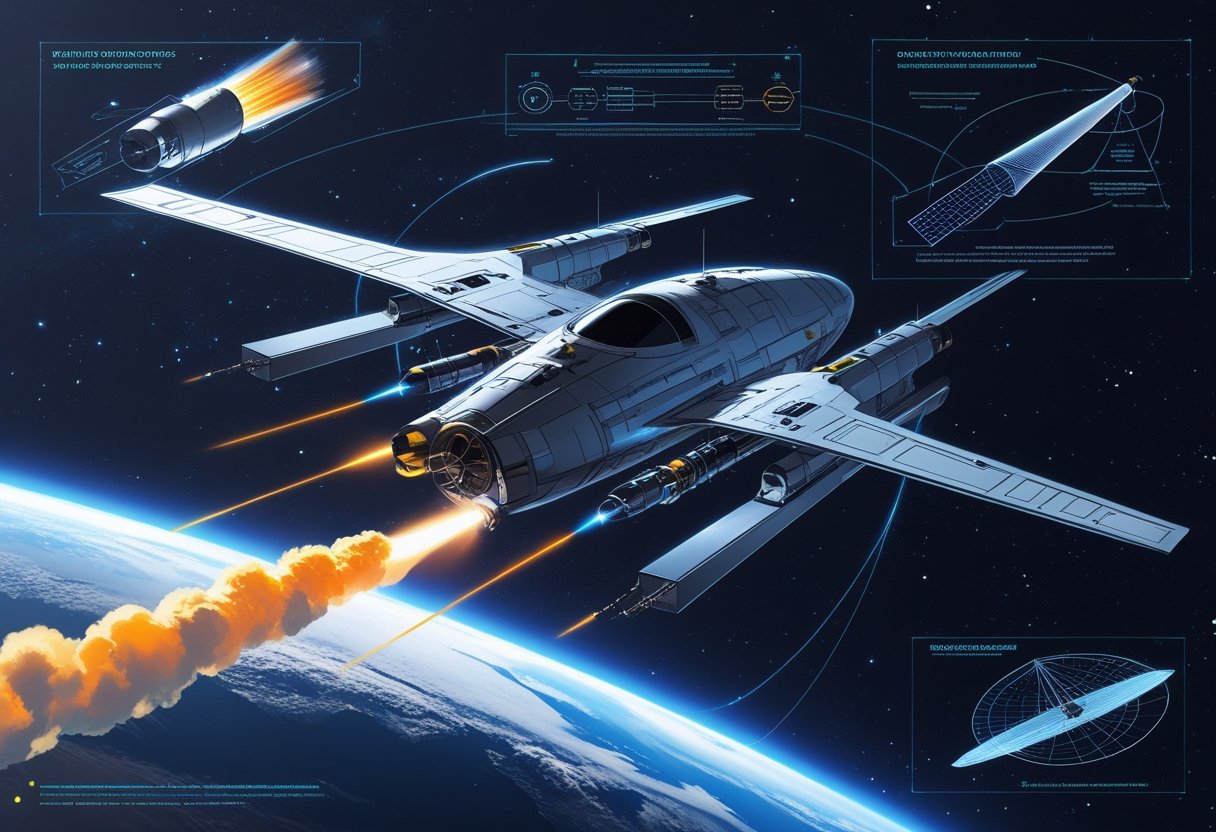
You will learn how spacecraft generate thrust by expelling mass, why momentum conservation governs every maneuver, and how performance ties directly to exhaust velocity and propellant fraction. These fundamentals determine how long your mission lasts, how much delta‑v you can buy, and what propulsion systems suit your spacecraft.
Newton’s Third Law and Conservation of Momentum
Every propulsion system relies on action–reaction: when your engine pushes exhaust one way, the spacecraft moves the opposite way. Momentum conservation (mass × velocity) applies to the combined system of vehicle plus expelled propellant, so the instantaneous change in your vehicle’s velocity equals the momentum carried away by reaction mass divided by vehicle mass.
For practical design, thrust (force) equals mass flow rate times exhaust velocity (T = ṁ·ve). You control thrust by varying propellant flow and exhaust velocity; different propulsion systems trade one for the other. Chemical rockets deliver high ṁ and moderate ve for large thrust, while electric thrusters use tiny ṁ but very high ve to maximize specific impulse (Isp).
Understand that thrust and Isp serve different purposes: thrust affects acceleration and lift-off capability, while Isp (proportional to ve) measures propellant efficiency and mission delta‑v economy. Your mission profile and payload mass drive which balance you choose.
How Rockets Work in the Vacuum of Space
Rockets do not need air to “push against.” In vacuum, exhaust expansion and nozzle design set exhaust velocity and pressure matching. Your nozzle converts internal thermal or electromagnetic energy into directed kinetic energy; properly expanded exhaust maximizes thrust by aligning pressure at the nozzle exit with ambient pressure.
For in‑space operation, vacuum performance typically exceeds sea‑level metrics because there’s no atmospheric backpressure. That increases effective Isp and exhaust velocity compared with ground tests. Reaction mass choice (chemical propellants, xenon for electric propulsion, water for resistojet concepts) affects storage density, handling, and achievable ve.
When you select a propulsion system, consider duty cycle and power: high‑thrust chemical engines suit quick maneuvers, whereas electric propulsion systems (ion or Hall thrusters) provide low thrust over long durations with high Isp, conserving reaction mass for greater cumulative delta‑v.
The Tsiolkovsky Rocket Equation
The Tsiolkovsky rocket equation quantifies how much delta‑v you can obtain from a given mass of propellant: Δv = ve · ln(m0 / mf). Here ve is exhaust velocity and m0/mf is initial mass over final mass. This logarithmic relation means adding propellant yields diminishing returns; doubling Δv requires exponentially more propellant.
To optimize your design, increase ve (higher Isp) or reduce dry mass rather than simply adding propellant. Electric propulsion raises ve dramatically, improving mission delta‑v per kilogram of reaction mass. Conversely, higher ve often reduces instantaneous thrust, which affects maneuver time and control authority.
Use the equation to size tanks and engines, estimate required propellant for orbit changes, and compare propulsion systems quantitatively. For reference data on propulsion concepts and thruster physics, consult detailed texts such as the comprehensive treatment in “Fundamentals of Electric Propulsion” for ion and Hall thruster behavior.
Key Propulsion Metrics and Performance
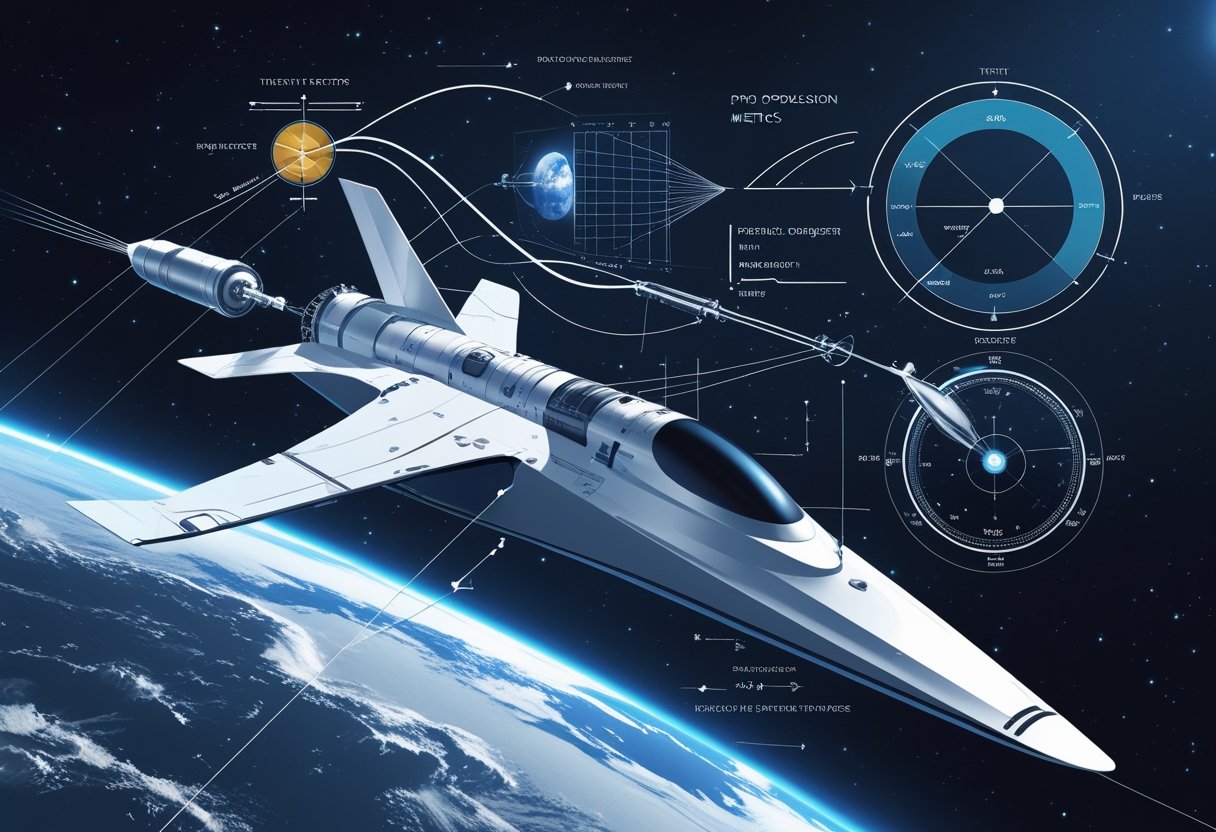
These metrics define how fast your spacecraft can accelerate, how long it can run, and how much propellant you must carry. Focus on thrust, efficiency, and the relationship between exhaust speed and propellant mass to pick the right engine for your mission.
Thrust and Thrust Density
Thrust is the force that changes your spacecraft’s velocity; you measure it in newtons (N) or pounds-force (lbf). For launches and rapid orbital transfers you need high thrust to overcome gravity and drag quickly.
Thrust density expresses thrust per unit engine volume or mass. It matters when you have tight volume or mass budgets, such as small launch vehicles or CubeSats. A high thrust density lets you pack more power into less structure, reducing dry mass and improving payload fraction.
When comparing engines, check both peak thrust and how long that thrust can be sustained. Solid rockets deliver very high thrust and high thrust density but cannot be throttled. Liquid engines give lower thrust density than solids generally but offer throttle and restart capability, which affects mission flexibility.
Specific Impulse and Efficiency
Specific impulse (Isp) quantifies how much impulse you get per unit propellant weight; it’s reported in seconds. Higher Isp means better propellant efficiency and less propellant mass for a given delta-v, which directly affects your mission mass budget. Electric thrusters (ion, Hall effect) commonly achieve Isp in the thousands of seconds, making them ideal when you can trade time for propellant savings.
Chemical engines have lower Isp—typically a few hundred seconds—but produce the high thrust needed at launch. For mission planning, convert Isp to exhaust velocity (Ve ≈ Isp × g0) to use the rocket equation and calculate required propellant mass for your delta-v.
Isp also drives system choices: pick a high-Isp system to minimize propellant mass for deep-space cruises, and a high-thrust, moderate-Isp system for surface departure or rapid maneuvers.
Thrust-to-Power Ratio
Thrust-to-power ratio tells you how much thrust you get per unit of onboard power; it’s essential for electric propulsion where electrical input limits performance. Low thrust-to-power means you need large solar arrays or reactors to reach useful thrust levels.
Hall thrusters and ion engines differ: a Hall thruster typically yields higher thrust-to-power than a gridded ion engine, giving better maneuver times for the same power. Conversely, high exhaust-velocity systems tend to have lower thrust-to-power, increasing transit time.
When sizing your power system, estimate continuous power, then multiply by the thruster’s thrust-to-power to get sustained thrust. This calculation determines realistic maneuver durations and helps balance solar array area, battery mass, and total spacecraft mass.
Exhaust Velocity and Propellant Mass
Exhaust velocity (Ve) is the speed at which propellant leaves the engine; it links directly to Isp by Ve = Isp × g0. Higher Ve reduces the propellant mass needed to achieve a target delta-v according to the Tsiolkovsky rocket equation.
Use the rocket equation to calculate propellant fraction: Δv = Ve × ln(mi/mf). Rearranging yields required propellant mass for your vehicle’s initial and final mass. Small increases in Ve yield disproportionately large propellant savings for high Δv missions.
Remember trade-offs: achieving higher Ve often means lower thrust or higher power demand. Evaluate Ve against your mission’s required delta-v, acceptable burn time, and available power to set a practical propellant mass budget. Consider propellant density and storage needs too, since those affect tank mass and overall vehicle design.
Chemical Propulsion Technologies
Chemical propulsion delivers high thrust and rapid delta-v using energetic reactions between propellants. You’ll find options that trade simplicity for control, and raw power for efficiency, so pick engines by mission role: launch, stage maneuvers, or fine in-space adjustments.
Solid Rocket Motors
Solid rocket motors (SRMs) store fuel and oxidizer in a single solid grain inside a sturdy casing. You can rely on SRMs for high thrust density and long-term storage; they ignite quickly and provide a predictable thrust curve. The downside is no throttling or restart capability, so you must design trajectories and stage separations around a fixed burn profile.
Typical uses include strap-on boosters for heavy-lift launch vehicles and emergency systems where simplicity and readiness matter. Engineers shape the grain’s internal perforation to tailor burn rate and thrust. Because SRMs lack active turbomachinery, they reduce complexity and cost but increase mission risk if you need in-flight throttle control.
Liquid Rocket Engines
Liquid rocket engines mix separate liquid fuel and oxidizer in a combustion chamber and control flow with pumps and valves. You get throttleability, shutdown/restart capability, and higher specific impulse than solids—critical for precise orbital insertions and docking maneuvers. Common propellant pairs include liquid hydrogen and liquid oxygen for high efficiency, and kerosene/LOX for dense, high-thrust stages.
Turbopumps and plumbing add complexity, requiring careful thermal and structural design. You’ll see liquid engines powering core stages and main engines—examples span from the Space Shuttle main engines to modern reusable first-stage rockets. Bipropellant systems give you higher performance than monopropellants like hydrazine, though hydrazine remains common for attitude control and small orbital adjustments due to its storability and simple thruster hardware.
Green Propellants and Advanced Chemical Fuels
Green propellants aim to reduce handling hazards and launch support costs while improving performance or operational flexibility. New ionic liquid-based propellants—demonstrated in missions like NASA’s Green Propellant Infusion Mission (GPIM)—replace toxic hydrazine with less hazardous formulations that still support monopropellant thrusters and, in some architectures, bimodal use for electric thrusters.
Advantages include lower ground-crew risk, simpler fueling infrastructure, and potential for higher density or specific impulse in next-gen designs. Challenges remain: new propellants require compatible tanks, materials, and catalysts for reliable decomposition in thrusters. You should evaluate green propellant trade-offs (toxicity, Isp, storage temperature) against mission needs, especially for small satellites and spacecraft where launch and ops costs strongly influence propellant choice.
Electric Propulsion Systems
Electric propulsion uses electrical energy to accelerate propellant to very high exhaust velocities, trading high specific impulse for low instantaneous thrust. You’ll see systems that suit small satellites to deep-space transfer, differing mainly by how they generate and accelerate plasma and how much power they need.
Ion Thrusters and Ion Engines
Ion thrusters accelerate ions using electrostatic grids or radiofrequency ionization to reach exhaust velocities of 20–80 km/s. You get high specific impulse (Isp typically 1,500–4,000 s) and very low propellant mass for long missions. Common propellants include xenon and krypton; alternatives like iodine or bismuth appear for smallsat use.
Operation: neutral gas → ionized plasma → ions extracted through charged grids → neutralizer emits electrons to prevent spacecraft charging. Typical uses: station-keeping, orbit raising, and primary propulsion on interplanetary probes. Thrust ranges from millinewtons to newtons; run times extend to thousands of hours. Trade-offs: grid erosion limits lifetime; higher-voltage designs reduce erosion but require more power and heavier power electronics. You should consider available electrical power and mission delta‑v when choosing an ion engine.
Hall-Effect Thrusters
Hall thrusters use a radial magnetic field and axial electric field to trap electrons and accelerate ions, producing moderate Isp (about 900–2,500 s) with higher thrust density than gridded ion engines. You’ll find them widely used on communications satellites and many recent planetary missions because they balance thrust, efficiency, and hardware simplicity.
They typically use xenon propellant and deliver thrust from tens of millinewtons up to several newtons, scalable by power (hundreds of watts to tens of kilowatts). Advantages: fewer delicate grids (less erosion risk), simpler neutralizer designs, and robust start/stop cycling. Limitations: plasma oscillations cause plume effects and potential spacecraft contamination; thermal and magnetic design require careful integration. For solar electric propulsion, Hall thrusters pair well with solar arrays at moderate power levels.
Arcjets, Resistojets, and Plasma Rockets
Electrothermal devices heat propellant with electric arcs or resistive elements to raise exhaust velocity above cold gas thrusters. Resistojet and arcjet Isp typically sit between chemical monopropellant and electrostatic thrusters (roughly 300–1,000 s). You’ll use them for higher-thrust orbit maneuvers and attitude control where simpler power conversion is preferred.
Arcjets create a plasma arc that heats propellant to high temperature before expansion through a nozzle; resistojets use electrically heated elements. VASIMR and magnetoplasmadynamic concepts fall into higher-power plasma rockets aimed at fast interplanetary transfer but need kilowatts to megawatts and complex thermal management. Pulsed plasma thrusters and vacuum arc thrusters suit very small satellites: they deliver micro- to millinewton impulses with minimal propellant and simple hardware. In every case, match thruster type to your spacecraft’s power budget, lifetime needs, and contamination risk.
Emerging and Advanced Propulsion Methods
These technologies aim to change how you move through the solar system: higher thrust-to-mass for crewed missions, extreme efficiency for long cruises, and novel ways to use sunlight or onboard reactors instead of chemical propellants.
Nuclear Propulsion and Thermal Rockets
You can get much higher thrust at better specific impulse with nuclear thermal propulsion (NTP) than with chemical rockets. NTP heats a low-molecular-weight propellant (usually hydrogen) in a nuclear reactor core and then expands it through a nozzle. That yields Isp typically in the 800–1000 s range—about twice typical chemical stages—so you carry less propellant for the same Δv.
Key trade-offs matter for your mission planning:
- Reactor mass and shielding increase spacecraft mass and complexity.
- Ground handling and political/regulatory hurdles exist for testing and launches.
- Technology readiness level is mid-range: reactor designs and full-system tests remain to be demonstrated in space.
You should track project milestones and demonstrations because an operational NTP system would shorten transit times to Mars and enable heavier cargo missions. Concepts related to nuclear thermal rockets often pair with advanced reactor designs to reduce mass and improve core lifetime.
Solar Sails and Photon Propulsion
Solar sails use momentum transfer from sunlight; you deploy large, lightweight reflective membranes to accelerate continuously without propellant. You can reach high cumulative Δv over months to years, making sails ideal for small payload, long-duration missions.
Operational points for mission design:
- Acceleration is low but persistent; mission profiles favor gradual spiral or interplanetary transfer.
- Sail materials and deployment mechanisms determine areal density and performance.
- Missions like IKAROS have proven the concept; the electric sail (E-sail) variant uses long charged tethers to harness the solar wind for higher thrust per area.
You should evaluate sail options by areal density (g/m²) and attitude-control methods. Photon propulsion also includes laser-pushed sails, where ground- or orbit-based lasers substitute for sunlight and significantly reduce transfer time for very low-mass probes—though infrastructure and cost raise the technology readiness hurdle.
Propellantless and Future Propulsion Concepts
You can explore propulsion that reduces or eliminates onboard propellant entirely. Concepts include electromagnetic tethers, E-sails, beamed-energy propulsion, and experimental ideas like direct momentum exchange using plasma or null-propellant cycling.
Important considerations:
- Many ideas sit at low to medium technology readiness levels and need flight validation.
- Electromagnetic tethers can generate thrust or produce power by interacting with a planet’s magnetic field, useful for deorbiting or small maneuvers.
- Beamed-energy systems shift energy generation off the vehicle, enabling higher effective Isp for tiny probes but requiring large ground or orbital infrastructure.
When assessing these options, weigh infrastructure cost, scalability, and mission cadence. You should prioritize technologies with demonstrable prototypes or recent orbital tests to reduce program risk.
Selecting a Propulsion System for Your Mission
Match thrust, specific impulse, mass, power, and cost to the mission’s delta‑V, timeline, and spacecraft constraints. Prioritize propulsion choices that fit orbital mechanics needs, structural limits, and available electrical power.
Matching Engines to Mission Requirements
You start by defining delta‑V budget, transfer time, and available mass and power. Chemical engines deliver high thrust and short burn times—useful for launch escape, rapid orbit raising, and large impulsive maneuvers. Electric propulsion (ion, Hall) gives far higher specific impulse, lowering propellant mass for long transfers, but needs continuous power and provides low thrust.
List of key trade factors:
- Thrust vs. time: high for chemical, low for electric.
- Specific impulse (Isp): low-to-moderate for chemical, high for electric.
- Power needs: chemical needs little onboard power; electric needs solar arrays or nuclear supply.
- System mass and volume: include tanks, feed systems, and power processing units.
You must also weigh schedule risk and flight heritage. If you need predictable, short-term maneuvers with existing launch vehicles like Falcon 9, favor proven chemical stages. For long interplanetary transfers or station‑keeping that value propellant mass saving, pick electric systems.
Mission Profiles: Interplanetary, Deep Space, and Station Keeping
For interplanetary missions, delta‑V and transfer time dominate your choice. Nuclear‑thermal or high‑Isp electric options shorten transit or reduce propellant, but require development and licensing. Chemical propulsion remains common for planetary orbit insertion and powered gravity assists when high thrust matters.
Deep space exploration favors systems that minimize propellant mass and support long durations. Nuclear electric or solar‑electric architectures extend mission reach; plan for radioisotope or reactor power if sunlight is weak. Account for thermal control, communications latency, and fault tolerance during long burns.
Station keeping and orbital maneuvers on satellites require repeatable, low‑impulse burns. Electric propulsion systems like Hall thrusters excel at geostationary station keeping and orbit raising thanks to high Isp. Cold gas or monopropellant systems provide simple, reliable attitude control and short impulsive adjustments for communication satellites.
Satellite and CubeSat Propulsion Choices
Satellites choose from chemical, electric, and hybrid solutions depending on service life and payload mass. GEO comsats commonly use electric propulsion for orbit raising and station keeping to save launch mass for payload and antennas. Design the propulsion and communication subsystems together so antenna pointing and thruster plumes don’t conflict.
CubeSats constrain you by volume and power. For a 1U CubeSat, cold gas or micro‑electrospray systems offer basic attitude and small delta‑V capability. A 3U CubeSat can accommodate modest electric thrusters or small chemical systems for meaningful orbit raising and deorbiting. Vendors and emerging providers like Dawn Aerospace and others supply subsystem options; evaluate flight heritage, integration effort, and vendor data.
Spacecraft Design, Engineering, and Supporting Systems
You’ll focus on structural choices, thermal resilience, and precise attitude control so propulsion integrates safely with the rest of the vehicle. Expect specifics about materials, thermal hardware, and the sensors and actuators that keep your spacecraft pointed and operational.
Spacecraft Materials and Lightweight Structures
You select materials to minimize mass while meeting stiffness and fatigue limits for launch and on-orbit loads. Carbon fiber composites dominate primary structures because they deliver high strength-to-weight ratios and allow tailored layups to control stiffness and thermal expansion. Use aluminum-lithium alloys for large frames where damage tolerance and manufacturability matter.
Design the propellant tank architecture around your propellant type and feed system. Common choices include composite-overwrapped pressure vessels (COPVs) for high-pressure tanks and integrally-stiffened metallic tanks for cryogens. Account for slosh dynamics with baffles and tune structural modes to avoid coupling with thrust-induced vibrations.
Apply structural optimization tools (topology, size, and layup optimization) and validate designs in a vacuum chamber and with modal testing. Verify loads with system-level simulations and hardware-in-the-loop to capture interactions between propulsion thrust, deployment mechanisms, and spacecraft systems.
Thermal Management and Protection
You manage heat from internal electronics, solar input, and propulsion events with active and passive systems. Passive methods include multi-layer insulation (MLI), reflective coatings, and low-conductivity standoffs to control steady-state temperatures in the vacuum of space. Use phase-change materials or heat pipes to redistribute transient thermal loads during burns.
Active thermal control uses electrical heaters, pumped fluid loops, or louvers when payload or propellant temperature windows are tight—critical for cryogenic propellants and sensitive instruments. Design redundant heaters and thermostatic control to prevent boil-off and preserve mission life.
Shield the vehicle from space radiation and micrometeoroids with graded shields and select materials to reduce secondary radiation. Implement thermal protection for reentry or high-heat-rate events using ceramic tiles, ablators, or heat-resistant composites where mission profiles demand them.
Attitude Control and Auxiliary Systems
You define attitude control to meet pointing, stabilization, and de-tumble requirements with a combination of reaction wheels, magnetorquers, and thrusters. Reaction wheels provide fine pointing; magnetorquers dump momentum to Earth’s magnetic field and save propellant. Include wheel redundancy and saturation management strategies.
Design sensors—star trackers, IMUs, sun sensors, and rate gyros—to provide accurate attitude knowledge. Fuse sensor data in an onboard guidance, navigation, and control (GNC) computer that runs fault detection and isolation routines. Use closed-loop control laws tuned in simulation and validated in hardware-in-the-loop rigs.
Plan auxiliary systems such as power, life support (if human-rated), and avionics to interface cleanly with propulsion and thermal control. Route harnesses and fluids to minimize thermal bridges and EMI. Test integrated spacecraft systems in thermal-vacuum chambers and under representative radiation to confirm performance in space environments.
Leave a Reply