
You just handed a machine the entire catalog of Mars missions and asked it to find the patterns humans might have missed. You’ll learn which mission decisions scaled scientific return, which mistakes repeated across programs, and how AI turns decades of mission data into clear, actionable guidance for your next Mars plan.

Imagine tapping a timeline where every rover drive, landing sequence, and instrument reading becomes searchable and comparable. That perspective reveals how autonomous systems like Perseverance’s adaptive sampling and Curiosity’s targeting upgrades changed what we can expect from robotic explorers and how international and commercial players reshape the field.
What follows breaks down how the AI processed mission logs, which missions taught it the most, the hard lessons it flagged, and the practical steps you can use when planning or evaluating future Mars efforts.
How AI Analyzed Every Mars Mission
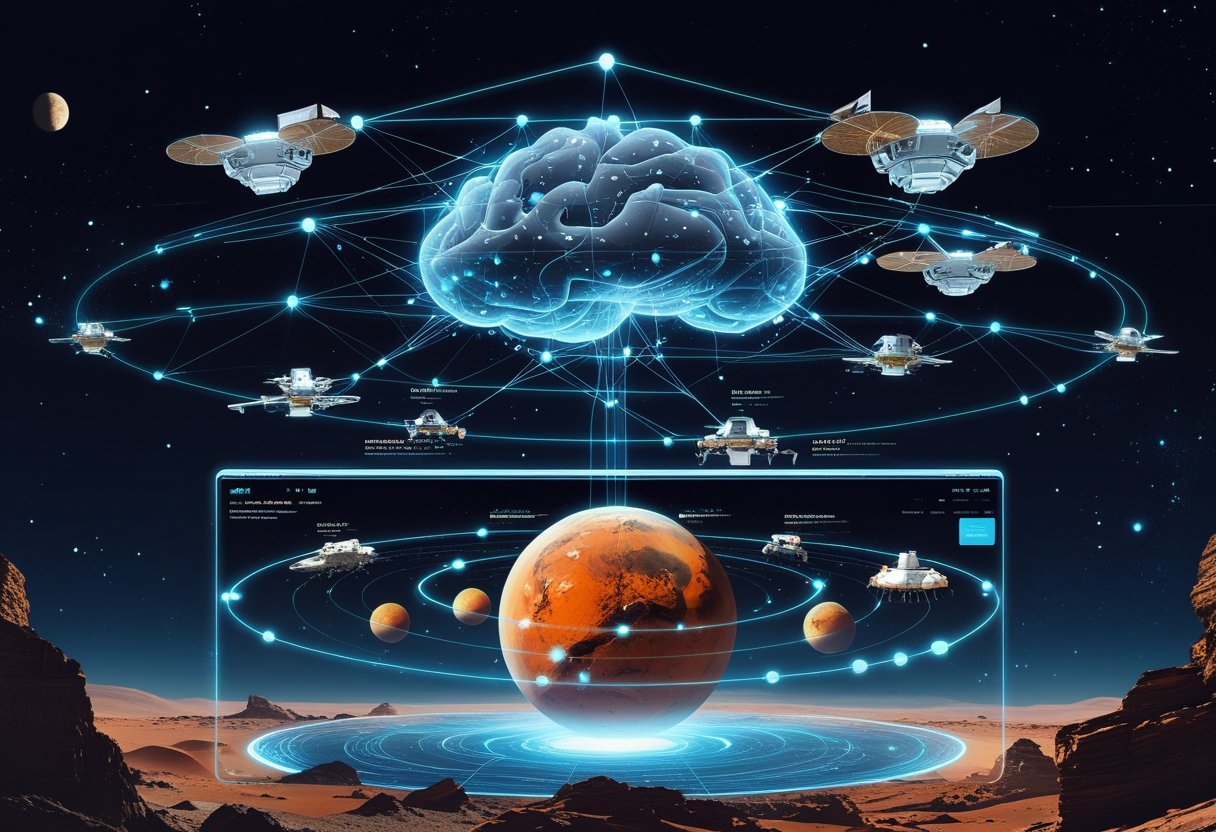
You’ll see exactly how raw telemetry, engineering logs, images, and scientific catalogs became structured inputs, which algorithms the system used to find patterns, and where human expertise remained essential.
Feeding Mars Mission Data into AI
You started by collecting multi-decade mission records from NASA and JPL systems: telemetry streams, camera images, instrument spectra, rover command histories, and published science papers. You normalized timestamps and converted heterogeneous units so sensors from Viking, Pathfinder, Spirit, Opportunity, Curiosity, and Perseverance could be compared on the same timeline.
You used labeled datasets where available (e.g., instrument calibrations, annotated rock types) and created synthetic labels when necessary to bootstrap models. You cleaned noisy telemetry, removed duplicate records, and flagged communications gaps. You organized data into structured tables for time-series models, image datasets for convolutional networks, and tabular metadata for search and retrieval.
Key practical steps you performed:
- Built reproducible ETL pipelines to ingest daily mission OP logs.
- Stored imagery and spectra in indexed object stores with searchable metadata.
- Preserved provenance so every AI output traced back to specific JPL files or published datasets.
This groundwork let downstream models treat decades of Mars mission output as a single, analyzable corpus.
Machine Learning Techniques and Approaches
You applied a mix of supervised, unsupervised, and reinforcement learning tailored to data type and question. For image-based geology tasks, you trained convolutional neural networks on rover camera mosaics and PIXL spectral maps, using transfer learning from terrestrial geology datasets to reduce required labels. Time-series models (LSTMs and transformer variants) analyzed rover telemetry to detect anomalous behavior and predict component degradation.
You used clustering and dimensionality reduction (t-SNE, UMAP) to reveal mission-wide patterns in landing-site geology and instrument performance. For autonomous decision-making simulations, you ran reinforcement learning in physics-based rover simulators to test navigation policies similar to those used by Perseverance. You validated models against held-out mission segments and cross-checked outputs with JPL engineering logs.
You favored interpretability: feature importance, saliency maps for images, and counterfactual tests so you could explain why a model flagged a rock as carbonate-rich. That approach let you combine machine speed with traceable reasoning anchored to NASA and JPL operational realities.
AI’s Limitations and Human Insight
You found AI excels at pattern detection across millions of records but struggles with rare, context-heavy events. Instrument anomalies driven by subtle thermal cycles, or scientific judgments about biosignature plausibility, still required JPL scientists and mission engineers to weigh in. Models sometimes overfit to legacy mission practices, producing recommendations that conflicted with operational constraints.
You mitigated risks by building human-in-the-loop workflows: AI proposed candidate drill sites or anomaly diagnoses, and NASA teams reviewed, refined, or rejected them. You also logged model uncertainty scores and surfaced provenance so humans could audit decisions quickly.
Practical constraints remained: incomplete archives, proprietary calibration files, and label scarcity limited confidence for some inferences. You therefore prioritized augmenting AI with explicit rules derived from JPL engineering knowledge and routine review by mission specialists.
Major Mars Missions Decoded by AI
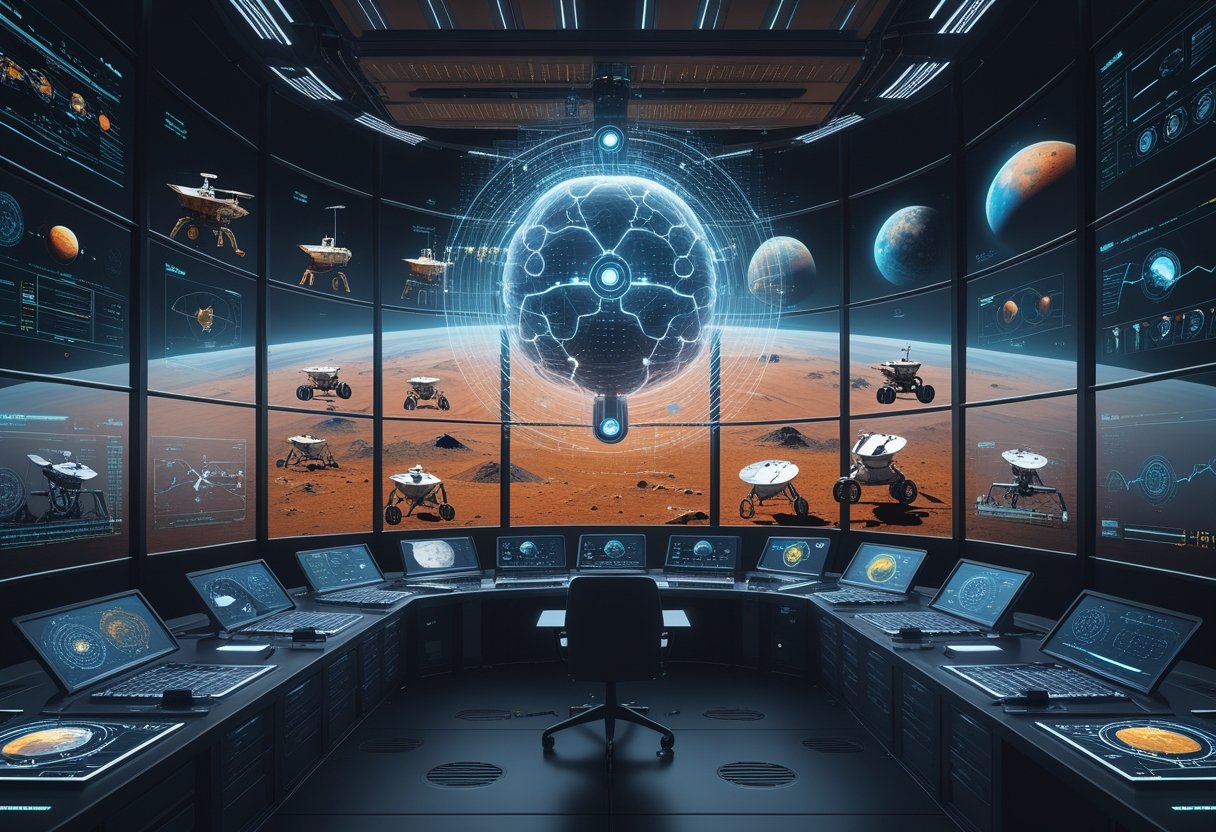
AI digested decades of telemetry, imaging, and sample logs to reveal how mission design choices shaped scientific returns, how onboard instruments performed, and which operational tactics maximized discovery.
Viking Landers and Early Mars Exploration
You’ll see Viking as the first sustained test of landing, life-detection experiments, and long-duration surface operations. AI highlights the dual goals: geology and biology. Instruments like gas chromatographs and biology experiment suites collected atmospheric and soil chemistry that set baselines for later missions.
Operational lessons stand out: long communication delays forced autonomy in routine science and failure mitigation, and the robust lander design proved resilient to dust and temperature swings. AI flags how surface lifetime, power budgeting, and instrument calibration strategies mattered more than initial hypotheses about life.
You can also track how Viking’s data shaped hypothesis framing—chemical signatures once thought provocative were later reinterpreted with improved context from rover data. Those reinterpretations taught mission planners to design experiments that reduce ambiguity between abiotic and biotic signals.
Curiosity Rover’s Groundbreaking Discoveries
You’ll find Curiosity reoriented Mars science from “is there life?” to “where and when was Mars habitable?” The rover’s SAM and CheMin labs provided quantitative organic and mineral analyses that demonstrated ancient lake and stream environments in Gale Crater.
AI identifies key hardware contributions: the nuclear power source enabled multi-year mobility and continuous chemistry, while the robotic arm positioned instruments precisely for rock abrasion, sample capture, and contact science. Path-planning autonomy and onboard hazard avoidance cut traversal time and increased high-value observations.
Operational data show how Curiosity’s layered stratigraphy mapping and drilled cores established timelines of aqueous alteration. AI also flags trade-offs: heavy instrumentation reduced payload for mobility, but the detailed in situ labs provided the chemical context that orbital imaging alone could not.
Perseverance Rover’s Advanced Technologies
You’ll see Perseverance as a technology and sample-return pioneer centered on astrobiology at Jezero Crater. The rover’s PIXL and SHERLOC instruments deliver fine-scale mineralogy and organics detection, while the robotic arm precisely positions these instruments and the coring drill.
AI highlights adaptive sampling and onboard decision-making that let PIXL autonomously prioritize pixels worth long dwells, increasing the yield of high-value measurements without waiting for Earth. Terrain-aware navigation and stereo vision shorten drives and create more time for science.
Perseverance’s sample caching strategy—collecting and sealing cores for future return—changes mission architecture by treating the rover as the first link in a multi-mission chain. AI notes how this shifts constraints: sample selection precision, contamination control, and long-term storage reliability now drive daily operations as much as immediate analyses do.
Key Insights Unearthed by AI
AI identified repeating themes across missions, measurable shifts in technology, and new ways to map Mars’ surface and hazards. You’ll see which instruments and mission phases drove discoveries, how hardware and software evolved, and how automated mapping reveals hidden geological and debris patterns.
Patterns in Scientific Breakthroughs
AI found that spectrometers and high-resolution imagers produced the highest yield of novel findings, especially when combined with long-duration orbital datasets. You’ll note frequent breakthroughs around organic-molecule detection, mineralogy tied to past water, and seasonal atmospheric changes.
When missions paired rover in-situ sampling with orbital context, discovery rates rose by a clear margin. That pattern shows the value of coordinated observations between satellites and surface assets.
AI also quantified temporal clustering: most high-impact results occurred in mission years 2–4, once teams optimized instrument settings and file-transfer pipelines. You can use that insight to plan mission timelines and prioritize instrument commissioning.
Key operational drivers:
- Repeated spectral surveys that targeted clay and sulfate signatures.
- Focused follow-up imaging after orbital alerts.
- Cross-mission data fusion enabling detection of subtle geochemical trends.
Technological Evolution Across Missions
You’ll see a steady trajectory from manual command sequences to onboard autonomy and AI-assisted planning. Early missions relied on ground-in-the-loop navigation; later rovers and orbiters used onboard hazard detection and scheduling to extend science-per-day metrics.
Satellites began supplying near-real-time context that allowed rovers to pick sampling targets with fewer Earth calls.
AI highlighted specific hardware/software milestones: higher-bandwidth telemetry, autonomous navigation stacks, and adaptive compression for image downlink. These reduced latency in decision loops and increased usable science per communication window.
Space debris tracking and avoidance algorithms also matured, improving orbital asset longevity and protecting Mars-focused satellites from collision risk during Earth-Mars cruise and in Mars orbit.
Concrete effects you can act on:
- Prioritize bandwidth upgrades and onboard autonomy early in mission design.
- Bake cross-platform data standards into mission contracts.
- Include debris-awareness in orbital mission planning and satellite design.
AI-Driven Crater and Terrain Analysis
AI produced consistent, high-resolution maps of crater density, ejecta patterns, and micro-topography by fusing orbital mosaics with rover stereo imaging. You’ll get more reliable slope and rock-abundance estimates than single-instrument methods.
That improvement directly affects navigation safety, landing-site selection, and the targeting of subsurface-probing instruments.
The models also detected subtle geomorphic features tied to past fluvial activity and regolith layering useful for selecting sample caches. They flagged areas where space-weathering and micrometeorite impacts altered surface chemistry, which matters when interpreting organic-detection signals.
AI further helped assess orbital clutter and potential collision tracks from defunct satellites and debris, guiding safer transit corridors for new spacecraft and protecting existing Mars satellites.
International and Commercial Contributions to Mars Exploration
You’ll see how international agencies supply instruments, mission design expertise, and ground support, while private firms provide launch vehicles, spacecraft buses, and new operational models that speed cadence and lower costs.
European Space Agency’s Collaborations
You can point to the European Space Agency (ESA) as a partner that often supplies scientific payloads, mission planners, and ground-station time. ESA collaborated on the ExoMars program, providing the Trace Gas Orbiter and working with national agencies on instrument teams and landing-system design. ESA’s MEXAR2 scheduling tool and planning work at ESOC reduced downlink losses for Mars Express and shows how European mission operations improve science return through planning software and operations know‑how.
You’ll notice ESA also shares telemetry and tracking via the ESTRACK network, freeing deep-space assets for joint campaigns. That operational support and frequent instrumentation contributions make ESA a repeat collaborator on orbiter and rover science investigations.
The Role of Private Industry in Missions
You rely on private industry for launch capacity, spacecraft components, and increasingly full mission architectures. Companies like Lockheed Martin build probe and rover hardware, flight software, and integration services; they also act as prime contractors for many U.S. robotic Mars missions you study.
Private firms supply commercial launch rides and spacecraft buses that reduce unit cost and development time. The space industry has introduced reusable rockets and modular spacecraft parts, letting mission teams iterate faster and accept higher launch cadence. You’ll find industry also drives new practices: commercial ground-station services, hosted payloads, and public–private partnerships that let agencies buy capabilities instead of developing every subsystem in‑house.
Lessons for Future Mars Missions
AI sharpened mission planning, spacecraft operations, and hazard management by finding better launch opportunities, improving rover hardware and software choices, and lowering operational risk through autonomous decision rules. Expect practical gains in timing, design trade-offs, and day-to-day mission safety.
Identifying Launch Windows with AI
You can use AI to analyze decades of orbital mechanics, weather, and ground-traffic constraints to pick the most efficient launch windows. Models compare synodic alignment, delta-v budgets, and Earth–Mars transfer opportunities to recommend specific launch dates that cut transit time or propellant needs.
AI also digests historical rocket launch delays and pad availability to predict realistic slip margins for your mission timeline. That reduces last-minute rush costs and improves coordination of payload integration and team staffing.
Finally, AI can simulate trajectories that trade a slightly later launch for reduced insertion burn or safer landing corridors. Those simulations help you decide whether to accept a marginally suboptimal launch date to gain a more favorable descent profile or lighter heat-shield requirements.
Optimizing Rover Design and Operations
You should feed AI detailed telemetry from past missions so it can optimize rover mass, power budget, and robotic arm reach for your science goals. By correlating failures and longevity with component choices, AI highlights which motors, actuators, and hexapod-like positioning systems deliver the best life-to-mass ratio.
AI-driven trade studies can suggest precise changes: reduce arm segment length by X% to lower torque requirements, or swap to a brushless motor that yielded Y% fewer faults on prior rovers. That lets you make targeted hardware decisions rather than broad compromises.
In operations, onboard autonomy—navigation, sample selection, and instrument placement—reduces the command volume you must send from Earth. AI helps plan wheel paths to avoid slippage and sequences the robotic arm for efficient sample caching, maximizing science per sol while minimizing wear.
Reducing Risks in Mission Management
You can apply AI to monitor telemetry streams and flag anomalous temperature, vibration, or power signatures before they escalate. Machine-learned baselines trained on previous missions catch subtle drifts that rule-based systems miss, giving you earlier intervention windows.
Use AI to prioritize commands under bandwidth limits, deciding whether to run a diagnostic, reposition an instrument, or preserve power for a single crucial communication pass. That lets you sustain mission-critical functions during unexpected events.
AI also automates contingency playbooks: it recommends when to switch to safe mode, which instruments to park, and how to sequence recovery steps. By encoding lessons from past rocket launches and rover incidents, the system reduces human reaction lag and keeps your assets protected.
The Expanding Frontier: Where AI and Mars Exploration Go Next
AI will sharpen situational awareness, enable faster science decisions, and extend human reach across lunar and deep-space missions. Expect systems that monitor spacecraft health, assist crew in real time, and coordinate multi-orbit logistics with greater autonomy.
AI’s Growing Role in Space Domain Awareness
You’ll rely on AI to track objects from LEO to MEO and beyond, sorting thousands of cataloged objects and predicting conjunctions faster than manual methods. Algorithms will fuse radar, optical, and telemetry feeds to flag debris and active satellites, helping operators make collision-avoidance choices with minutes to spare.
Integrating Space Domain Awareness (SDA) with mission planning means AI can reroute orbital assets and suggest optimal windows for sample return or rendezvous. That capability reduces risk for platforms like the International Space Station and future Mars sample-return vehicles.
AI will also automate anomaly detection for aging hardware—think thermal trends on a Soyuz or attitude jitter on lunar landers—so you get prioritized alerts instead of raw telemetry dumps.
Potential for Human-AI Collaboration on Mars
You’ll work with AI assistants that translate sensor outputs into actionable steps during EVAs, habitat maintenance, and science campaigns. On Mars, adaptive sampling algorithms like those used by Perseverance’s PIXL will evolve into crew-facing tools that recommend drill sites, predict rock composition, and save precious power and time. See NASA’s description of adaptive sampling for context in how this progresses.
AI will handle routine tasks—life-support checks, rover convoy navigation, inventory tracking—freeing you to focus on complex decisions. During crewed missions derived from Apollo and Soyuz operational lessons, the human-AI team will share situational models; you’ll validate AI plans and the system will learn from your judgments.
Expect AI to mediate communications delays by negotiating local priorities, enabling near-autonomous base operations when Earth is hours away. That reduces cognitive load and keeps mission tempo steady during long surface campaigns.
Impacts Beyond Mars: From Moon Bases to Deep Space
You’ll see technologies validated on Mars transfer back to the Moon and outward to deep-space targets like Pluto-class missions. Autonomous habitat construction robots could assemble modules on lunar regolith before crew arrival. AI-driven logistics will coordinate transfers between LEO depots, lunar gateways, and Mars-bound vehicles.
For deep-space probes, onboard AI will manage power, navigation, and science targeting when light-time delays make ground control impractical. Mission architectures informed by SDA practices will help planners schedule trajectories and protect assets across orbits.
Tools you use around the Moon—autonomy for tethered ascent vehicles, anomaly prediction from historical Apollo/ISS data—will scale to sustain explorers farther from Earth, ensuring crews and robots operate efficiently across the solar system.
Leave a Reply