
I’ll show you practical ways to use AI so you learn astronomy up to ten times faster by focusing your time on high-value concepts, automating tedious data work, and getting instant, tailored explanations when you need them. Use AI to generate personalized lessons, simulate observations, and explain complex concepts in plain language so you progress far faster than with passive reading alone.
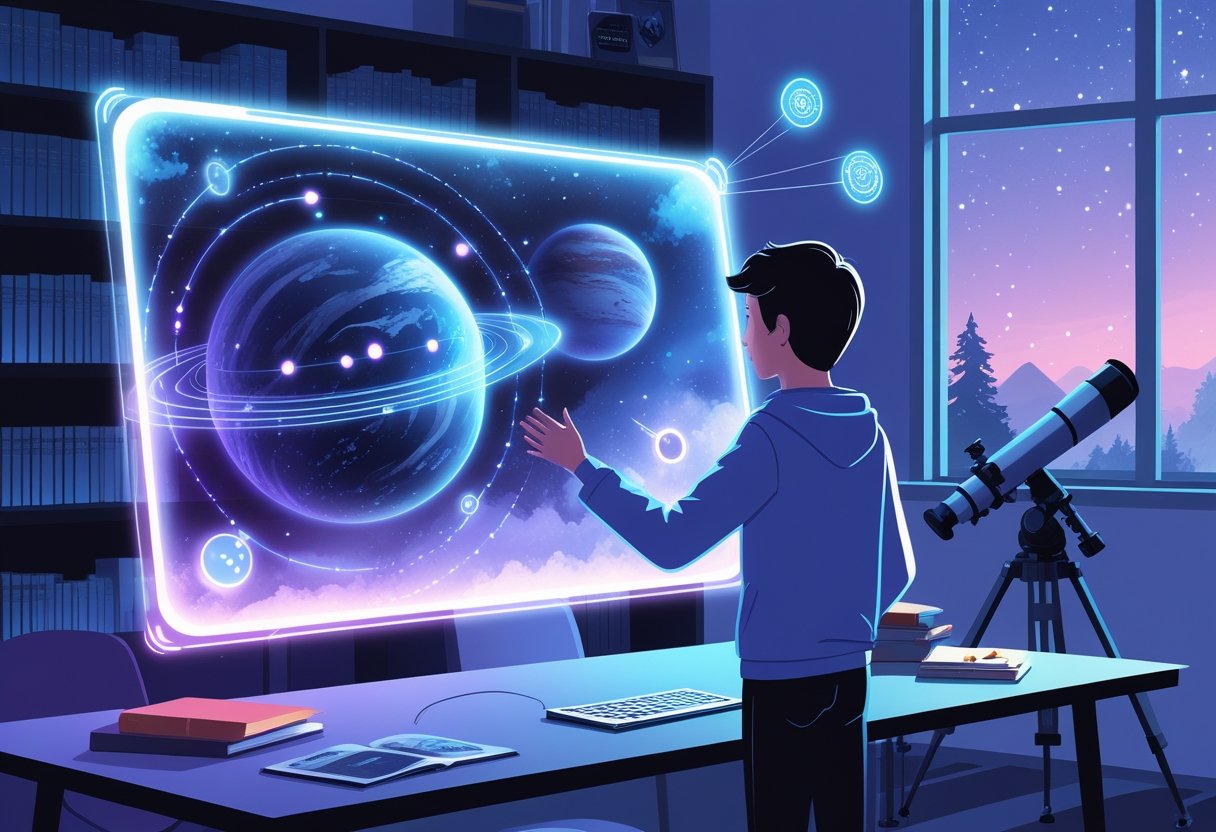
I’ll guide you through which AI tools work best for image analysis, simulations, and concept mastery, how to customize those tools to match your goals, and simple study routines that make AI an active learning partner. Expect clear, evidence-backed techniques and step-by-step examples that you can apply to observational skills, theory, and problem solving without wasting effort.
Why AI Accelerates Astronomy Learning
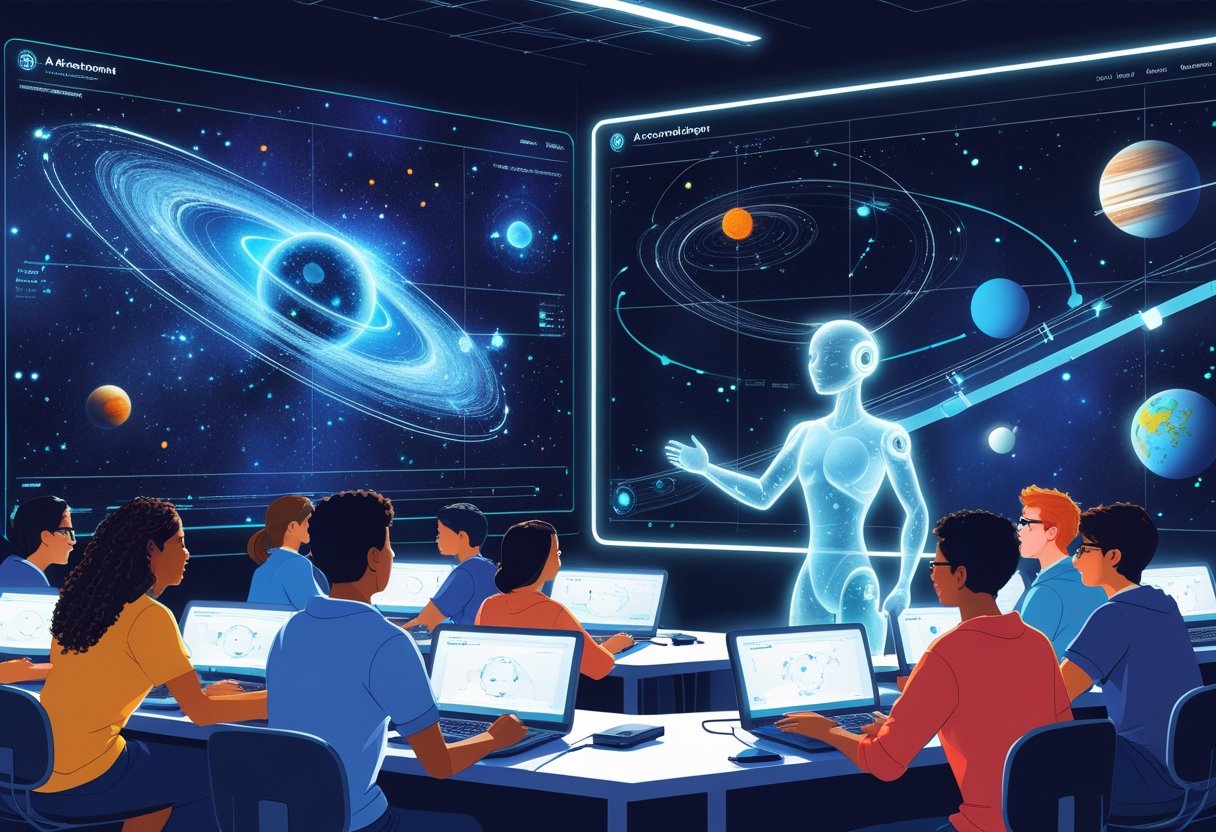
I focus on concrete mechanisms AI uses to speed understanding: it models my cognition, adapts content to my gaps, and converts large datasets into compact, actionable learning tasks.
Cognitive Science Behind AI-Powered Learning
I rely on AI systems that implement evidence-based learning principles such as spaced repetition, retrieval practice, and incremental difficulty. These systems track my response times and error patterns, then schedule review of topics I struggle with more frequently than material I master. That mirrors what neuroscientists call consolidation: repeated, well-timed retrieval strengthens long-term memory traces.
I notice AI also provides immediate, informative feedback. Instead of a generic “wrong,” the model highlights the mistaken concept (for example, confusion between luminosity and flux), explains the misconception, and gives a short corrective example. This targeted feedback reduces unproductive practice and shortens the number of repetitions required to reach fluency.
Transforming Traditional Study Techniques
I replace passive reading and one-size-fits-all lectures with active, machine-generated practice. AI can generate focused problem sets—lightcurve fitting tasks, orbital mechanics puzzles, or image-classification exercises—tailored to my current skill level. I complete fewer problems but learn more per problem.
I use AI tools that simulate real research workflows: they pull subsets from survey data, annotate examples, and let me run model fits. That exposure to authentic datasets trains both my conceptual understanding and my practical data skills, shortening the gap between classroom knowledge and research-ready competence.
The Role of Personalization in Rapid Learning
I get individualized learning paths based on fine-grained diagnostics. The AI profiles my strengths (spectral analysis) and weaknesses (coordinate transforms), then sequences lessons to exploit my prior knowledge while remediating gaps. Personalization reduces wasted study time by focusing only on what I need next.
I also adapt modality to my preferences: when I learn faster from visuals, the system converts equations into annotated plots and interactive sliders. When I prefer text, it provides concise derivations and targeted reading. That modality matching, combined with pace control, makes my study sessions more efficient and much more productive.
Essential AI Tools and Resources for Astronomy
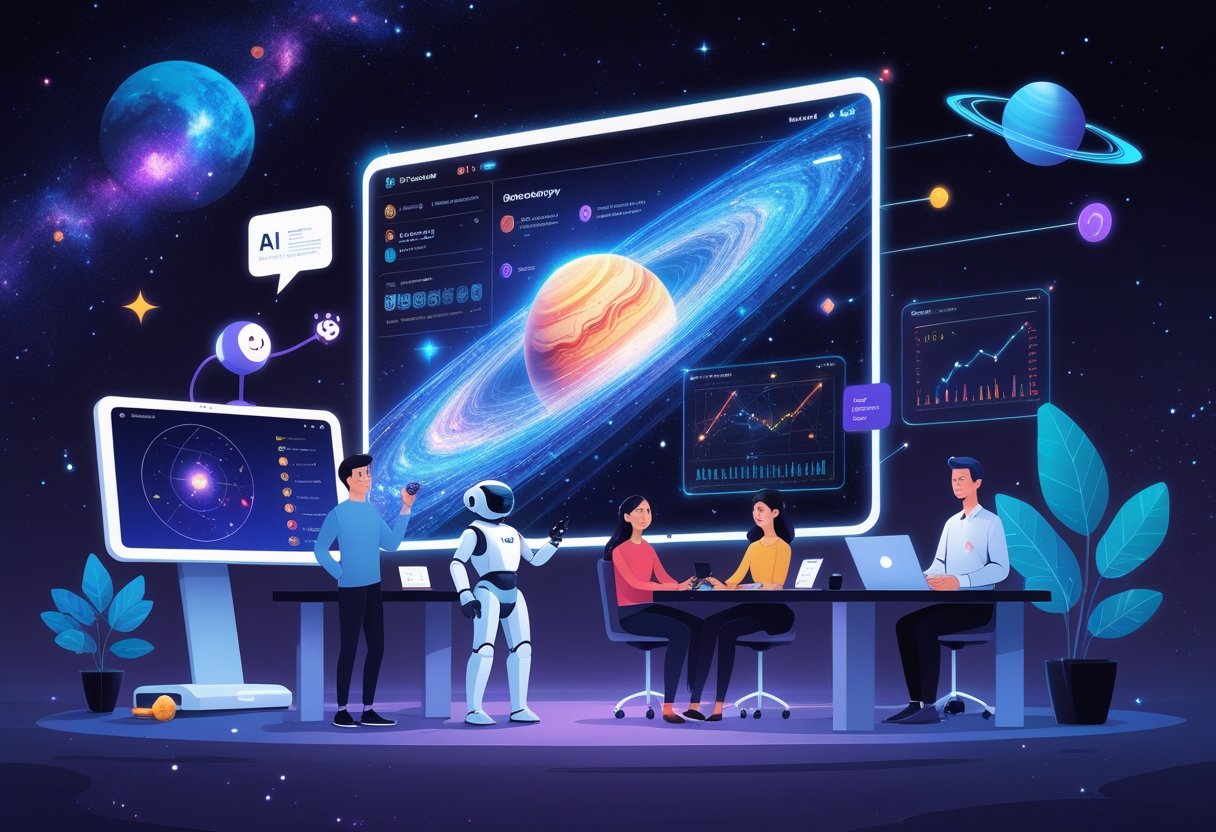
I list practical, high-impact tools that I use to speed learning: simulation platforms for experiments, interactive apps for sky practice, and AI note tools to capture insights and convert lectures into concise study material.
AI-Powered Simulation Platforms
I rely on physics-accurate simulators that let me test orbital mechanics, telescope optics, and population synthesis without requiring observatory time. Key features I look for are adjustable parameters (mass, distance, wavelength), batch-run capabilities to explore parameter space, and exportable data for plotting.
Examples include platforms that integrate machine learning models to denoise images and reconstruct faint sources, improving detection limits in simulated images. I prioritize simulators with scripting interfaces (Python API or Jupyter support) so I can run ensembles and reproduce results. If a platform offers pre-built modules for stellar evolution or binary population synthesis, I use those to compare outcomes quickly.
I check for community models and shared notebooks; that speeds learning by letting me modify existing experiments. Licensing and access matter: some tools are free for education, others require institutional accounts.
Interactive Astronomy Apps
I use interactive apps for pattern recognition and real-time practice under realistic observing conditions. Good apps provide tiled sky maps, epoch control to simulate proper motion, and layered catalogs (stars, galaxies, transient alerts). I value apps that connect to real survey data or simulated survey modes to practice target identification.
Several apps use AI to generate quizzes, identify objects from images, or produce visual explanations of concepts like redshift or light curves. I prefer apps that offer VR/3D mode for spatial intuition and that export annotations or screenshots for study notes. Cross-platform availability (mobile and desktop) helps me practice anywhere.
When choosing, I look for apps linked to citizen science projects or observatory feeds so I can apply skills on real tasks. Integration with telescope control software is a bonus when I progress to hands-on observing.
Automated Note-Taking and Summarization Tools
I capture lectures, papers, and tutorial videos with AI transcription and summarization to reduce review time. Effective tools transcribe with astronomy-specific vocabulary accuracy and generate structured notes: definitions, equations, and action items (e.g., run simulation X with parameters Y).
I use features that produce flashcards, concept maps, and searchable highlights from long sessions. Priority features include citation capture for papers, export to Markdown or LaTeX, and the ability to link summaries to original timestamps or figures. I vet models for hallucination risk by spot-checking summaries against source material.
For teamwork, I pick tools with shared workspaces and version history so collaborators can annotate and correct summaries. Secure storage and clear data policies matter when I upload unpublished data or class recordings.
Customizing AI Learning Strategies for Astronomy
I focus on practical adjustments that make AI-driven study efficient: matching resources to how I learn, choosing formats that reveal spatial and temporal patterns, and setting measurable AI-guided milestones.
Determining Your Learning Style
I start by diagnosing how I learn best: visual (images, simulations), verbal (explanations, transcripts), kinesthetic (hands-on labs), or numerical (data and code). I test this with a short routine: read one paragraph, watch a 2-minute simulation, and run a simple dataset query. I note which mode helps me retain facts like orbital mechanics or stellar classification.
I then feed those preferences to an AI tutor. For visual learners I ask for annotated images and interactive sky maps. For verbal learners I request concise summaries and spoken explanations. For kinesthetic learners I create step-by-step lab prompts that use astronomy datasets. For numerical learners I generate Jupyter notebook exercises that analyze real light-curve data.
Keep measurement simple: retention quiz scores, time-to-master a concept, and number of correct problem solutions. I iterate every two weeks and adjust prompts based on what improves those metrics.
Adapting Content Formats with AI
I tell the AI which content formats I prefer and it repackages material accordingly. Examples I use: convert a lecture into a 6-slide visual summary, transform a paper into a 300-word explainer, or create a 5-step lab exercise from telescope catalog data. That keeps complex topics like spectral classification or N-body simulations digestible.
I also leverage multimodal AI tools to generate images, animated orbits, and CSV exports. If I need spatial intuition, I request interactive 3D visualizations or annotated star charts. If I need procedural skill, I ask for runnable code snippets and test inputs. I use short checklists to ensure clarity: objective, input data, step-by-step actions, expected result.
When a format fails, I tell the AI specifically what to change—reduce math density, add labels, or include intermediate answers. This targeted feedback accelerates improvements and reduces wasted study time.
Setting AI-Driven Learning Goals
I define concrete, time-bound goals and map AI tasks to each milestone. Example goals: “Identify 10 constellations by sight in two weeks,” “Fit a transit light curve with code in four days,” or “Explain main-sequence evolution in 300 words within three days.” I keep goals measurable and limited to one cognitive target per week.
For each goal I create an AI study plan with daily micro-tasks, resources, and assessment checkpoints. The plan includes: practice items, a short formative quiz, one synthesis paragraph, and a practical exercise. I schedule automated reminders and ask the AI to adapt difficulty after each checkpoint.
I track progress with simple metrics: accuracy on quizzes, time per exercise, and number of successful runs of analysis code. Those metrics tell me when to request more advanced material or to revisit fundamentals.
AI Techniques for Mastering Astronomy Concepts
I focus on practical methods you can apply immediately: turning raw data into visuals, training retrieval with AI-driven flashcards, and using models to check calculations and sketch solutions in real time.
Visualizing Complex Astronomical Phenomena
I use AI to convert observational data and equations into clear visuals that reveal structure and scale. For example, I feed spectra, light curves, or orbital parameters into tools that generate annotated plots and interactive sky maps. Those visuals let me compare line profiles, identify Doppler shifts, and inspect transit shapes without replotting raw arrays by hand.
I prioritize multi-modal displays: combining an image, a spectrum, and a timeline side-by-side clarifies cause-and-effect (e.g., shock heating vs. emission lines). When needed, I prompt models to animate processes like accretion flows or orbital resonances so I can pause at critical moments and measure values directly from frames.
Practical checklist:
- Upload FITS, CSV, or text output for automated plotting.
- Request labeled axes, units, and fitted model overlays.
- Ask for zoomable, time-sliced animations to inspect dynamics.
Active Recall and Spaced Repetition with AI
I build targeted flashcards from lecture notes, papers, and equations using AI to extract concepts and generate concise questions. The AI creates cards that test specific retrieval: “Derive distance modulus from apparent and absolute magnitude” instead of vague prompts. That sharpens recall for formulas and derivations I use on problem sets.
I pair those cards with spaced repetition schedules the AI adapts to my performance. The system increases interval spacing for items I answer correctly and shortens it for weak topics, so I review only what needs reinforcement. I also include worked-solution cards where the AI grades my step-by-step reasoning and highlights algebraic mistakes.
Implementation tips:
- Convert derivations into stepwise question-answer pairs.
- Include numerical practice cards with randomized parameters.
- Enable automated interval tuning and performance reports.
Using AI for Real-Time Problem Solving
I leverage AI as a real-time collaborator when solving homework or lab problems. I paste a problem statement and my intermediate steps; the model checks units, flags algebraic errors, and suggests the next logical step. For numerical tasks, I let the AI run computations and return code snippets (Python/NumPy/astropy) I can execute and verify locally.
I use the AI to propose multiple solution paths—analytic approximation, numerical integration, or dimensional analysis—so I can choose the most efficient method for the problem scale. When dealing with data, the AI outputs reproducible scripts to load files, perform calibrations, and generate publication-quality plots.
Quick workflow:
- Share problem + my attempt.
- Request unit checks and error localization.
- Ask for runnable code and a brief justification for the chosen method.
Relevant tools include interactive visualization platforms and AI study assistants tailored to astronomy, such as implementations that summarize theory and produce study aids for students. For guided practice, I combine those tools with hands-on coding and repeated retrieval to learn faster.
Practical Tips for Integrating AI in Astronomy Self-Study
I focus on specific, repeatable steps that make study time more productive and measurable. The tips below show how I structure sessions, track weaknesses, and use AI feedback to stay motivated and learn faster.
Structuring Effective AI Study Sessions
I schedule 45–60 minute blocks split into three parts: 10 minutes review of previous notes, 30–40 minutes of active learning with AI tools, and 5–10 minutes of reflection. During active learning I use an AI tutor for targeted tasks — for example, ask a chatbot to quiz me on spectral classification, generate synthetic light curves, or explain transit photometry step-by-step. I keep a focused task list: “fit a transit model,” “classify five galaxy images,” or “derive the Doppler shift equation.”
I limit tool choice to two per session (e.g., a neural-network image classifier and a language model for conceptual checks). That reduces context switching and helps me learn faster. I also vary modalities: some sessions focus on coding (Python, AstroPy), others on interpretation (spectra, photometry). I capture commands and prompts I used in a short log so I can reproduce successful prompts later.
Tracking Progress and Knowledge Gaps
I maintain a simple progress table with columns: Topic, Task, Date, Confidence (1–5), Next Action. Every week I run an AI-generated diagnostic quiz tailored to the topics I studied, then update confidence scores. If my average confidence in a topic drops below 3, I schedule a remediation session and ask the AI to create a focused practice plan with 5 targeted problems.
For datasets I use small, labeled samples (e.g., 100 Kepler light curves) and track model performance metrics like accuracy and false-positive rate for classification tasks. Those numbers tell me where my understanding or the model’s training is weak. I also save example mistakes and ask the AI to explain them in plain language, which exposes specific misconceptions I can fix.
Motivating Yourself with AI Feedback
I set measurable short-term goals, then ask an AI coach to convert them into daily micro-tasks and automated reminders. For example, “Complete three transit-model fits this week” becomes three timed sessions with suggested prompts and checkpoints. I request immediate feedback after each task — code review, explanation of errors, or a one-paragraph summary of what I learned — which keeps momentum high.
I use progress visuals generated by AI (charts of confidence scores, task completion streaks) and pin them to my study dashboard. When I hit a streak or improve a metric (e.g., classification accuracy +8%), I log a brief note and let the AI suggest the next incremental challenge. That steady, data-driven feedback loop helps me learn faster while keeping motivation concrete and trackable.
Expert Insights and Neuroscientific Foundations
I distill practical, neuroscience-backed tactics and AI methods that accelerate skill acquisition in astronomy. Expect clear, actionable steps rooted in neuroplasticity, spaced retrieval, and targeted AI tools that model your weak spots.
How Neuroscientists Approach Learning Optimization
I adopt strategies used by neuroscientists to prioritize long-term retention and transfer. They emphasize spaced repetition schedules tuned to forgetting curves, so I recommend spacing astronomy problem sets and flashcards across increasing intervals rather than massed study sessions.
Neuroscientists also use interleaving: I mix star classification, orbital mechanics, and spectral analysis in a single practice block to improve discrimination and retrieval under varied contexts.
I track performance with objective metrics — accuracy on curated question banks, reaction time on identification tasks, and error patterns. That data informs adaptive practice: I focus on the 20% of concepts causing 80% of errors.
I supplement practice with short, high-quality feedback cycles. Immediate correction for factual errors and delayed, reflective feedback for problem-solving steps both enhance consolidation.
Applying Neuroplasticity Techniques in Astronomy
I target neuroplastic mechanisms through deliberate, high-quality practice and varied input. To strengthen visual pattern recognition, I train on progressively noisy telescope images and degraded spectra so my brain learns robust feature extraction.
I pair effortful retrieval with multimodal cues: reading a paper, coding a simulation, and verbally explaining a concept each form separate retrieval routes, which strengthens memory traces.
I integrate sleep and rest into learning blocks because consolidation occurs during slow-wave sleep. I schedule complex modeling tasks before sleep and set short naps after intense lab simulations when feasible.
I use AI tools to personalize difficulty. An adaptive system identifies my weak problem types and generates gradients of challenge, which aligns practice with plasticity windows and prevents plateauing.
Real-Life Success Stories
I draw lessons from practitioners who combined neuroscience principles with AI to accelerate astronomy learning. One trainee used an AI-driven spaced-repetition system that analyzed her error clusters and generated tailored simulation missions; her classification accuracy doubled in three months.
Another early-career researcher integrated noisy-image augmentation and deliberate retrieval; with weekly sleep-timed consolidation routines she reduced false-positive detections in transit photometry by 30%.
I recommend replicating these approaches: capture detailed learning logs, use AI to detect error patterns, and restructure practice around spaced, interleaved sessions that target specific deficits.
If you pair those methods with deliberate rest and progressive sensory challenges, you leverage both neuroscientific foundations and AI to learn astronomy substantially faster.
Leave a Reply