
I want you to move from curiosity to a clear, practical plan that uses AI to shape a personalized astronomy learning path for your interests and pace. AI can assess your current knowledge, suggest tailored topics, and generate practice activities so you progress more efficiently than with one-size-fits-all materials.
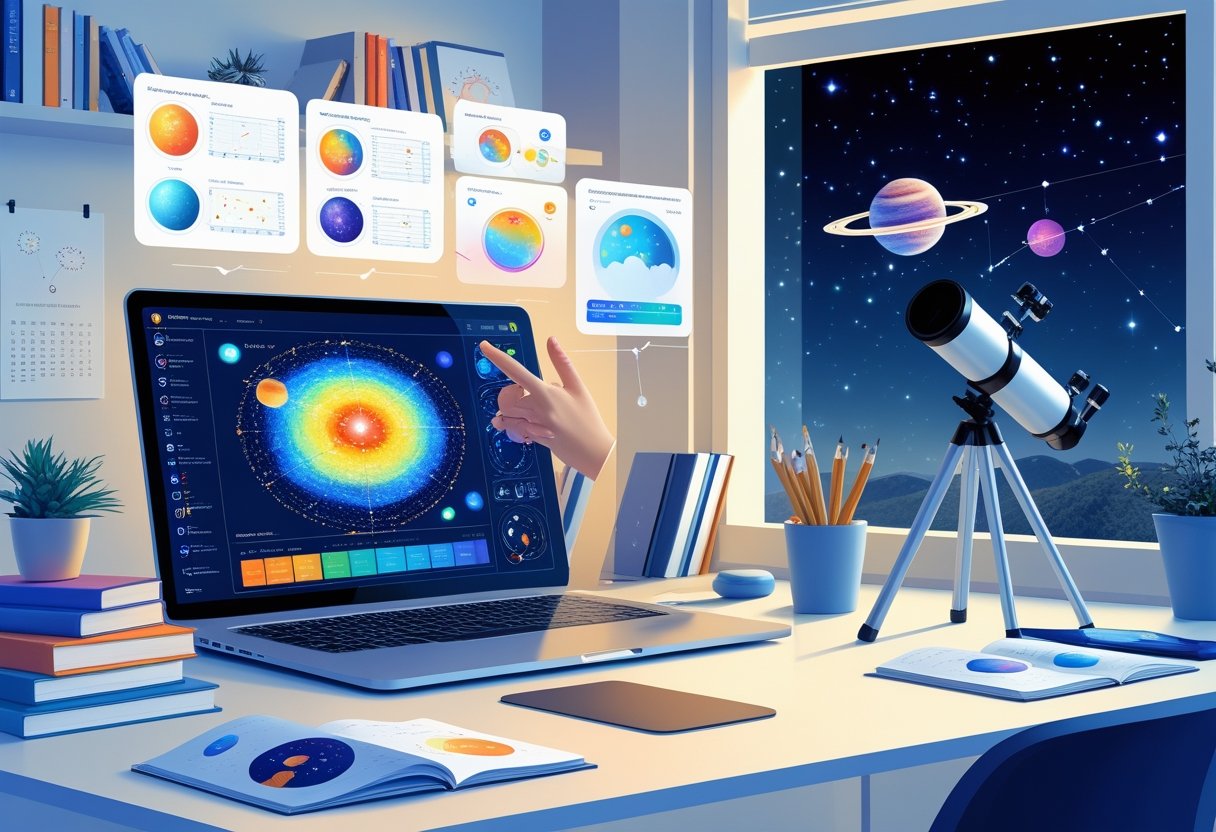
I’ll show how AI fits into astronomy education, help you define achievable learning goals, and point to tools that turn raw data and concepts into interactive lessons. Expect a step-by-step approach that adapts core astronomy topics to your learning style and tracks measurable progress so you stay on course.
Understanding AI in Astronomy Education
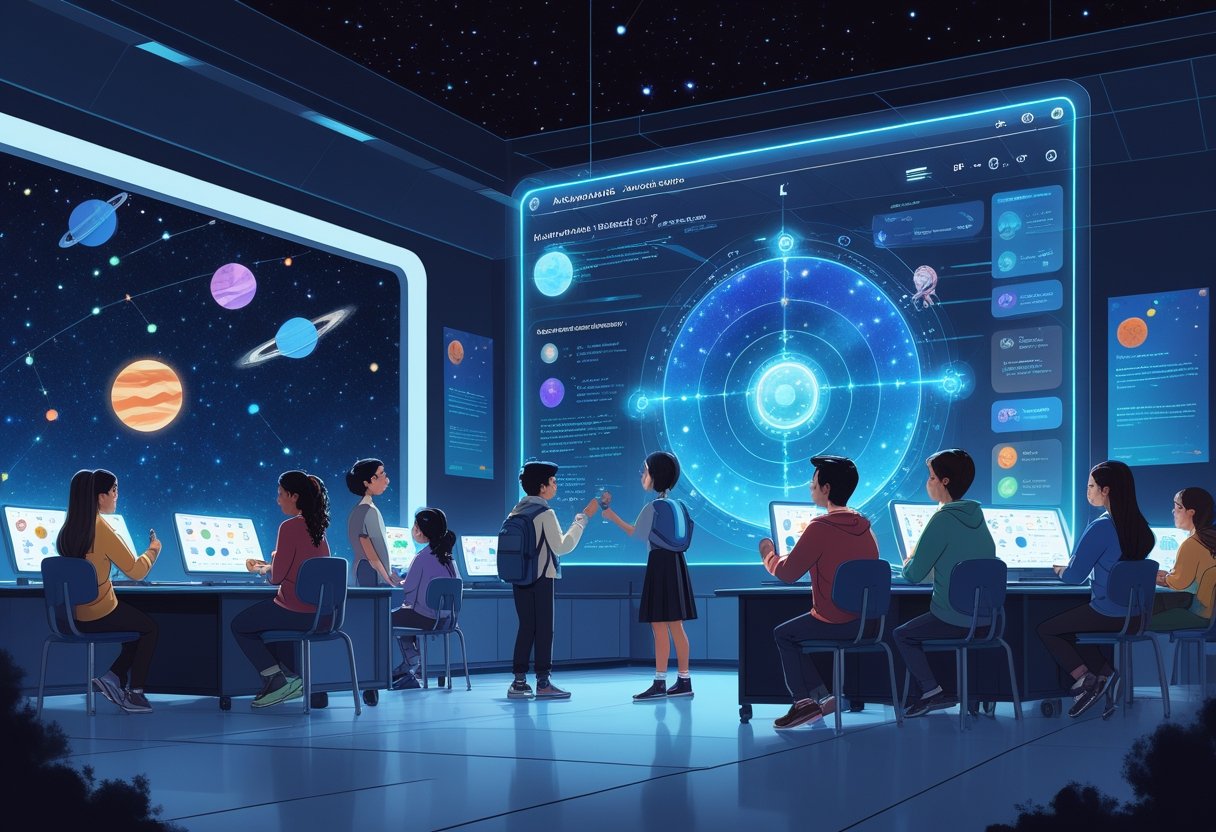
I explain how AI tools transform instruction, data exploration, and visualization in astronomy while highlighting practical trade-offs you should expect.
Types of AI Used in Astronomy Learning
I use several AI categories when designing learning experiences for astronomy students.
- Machine learning (ML): Supervised models help classify galaxy morphologies and variable stars from survey data. I apply ML to automate labeling tasks and to generate practice datasets that mirror real survey biases.
- Generative models: I employ text models to create tailored lesson explanations and image models to produce scientifically plausible visualizations for concepts like nebula structure. These accelerate content creation for diverse learning levels.
- Explainable AI (XAI): I prioritize XAI methods so students can trace why a model made a classification, which builds data literacy and critical thinking.
- Simulation-driven AI: I integrate physics-based simulators with AI surrogates to let students run parameter sweeps (orbit parameters, stellar populations) in minutes rather than hours.
I choose tools based on learning objectives, data availability, and the need for interpretability.
Benefits of AI for Astronomy Students
AI boosts personalized learning and hands-on data skills that astronomy courses need.
I use adaptive tutors to identify gaps in a student’s knowledge—then present targeted exercises on celestial mechanics or photometry. This reduces wasted time on already-mastered concepts.
AI also enables affordable, realistic labs: students can analyze calibrated survey datasets, run classification projects, and generate publication-quality plots using the same pipelines astronomers use.
Visualization models help students grasp scales and spectral differences that text alone cannot convey.
Additionally, exposure to AI workflows prepares students for research roles that increasingly rely on ML pipelines and reproducible code.
Challenges and Limitations of AI Integration
I confront several practical and pedagogical limitations when integrating AI into astronomy learning.
Data quality and bias: public survey data contain selection effects; I must teach students to recognize these before trusting model outputs.
Compute requirements: training complex models demands GPUs and cloud credits many institutions lack, so I often rely on pre-trained models or lightweight algorithms.
Misleading visuals and hallucinations: generative image or text models can produce plausible but inaccurate representations; I train students to verify outputs against peer-reviewed literature or raw data.
Assessment alignment: I design rubrics that evaluate both scientific reasoning and AI literacy to avoid overvaluing polished outputs produced by opaque models.
Ethical and accessibility concerns also matter—students need guidance on responsible AI use and on making tools available to diverse learners.
Defining Personalized Astronomy Learning Goals
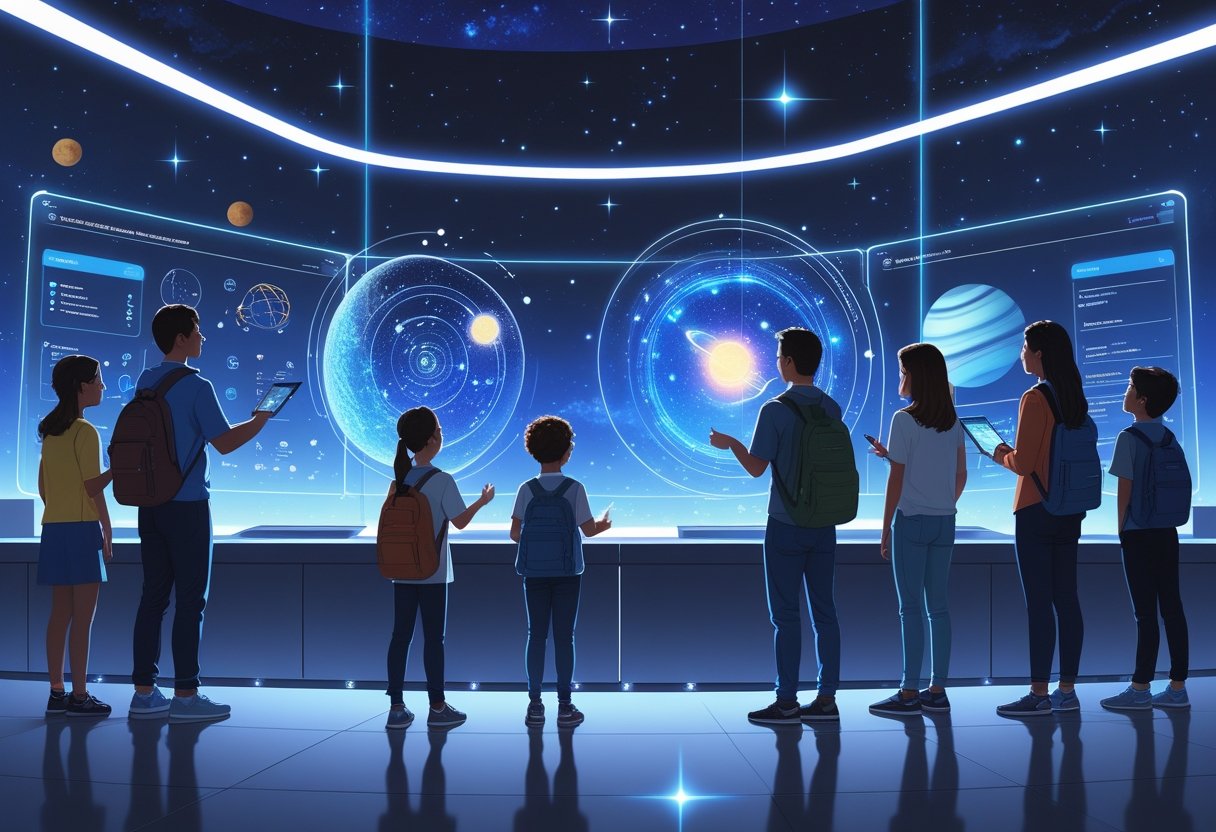
I focus on clear, measurable goals tied to skills, content areas, and activities so my plan guides study time and technology choices. I prioritize outcomes I can assess: concept mastery, data-analysis skills, observing proficiency, and sustained engagement with astronomy.
Identifying Key Learning Objectives
I begin by listing concrete objectives that match my timeline and resources. Examples:
- Understand the lifecycle of stars and explain spectral classification.
- Use telescope controls to perform a polar alignment and capture a 5‑minute stacked image of Jupiter.
- Import, clean, and plot light-curve data in Python to identify transit signals.
I rank objectives by priority and effort required. I mark each as short-term (weeks), medium-term (months), or long-term (year+). This lets me allocate AI-driven lessons and simulations efficiently.
I map objectives to assessment types: quizzes for conceptual knowledge, lab reports for data skills, and observing logs for practical ability. I then assign measurable success criteria (e.g., 80% quiz score, three quality images, reproducible code analysis).
Assessing Prior Astronomy Knowledge
I run a quick skills audit to avoid redundant work. I list what I already know (basic mechanics, algebra, sky constellations) and what I lack (spectroscopy interpretation, photometry, Python scripting).
I use targeted diagnostics: short concept quizzes, a one‑hour coding task, and a night-sky identification exercise. These pinpoint gaps and inform pacing. I record scores and examples of work so an AI tutor can adapt content.
I factor in workflows and tools I use—desktop vs. mobile, available telescopes, and preferred programming environments. That ensures my personalized learning path ties directly to applicable practice, not abstract modules.
Tailoring Goals to Individual Interests
I align goals with topics that keep me motivated, such as exoplanets, cosmology, or astrophotography. If I prefer hands-on practice, I emphasize observing logs and image processing tasks. If I like data work, I prioritize time-series analysis and simulation exercises.
I let interest drive elective objectives while keeping core competencies mandatory. For example, if exoplanets attract me, I still require a baseline of stellar astrophysics and statistics to support that focus.
I write each goal with context: why it matters to me, what tool or AI feature will help, and a clear success metric. This makes the personalized plan practical and durable, and helps AI recommendations stay relevant to my learning preferences.
AI Tools and Platforms for Personalized Astronomy Learning
I focus on practical tools that let me tailor pace, content, and practice to a learner’s goals, skill level, and data sources. The options below show where AI can handle content curation, simulated observation, assessment, and adaptive delivery so I can build an efficient, measurable study plan.
AI-Powered Learning Platforms
I use AI-powered learning platforms to create individualized study paths based on a learner’s background and goals. These platforms ingest syllabus material, lecture notes, or past quiz results and generate a mapped curriculum that prioritizes weak topics such as orbital mechanics or spectral analysis.
Key capabilities include automated concept mapping, spaced-repetition scheduling, and generation of concise summaries or flashcards from lecture text. Many platforms incorporate NLP to convert readings into practice questions and to explain answers in plain language.
For classroom use, I can assign different tracks to students and track progress dashboards that highlight mastery gaps. Some commercial tools also offer community features and educator controls for assigning custom modules.
Interactive Simulations and Virtual Labs
I rely on interactive simulations to give hands‑on experience with telescopes, orbital dynamics, and spectroscopy without physical equipment. High-fidelity virtual labs let me adjust parameters — aperture size, exposure time, or redshift — and immediately see effects on simulated images or data.
These environments often embed AI agents that suggest next experiments, detect common misconceptions (for example, confusing apparent and absolute magnitude), and adapt difficulty in real time. I can export simulated observation logs for later analysis or import real datasets to compare with model outputs.
Using these tools, students practice observational planning, learn data-reduction steps, and build intuition about instrument limitations before they access real telescopes.
Automated Assessment and Feedback
I use automated assessment to measure understanding and provide rapid, targeted feedback. Systems generate varied question sets from core materials and grade open responses using rubrics augmented by NLP scoring.
Immediate feedback pinpoints conceptual errors, recommends remedial modules, and suggests specific exercises — for instance, additional problems on light curves if a student struggles with exoplanet transit interpretation. Educators get analytics on cohort performance, item difficulty, and time-on-task to inform lesson adjustments.
When configured well, automated grading saves time while maintaining consistent standards and enabling frequent low‑stakes testing that improves retention.
Customized Content Delivery
I configure customized content delivery so each learner receives the right format at the right time. AI models classify learner preferences (video, text, interactive) and deliver the same concept in multiple modalities: a short explainer video on stellar evolution, a stepwise text walkthrough of H-R diagram placement, or an interactive plot to manipulate stellar parameters.
Adaptive sequencing spaces review and introduces advanced topics only after mastery. I can link external tools, such as personalized feeds of curated articles or tailored telescope observing lists, to keep content aligned with learning goals.
Educators can inject curriculum constraints and learning objectives, while AI maintains engagement and optimizes for measurable skill gains.
Relevant reading: explore an example lab manual integrating generative AI for astronomy exercises at ResearchGate (Artificial Intelligence and Astronomy Lab Manual for Generative AI-Based Learning Activities) (https://www.researchgate.net/publication/392236622_Artificial_Intelligence_and_Astronomy_Lab_Manual_for_Generative_AI-Based_Learning_Activities).
Designing a Step-by-Step Personalized Astronomy Learning Plan
I focus on concrete steps you can apply immediately: how I choose resources, set adaptive schedules, and add visual tools that map to specific celestial bodies and learning goals.
Curating Astronomy Resources with AI
I start by defining a learning objective for each unit (e.g., orbital mechanics, stellar classification, or observational techniques).
Then I use AI-powered search and recommendation tools to assemble a balanced set of materials: peer-reviewed papers for theory, interactive tutorials for concepts, and beginner-to-advanced video lectures for skills progression.
I filter content by readability, length, and alignment with my objective. I ask the AI to rank items by estimated study time, prerequisite knowledge, and user ratings.
I also include practical resources: astronomy software manuals, telescope setup guides, and datasets for hands-on work.
To keep content personalized, I have the AI generate 3–5 micro-lessons from larger sources that match my current skill level.
When a resource conflicts with another, I request a short AI-generated comparison that highlights differences and recommends which to follow based on my goals.
Building Adaptive Study Schedules
I translate objectives into time-bound milestones and let an adaptive scheduler propose a weekly plan.
The scheduler weighs my available hours, attention span, and skill gaps to allocate study blocks for reading, simulations, and observing sessions.
I use rules: prioritize practice (labs, image processing) over passive reading when learning a new observational technique.
I set recurring low-effort tasks—15–30 minute reviews of terminology or star charts—to reinforce retention between major sessions.
I monitor progress through short quizzes and task completion; the AI adjusts future sessions by increasing practice time if I score below threshold or introducing advanced problems when I demonstrate mastery.
I keep buffer days for weather-dependent observing and reserve time for processing astrophotography or analyzing telescope data.
Incorporating Visualizations and Sky Maps
I integrate interactive sky maps and 3D visualizations that align with each lesson’s target celestial bodies.
For example, when studying planetary motion I load a solar system simulator set to date ranges that show conjunctions and oppositions relevant to planned observing nights.
I use layered visual aids: labeled star charts for naked-eye observing, annotated deep-sky object maps for telescope use, and spectrogram viewers for stellar classification exercises.
I ask AI to generate step-by-step visualization presets—camera settings, filter choices, and framing suggestions—for specific targets like Messier objects or planets.
I schedule visualization sessions immediately before observing windows to reinforce orientation skills.
After observations, I compare my images or logs with AI-enhanced visual references to identify discrepancies and refine the next learning cycle.
Relevant tools and reading I often use include AI-curated lesson sets, interactive planetarium apps, and telescope data-processing tutorials to keep my personalized astronomy learning practical and measurable.
Exploring Core Astronomy Topics with AI Assistance
I outline concrete, study-ready ways to use AI to learn about objects, events, and life cycles in the sky. I emphasize methods that let you analyze images, measure properties, and build data-driven intuition.
Understanding Celestial Bodies
I use AI tools to classify and quantify celestial bodies—planets, moons, asteroids, comets, dwarf planets, and exoplanets—starting from raw observations. For images I run a convolutional neural network (CNN) or a pretrained vision model to separate resolved objects from background noise, then extract measurable properties: angular size, apparent magnitude, color indices, and surface features. For exoplanets I combine transit light-curve fitting with Gaussian process noise models to estimate radius and orbital period.
I organize results in a short table to guide follow-up work:
- Object type — Key AI task — Primary measurements
- Planet/moon — Image segmentation — Diameter, albedo, craters
- Asteroid/comet — Object detection — Orbit elements, activity index
- Exoplanet — Transit modeling — Radius, period, transit depth
I validate AI outputs by cross-checking catalog data (e.g., Minor Planet Center) and by running uncertainty estimates. That keeps my measurements reproducible and suitable for assignments or citizen-science projects.
Analyzing Celestial Phenomena
I focus AI workflows on transient and periodic phenomena: eclipses, transits, meteor showers, novae, supernovae, and variable stars. For time-domain data I train or fine-tune sequence models—LSTM, Transformer, or simpler autoregressive regressors—to detect periodicity, flare events, and sudden brightening. I feed the model calibrated light curves and include contextual features: position on the detector, local background level, and known catalog neighbors.
I create targeted alerts and visualization dashboards so I can inspect candidate events quickly. Key steps I follow:
- Preprocess: detrend and normalize time series.
- Detect: run anomaly detection or period-search algorithms.
- Classify: assign likely phenomenon (e.g., Type Ia vs. core-collapse) using multimodal inputs.
I always examine the model’s feature importance or attention maps to confirm the classification uses astrophysical signals rather than artifacts.
Studying Stellar Evolution
I use AI to link observable stellar properties to evolutionary stages for main-sequence stars, giants, white dwarfs, and pre-main-sequence objects. I combine photometric colors, spectra (when available), and parallax-based absolute magnitudes as input features to regression or classification models. Models predict parameters such as mass, radius, age, and metallicity, and they map stars onto the Hertzsprung–Russell diagram automatically.
I incorporate stellar evolution model grids (e.g., MESA or PARSEC) as training priors to keep predictions physically consistent. Practical tasks I perform:
- Estimate age and mass from color-magnitude features.
- Identify red giants and estimate core/fusion status.
- Flag unusual objects (blue stragglers, subdwarfs) for follow-up spectroscopy.
I report uncertainties and compare AI-derived ages with cluster ages or isochrone fits to assess reliability before using results in study plans or projects.
Maximizing Learning Outcomes and Future Development
I focus on measurable gains, active collaboration, and iterative refinement to keep my astronomy learning aligned with career or hobby goals. Practical metrics, educator input, and community feedback guide adjustments so I build both knowledge and transferable skills.
Tracking Progress with AI Analytics
I use AI analytics to monitor mastery of concepts like celestial mechanics, spectroscopy, and observational techniques. Dashboards show competency scores, time-on-task, and error patterns; I check these weekly to spot weak topics and prioritize study sessions.
I set clear thresholds (for example, 85% mastery on orbital mechanics problems) so the system can trigger targeted micro-lessons or practice problems automatically.
Key metrics I track:
- Mastery percentage by topic.
- Response time and accuracy on problem sets.
- Retention measures from spaced-repetition recall tests.
When analytics flag persistent errors, I assign guided simulations or request focused feedback from an educator via the platform. That combination—AI diagnostics plus human insight—shortens the feedback loop and prevents misconceptions from becoming entrenched.
Connecting with Educators and Peer Communities
I schedule regular check-ins with educators to validate conceptual understanding and get recommendations for readings or lab exercises. I prefer short, focused mentoring sessions (20–30 minutes) where we review my analytics and co-create next steps.
I also join astronomy study groups and forums to test ideas, share observing plans, and compare data from backyard telescopes or public datasets.
Practical ways I engage others:
- Post weekly observing logs to a peer group for critique.
- Request rubric-based feedback from an instructor on lab write-ups.
- Participate in guided lab nights or virtual office hours to practice instrument setup.
These interactions expose me to diverse problem-solving approaches and keep my personalized learning plan accountable. Educators help translate analytics into teaching actions; peers provide real-world practice and motivation.
Evaluating and Adjusting Your Learning Plan
I review my plan monthly, using a short checklist that maps goals to progress and available time. If I miss milestones, I re-balance intensity (e.g., swap a theory module for hands-on observing) and update deadlines.
I apply concrete decision rules: extend a module if mastery <80% after two attempts, or accelerate to the next topic when I hit 90% mastery and can teach the concept aloud.
Adjustment steps I follow:
- Export last 30 days of AI performance data.
- Discuss anomalies with an educator or mentor.
- Reallocate study blocks and add specific resources (simulations, datasets, or mentor sessions).
This cycle keeps my learning efficient and ensures personalized learning remains responsive to my pace, interests, and evolving astronomy goals.
Leave a Reply