
You’ll quickly see how artificial intelligence helps NASA make smarter decisions, move spacecraft autonomously, and turn massive streams of data into discoveries. AI lets spacecraft and rovers act on their own, optimizes mission schedules, and finds scientific signals humans would miss—so missions run safer and produce more science.
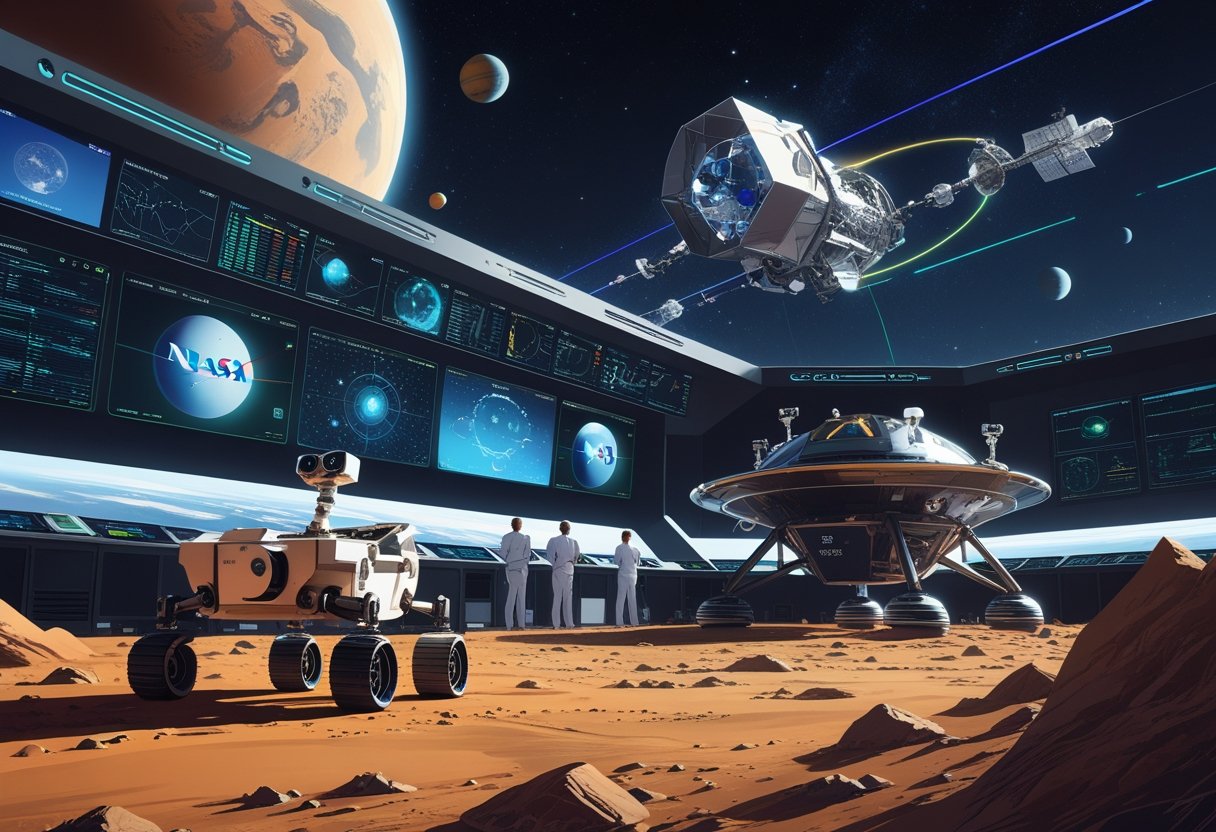
I’ll walk you through how AI works at NASA in plain language, from onboard autonomy that steers rovers to algorithms that sort exoplanet signals and monitor spacecraft health. Expect clear examples of autonomous exploration, mission planning and operations, data-driven discovery, and how humans and AI collaborate on complex missions.
Follow along to learn specific ways AI already shapes space exploration and what that means for future missions to Mars, the Moon, and beyond.
What Is Artificial Intelligence and How Does NASA Use It?
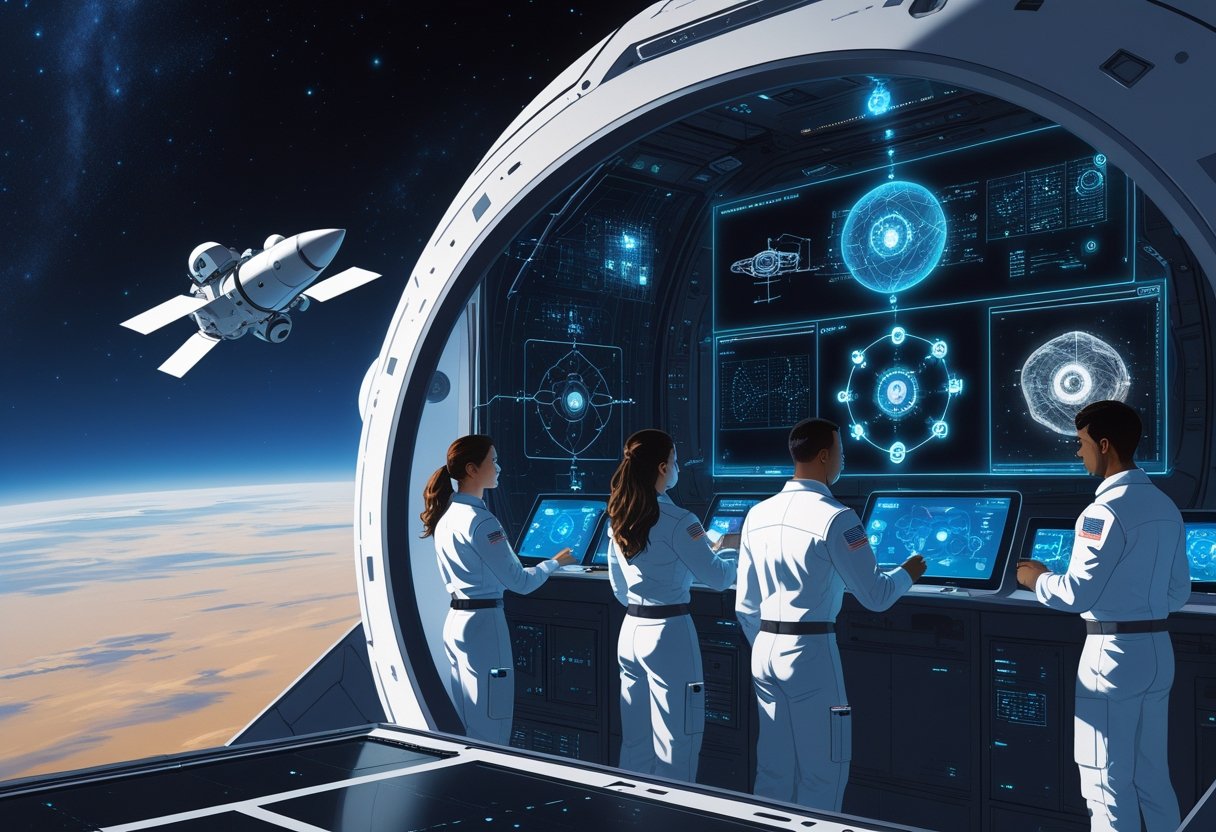
I explain what AI means for spacecraft and missions, how NASA organizes AI work, and the major milestones that show AI moving from research into operations.
Definition of Artificial Intelligence in Space Context
I define artificial intelligence here as software and algorithms that can perceive, decide, learn, or act with limited human intervention. In NASA’s context that includes onboard autonomy (real-time navigation and hazard avoidance), data-driven science (classifying exoplanet signals or processing satellite imagery), and mission-support tools on Earth (scheduling, anomaly detection, and predictive maintenance).
AI systems used by NASA combine methods such as machine learning, computer vision, planning, and symbolic reasoning. They often run on resource-constrained hardware, so engineers prioritize model efficiency, robustness to sensor noise, and explainability. I emphasize safety: verification, validation, and human-in-the-loop controls remain central to deployment decisions.
Overview of AI Adoption at NASA
I describe NASA’s institutional approach: distributed research groups, mission teams, and a central AI leadership role. NASA created a Chief Artificial Intelligence Officer position to coordinate policy and adoption; David Salvagnini currently fills that leadership function to align AI efforts across centers and missions.
Adoption spans from early research to operational use. Teams prototype algorithms in simulation, test them on airborne or rover analogs, then integrate vetted capabilities into flight software. Onboard autonomy on rovers, AI-assisted Earth science products, and automated mission planning illustrate this pipeline. NASA also engages external partnerships for commercial and academic advances.
Key NASA AI Milestones
I highlight milestones that demonstrate real capability and operational impact.
- Perseverance rover autonomous driving: the rover performs hazard detection and drives autonomously for most traverses, reducing reliance on Earth-based commands.
- Onboard AI research platforms: projects like OnAIR create standardized pipelines and architectures for testing onboard machine learning and autonomy.
- Agency-level AI governance: issuance of use-case reports and adoption frameworks to manage risk and accelerate vetted deployment across missions.
- Earth-science and discovery successes: automated analysis of satellite imagery for disaster response and machine learning pipelines that aid exoplanet detection.
Each milestone pairs technical achievement with policy and testing progress. I point to operational demos, software platforms, and governance steps as the combined path that moves AI from lab experiments into mission-critical roles.
AI-Powered Autonomous Exploration
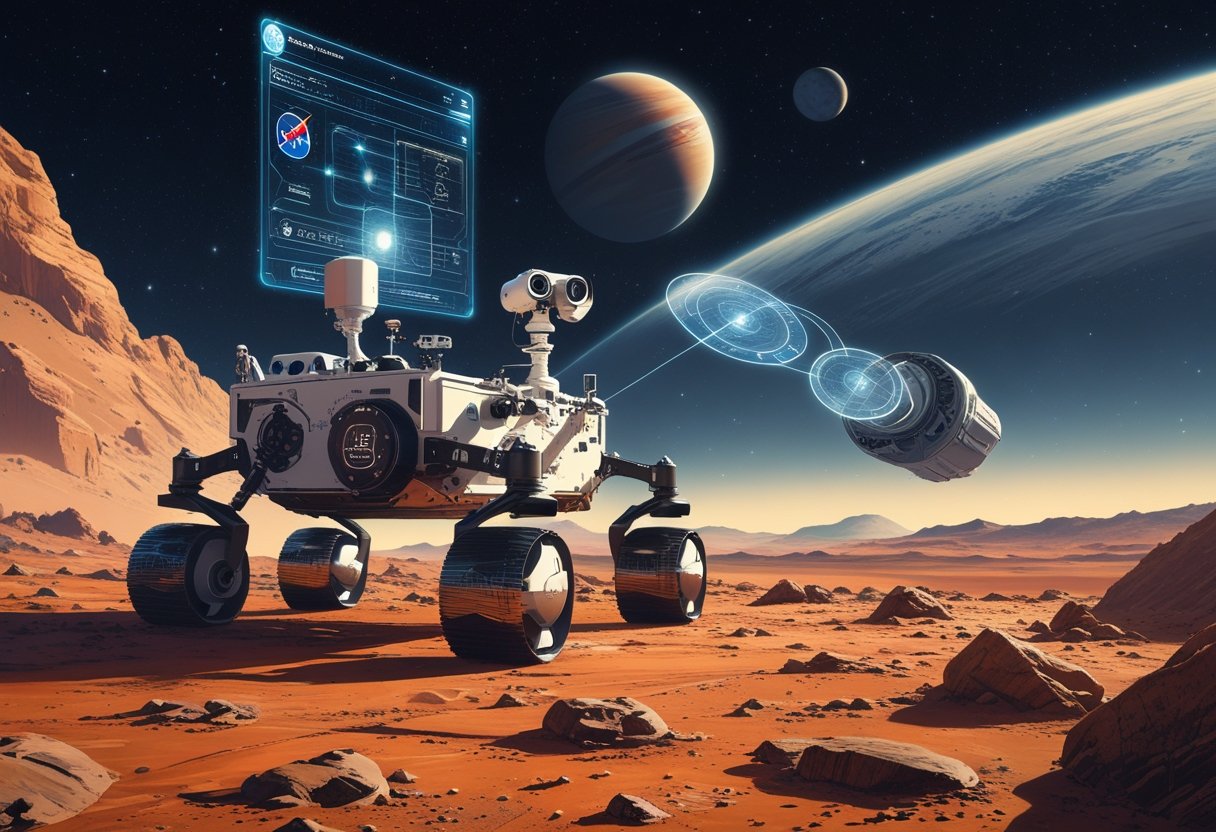
I describe how onboard AI enables spacecraft and rovers to make timely decisions, navigate unknown terrain, select scientific targets, and manage operations with far less ground intervention than earlier missions did.
Why Autonomy Is Essential in Deep Space
I rely on autonomy because signal delays and limited bandwidth make real-time control from Earth impossible for deep space missions. Round-trip communication with Mars can exceed 10 minutes, and farther probes face hours or days of latency. That delay forces spacecraft and rovers to detect hazards, adjust paths, and prioritize tasks without waiting for commands.
Autonomy also preserves power and bandwidth. An onboard system decides which data to compress, transmit, or discard, and schedules instrument use when energy is available. Those choices maximize scientific return per watt and per megabit.
Autonomous Navigation for Rovers and Spacecraft
I focus on algorithms that process camera images, LIDAR, and inertial sensors to build local maps and plan safe routes. For rovers, visual odometry and stereo imaging let the vehicle estimate terrain slope, identify obstacles, and compute wheel trajectories in real time. For spacecraft, optical navigation uses star and surface landmarks to refine trajectory and attitude.
Autonomous navigation blends classical control with machine learning: ML models classify traverseable terrain while deterministic planners ensure collision-free paths. This hybrid approach gives predictable safety with improved adaptability to novel terrain.
Popular NASA Systems: AutoNav, AEGIS, MLNav
I highlight three systems NASA uses or develops. AutoNav performs onboard optical navigation for deep-space probes, using images of planets or stars to update trajectories without Earth-based processing. AEGIS (Autonomous Exploration for Gathering Increased Science) runs on Mars rovers to autonomously select and image scientifically interesting targets during a single drive or observation window. MLNav refers to machine-learning navigation prototypes that classify features and suggest safe routes, augmenting traditional planners.
Each system trades off autonomy level and computational load. AutoNav emphasizes precise astrodynamics; AEGIS emphasizes science targeting; MLNav emphasizes perception and rapid decision-making. Together they support autonomous operations across spacecraft and planetary rovers.
Real-World Example: Perseverance Rover
I describe Perseverance as a practical example of onboard autonomy. The rover uses an integrated set of autonomy tools: visual odometry for short-term wheel control, AEGIS-like capabilities for target selection, and on-the-fly stereo imaging to avoid hazards during drives. These systems let Perseverance cover more ground and collect more samples than it could under strict ground command.
Perseverance’s autonomy reduced command latency effects and increased science flexibility. Onboard decision-making enabled the rover to adapt drives around boulders, select promising outcrops for imaging, and prioritize samples—demonstrating how autonomous rovers extend mission reach in deep space.
Relevant reading: NASA’s overview of its Artificial Intelligence programs
Mission Planning, Scheduling, and Operations
I describe how AI helps plan complex missions, create executable schedules, and adapt operations when conditions change. The focus is on automated planning tools, scheduling systems like ASPEN and CLASP, and AI-driven resource management for real-time mission execution.
AI in Automated Mission Planning
I use automated planners to generate task sequences that meet scientific goals and spacecraft constraints. These planners take inputs such as scientific priorities, communication windows, power budgets, thermal limits, and instrument availability. The planner searches for action sequences that maximize science return while obeying safety and engineering rules.
I rely on symbolic planners and mixed-integer optimizers depending on problem scale. Symbolic planning handles logical task dependencies; optimization handles numeric constraints like energy and downlink volume. I validate plans with simulation tools that model spacecraft state over time and flag infeasible actions.
I incorporate machine learning for pattern recognition in telemetry and to propose candidate plan fragments based on past missions. That shortens planning cycles and reduces human workload while keeping engineers in the loop for final approval.
Scheduling with ASPEN and CLASP
I use ASPEN to translate high-level goals into time-ordered schedules that respect hard constraints. ASPEN (Automated Scheduling and Planning Environment) encodes resource models — for power, data, and instrument conflicts — and produces conflict-free schedules suitable for uplink to spacecraft.
I use CLASP (Coverage Planning & Scheduling) for longer-term coverage and coordination across assets. CLASP optimizes which observations to take and when, considering revisit rates and spatial coverage requirements. It balances competing objectives such as maximizing science value versus minimizing resource consumption.
Both tools support what-if analysis. I can modify constraints or priorities and quickly regenerate schedules. That lets mission teams evaluate trade-offs — for example, swapping a high-power instrument observation for extended communications — before committing to uplink.
Resource Management and Adaptive Operations
I monitor spacecraft telemetry and feed real-time state into AI agents that manage resources and trigger adaptive responses. These agents track battery state-of-charge, thermal margins, and data buffer occupancy to prevent violations of operational limits.
I implement rule-based safeguards plus learning-based predictors for component degradation and fault likelihood. Predictors forecast, for instance, when an instrument will exceed thermal limits, allowing the scheduler to reassign tasks proactively. The system issues candidate commands and alerts engineers for time-critical decisions.
I also use onboard autonomy to handle short-timescale events. For time-critical navigation or anomaly response, onboard planning can alter sequences without ground contact, preserving mission safety and science continuity while respecting the higher-level constraints set by ground-generated schedules and policies.
AI for Scientific Discovery and Data Analysis
I focus on how AI turns massive, complex spacecraft and telescope measurements into concrete scientific results. I explain specific tools, how they work, and where they’ve already changed discovery workflows.
Handling Big Data from Space Missions
Spacecraft and observatories generate terabytes of raw data daily. I use machine learning models to automate tasks like image calibration, anomaly detection, and prioritized downlink scheduling so researchers see high-value data first.
For example, convolutional neural networks (CNNs) classify image features and separate instrument noise from real signals. Unsupervised learning clusters spectral signatures to flag unusual events for human review.
I also deploy pipelines that combine rule-based filters with learned models; rules ensure physical plausibility while models capture subtle patterns. These pipelines scale across distributed cloud storage and edge computing on probes when bandwidth is limited.
Detecting Exoplanets: ExoMiner and Kepler Space Telescope
Kepler produced long, precise light curves for over 150,000 stars, creating a perfect dataset for ML-based planet searches. I explain transit signals with supervised classifiers that learn from confirmed planet examples and vetted false positives.
ExoMiner applies deep neural networks to vet transit candidates, improving reliability over manual vetting by encoding known astrophysical false positive patterns. It reduces the human workload and increases sensitivity to small, Earth-size transits.
I emphasize training on labeled Kepler outcomes, cross-validating to avoid overfitting, and combining model scores with astrophysical vetting to produce high-confidence planet catalogs.
AI in Telescope Operations: Hubble and James Webb
I describe AI’s role in instrument health monitoring and observation scheduling for Hubble and the James Webb Space Telescope (JWST). Predictive maintenance models analyze telemetry to detect degrading components before failure.
Observation schedulers use optimization algorithms and ML to maximize science return under pointing constraints and limited thermal windows. For JWST, AI aids in target acquisition by pattern-matching guide stars and refining pointing solutions from onboard images.
Onboard processing reduces raw data volumes, sending prioritized high-value frames first. This lets mission teams respond faster to transient events like supernovae or gravitational-wave counterparts.
Search for Extraterrestrial Intelligence
I cover how AI helps distinguish technosignature candidates from natural astrophysical phenomena. Signal-processing neural nets scan radio and optical datasets to spot narrowband, repeating, or modulated patterns that match engineered transmissions.
Clustering and anomaly-detection systems filter millions of candidates, elevating only those with statistically unusual features for human analysis. I combine domain-specific rules—like dispersion behavior for radio signals—with ML to reduce false positives from human-made interference.
Collaborative platforms let researchers re-train models on new confirmed examples, continuously improving detection sensitivity while maintaining transparency in decision rules.
Improving Spacecraft Health and Sustainability with AI
I describe how AI helps spacecraft stay functional longer, detect failures quickly, and reduce debris risk through smarter operations and repair strategies. The following subsections explain predictive maintenance, real-time anomaly detection, and actions that advance long-term space sustainability.
Predictive Maintenance for Satellite and Spacecraft Longevity
I use predictive maintenance models that analyze telemetry streams, vibration readings, temperature logs, and power usage to forecast component degradation before it becomes critical. Models typically fuse time-series sensor data with historical failure records to estimate remaining useful life (RUL) for batteries, reaction wheels, and onboard computers.
I prioritize features such as sudden increases in current draw, rising bearing temperatures, and repeated error flags because those correlate strongly with impending failures. When a model flags elevated risk, mission planners can schedule reduced loads, switch to redundant hardware, or command corrective maneuvers to extend mission life.
I also emphasize transparency and validation: interpretable models and simulation-based testing verify predictions against known fault cases. This practice aligns with NASA’s emphasis on accountable AI and helps ensure operators trust automated recommendations.
Automated Anomaly Detection
I deploy anomaly-detection algorithms that run onboard and on the ground to spot deviations from normal system behavior within seconds to minutes. Techniques include unsupervised methods (autoencoders, isolation forests) to learn normal baseline patterns and supervised classifiers trained on labeled fault examples to prioritize critical alerts.
I focus on reducing false positives by combining multiple sensor channels and contextual mission data—orbital phase, thermal cycles, and commanded activities—to filter benign deviations. When an anomaly is detected, the system generates ranked alerts with suggested diagnostic actions and confidence scores so engineers can triage efficiently.
I also build automated containment responses for high-risk faults: safe-mode transitions, power reconfiguration, and isolation of faulty components. These preapproved actions let the spacecraft protect vital systems even when ground contact is delayed.
Advancing Space Sustainability
I apply AI to reduce collision risk, lower debris creation, and optimize end-of-life disposal to protect orbital environments. Models ingest cataloged object tracks, conjunction probabilities, and propulsion constraints to plan low-fuel avoidance burns and precise deorbiting maneuvers. See NASA’s discussion of AI uses in mission planning for context: https://www.nasa.gov/artificial-intelligence/.
I also use autonomy to extend usable life for aging assets via adaptive mission profiles and coordinated servicing. For multi-satellite constellations, AI can schedule cooperative maneuvers that minimize propellant use and reduce the chance of fragmentation events.
Finally, I incorporate responsible-AI practices—robust testing, risk management, and human-in-the-loop controls—so algorithms that affect orbital safety remain auditable and aligned with sustainability objectives.
Human-AI Collaboration in Space Missions
I describe how AI tools support astronauts directly, help with complex decisions, and require rules for data handling and ethical use. The following paragraphs explain specific crew-facing systems, decision workflows where AI adds value, and privacy and policy safeguards that govern AI on missions.
Crew Support: CIMON and Virtual Companions
I have seen crew-facing systems designed to reduce workload and provide companionship in isolated environments. One example is CIMON (Crew Interactive Mobile Companion), which uses voice interaction, facial recognition, and a conversational agent to help astronauts run experiments, retrieve procedures, and maintain morale. CIMON can display schematics, read experiment steps aloud, and respond to voice queries without a ground roundtrip, saving time during tightly scheduled operations.
Virtual companions now often blend rule-based task assistants with generative components for natural dialogue. I note that generative AI can produce clear instructions and summarize telemetry, but it must be constrained to avoid hallucinations. Onboard systems prioritize deterministic outputs for critical procedures and reserve conversational features for non-critical interaction.
Key practical features include: voice activation, offline models or vetted on-orbit inference, and audit logs of interactions for later review. These design choices reduce operator surprise and maintain mission safety while improving crew mental health and task efficiency.
AI-Assisted Astronaut Decision-Making
I rely on AI to compress large datasets into actionable options during time-critical events. Onboard autonomy analyzes sensor streams — life support metrics, power levels, and navigation telemetry — and presents ranked courses of action with estimated probabilities and trade-offs. The human-in-the-loop maintains final authority, reviewing AI suggestions and applying contextual judgment.
I emphasize transparency: AI outputs must include confidence scores, the rationale for recommendations, and comparable historical examples when available. This helps astronauts judge when to follow automated guidance. For navigation or surface traversal, autonomy can execute low-level controls while I focus on higher-level objectives.
Mission planners use AI on the ground to run simulation ensembles that expose failure modes and recommend contingency branches. I integrate those branches into crew procedures so that when AI proposes a response, the crew recognizes it as an approved contingency, reducing cognitive load and response time.
Managing Privacy and Responsible AI Use
I treat crew data — voice, video, biometric streams — as highly sensitive and apply strict controls. Systems log access, encrypt stored data, and limit telemetry shared with ground teams to what mission needs dictate. These practices align with federal guidance on AI governance and privacy, such as considerations from Executive Order 13960 about reliable, safe, and secure AI use.
I also enforce responsible-AI principles onboard: models undergo validation for robustness, bias checks, and failure-mode documentation before deployment. For generative features, I require guardrails that prevent fabrication of mission-critical facts and keep a clear separation between speculative suggestions and validated procedures.
Operational rules include least-privilege access, regular auditing, and clear consent protocols for recording crew interactions. These measures protect privacy, preserve crew trust, and ensure AI supports mission objectives without introducing unacceptable risk.
The Future of AI in NASA’s Space Endeavors
I expect AI will shift from a supporting tool to a mission partner, improving decision speed, autonomy, and scientific return while introducing new risks that need disciplined management.
Trends in Generative and Adaptive AI
I see generative models expanding how NASA creates mission artifacts and interprets data. Onboard models could synthesize terrain maps from sparse sensor inputs, produce telemetry summaries in natural language, and generate candidate plans for anomaly response. These models will adapt in-flight by fine-tuning on local data, reducing dependence on ground uplinks.
I anticipate tighter integration of physics-informed architectures so generative outputs respect orbital mechanics and instrument constraints. That reduces hallucination risk and keeps outputs actionable for flight software. I also expect workflow tools that let engineers rapidly validate and constrain model behavior before deployment.
Vision for Fully Autonomous Exploration
I envision rovers, landers, and probes making mission-level choices when latency prevents real-time human control. Autonomy will include multi-day navigation, fault diagnosis, and scientific target selection based on onboard hypothesis testing. I expect layered autonomy: reactive control for hazards, tactical planning for local science, and strategic planning that aligns with mission goals.
I plan for hybrid human–AI control where operators set high-level objectives and AI negotiates trade-offs like power, data budget, and risk. Autonomous sample caching, in-situ resource scouting, and coordinated swarm behaviors are specific capabilities likely to mature next.
Opportunities and Challenges Ahead
I identify clear opportunities: faster science return, extended mission life, and reduced operational costs through adaptive scheduling and anomaly prediction. Generative AI can accelerate instrument calibration and data compression, saving downlink bandwidth.
I also flag risks: model brittleness in novel environments, verification and validation for safety-critical systems, and data bias from limited training sets. I expect rigorous testing regimes, modular explainability tools, and policies for trusted updates to be necessary. Collaboration with industry and standards bodies will be essential to balance innovation with mission assurance.
Leave a Reply