
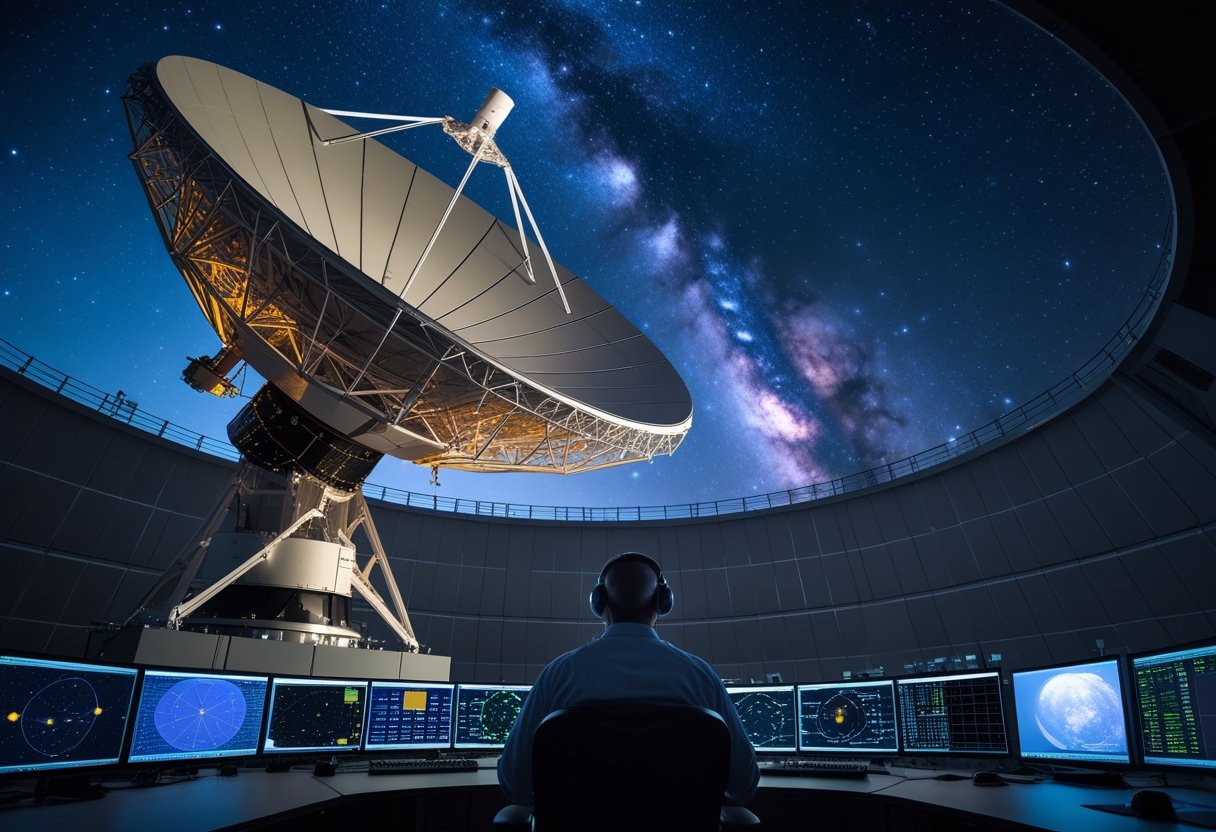
You can follow signals sent from a tiny transmitter on a distant probe all the way to Earth because NASA pairs giant, precisely aimed antennas with clever signal-boosting techniques and global coordination. That combination lets you get usable data and commands from spacecraft that are tens of billions of kilometers away.
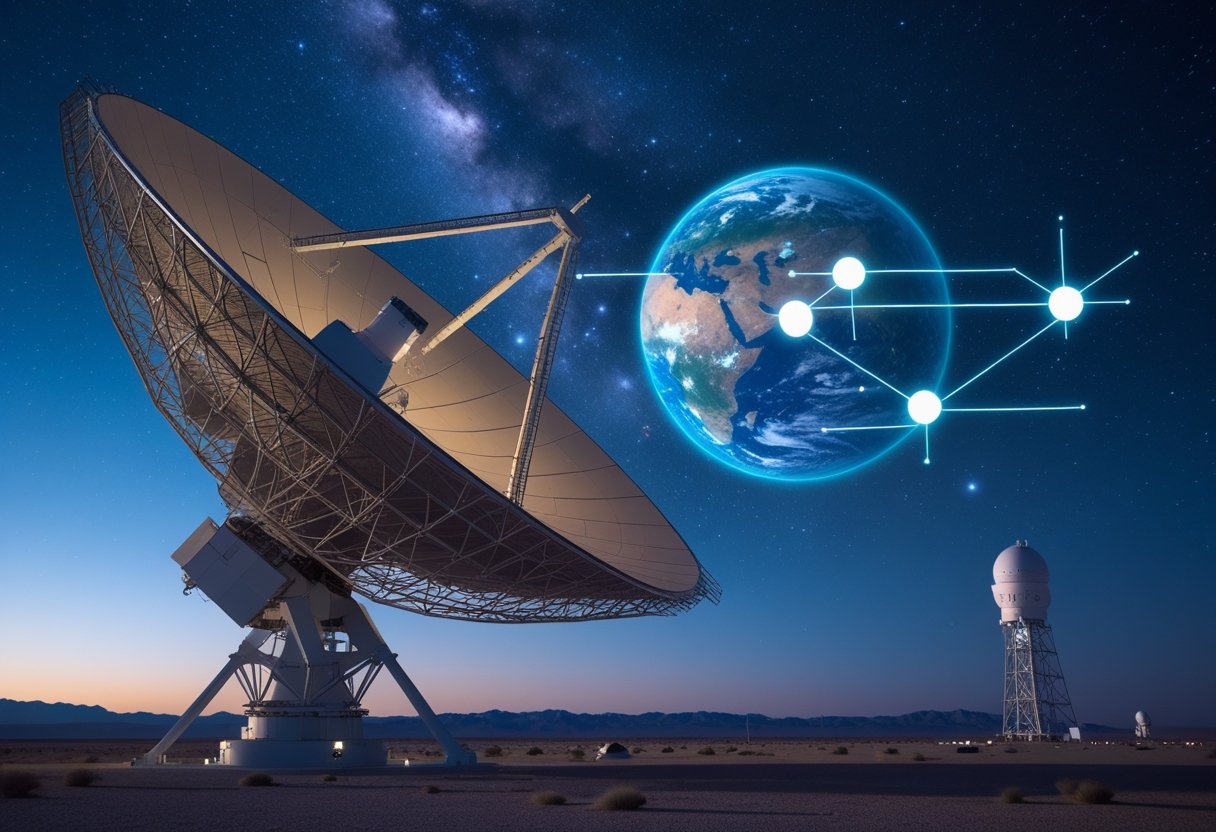
You’ll explore how radio waves carry binary messages at light speed, why antenna size and arraying matter, and how the Deep Space Network keeps continuous contact by spacing sites around the globe. Expect clear explanations of Voyager’s ongoing link across interstellar space, how spacecraft send and receive weak signals, and the new technologies driving future communications.
Stay with this post to see real examples, technical tricks engineers use to recover faint signals, and what comes next as missions push farther into the solar system and beyond.
The Science of Deep Space Communication
You’ll learn how spacecraft send and receive tiny radio signals across vast distances, why light-speed delays set strict timing, and how signal strength collapses with distance.
How Radio Waves Travel Across Interplanetary Space
Radio waves are electromagnetic waves your spacecraft uses to carry data as modulated carrier signals. Ground antennas convert those faint oscillations back into binary information—ones and zeros—using sensitive receivers and error-correction coding.
You rely on the Deep Space Network’s large parabolic dishes to collect as much of the radio energy as possible. Antenna size, transmitter power (often 10–20 watts on probes), and frequency band determine how much signal reaches Earth. Higher frequencies can carry more data but suffer greater pointing and atmospheric constraints.
Space is mostly empty, so there’s minimal absorption, but plasma near the Sun and planetary ionospheres can distort phase and polarization. You overcome this with redundancy: multiple passes, forward error correction, and mission planning that schedules the best geometries for high-data links.
Understanding the Speed of Light Limitation
Radio signals travel at the speed of light—about 300,000 km/s—so one-way communication with distant probes takes minutes to hours. For example, a probe 20 billion kilometers away yields a one-way delay around 18.5 hours.
That delay forces you to design spacecraft to operate autonomously for routine tasks and to queue time-critical commands well in advance. Real-time control is impossible beyond lunar distances; instead, you upload sequences and onboard fault protection that execute without immediate human intervention.
Mission timelines factor round-trip light time for telemetry confirmation and for planning antenna allocations. When you schedule transmissions, you must also account for Doppler shifts caused by relative motion, which change carrier frequency and affect receiver tuning.
Signals Fading Over Billions of Kilometers
Signal strength falls with the square of distance, so a tenfold increase in range cuts received power by 100 times. At interplanetary scales, that attenuation makes received signals vanishingly small—often below the thermal noise floor—so you depend on high-gain antennas and long integration times.
Engineers use techniques to recover data from extremely weak signals: narrowband receivers, coherent integration, and advanced error-correction codes that recover bits from noisy measurements. You’ll also see arraying, where multiple DSN antennas combine coherently to boost effective sensitivity.
Transmitter power, antenna gain, and link margin form a link budget you must optimize. Mission designers trade data rate for reliability: lower rates increase the chance of correct decoding at the cost of longer transmission windows.
NASA’s Deep Space Network: Earth’s Interstellar Phone Line

The Deep Space Network (DSN) links you directly to probes and orbiters far beyond Earth, capturing tiny radio signals and sending precise commands. You tap into three global sites, giant radio dishes, and a mission control backbone run by the Jet Propulsion Laboratory to keep data flowing across billions of kilometers.
DSN Locations Around the Globe
The DSN operates three complexes spaced roughly 120° apart to give you near-continuous contact with spacecraft. You will find them at Goldstone, California; near Madrid, Spain; and near Canberra, Australia. That spacing ensures at least one site can see a given deep-space target as Earth rotates.
Each complex hosts multiple antennas: 34-meter and 70-meter-class dishes plus newer 34-meter beam-waveguide antennas. You rely on this redundancy when a dish is down for maintenance or a mission needs extended bandwidth. The Jet Propulsion Laboratory coordinates which site tracks which spacecraft, schedules antenna time, and routes telemetry to mission teams.
How Radio Dishes Detect Faint Signals
Radio dishes collect and focus electromagnetic waves the spacecraft transmits. Your dish’s parabolic surface concentrates those waves onto a feed horn, where ultra-low-noise amplifiers boost signals that would otherwise be lost in thermal and cosmic noise.
Signal processing then extracts telemetry from signals that may arrive at picowatt power levels after traveling billions of kilometers. You depend on technologies like high-gain antennas on spacecraft, coherent transponders for two-way timing, and cryogenically cooled receivers at the DSN to improve sensitivity. Precise timing and frequency standards—locked to hydrogen masers—let you separate real spacecraft signals from interference and correct Doppler shifts caused by relative motion.
The Importance of Goldstone and Other Stations
Goldstone plays a central role in U.S. mission support and testing; its Mojave Desert location provides radio-quiet skies and large dishes for weak-signal work. You’ll often see Goldstone assigned to planetary missions, gravity-assist tracking, and spacecraft emergencies where every decibel of sensitivity helps.
Madrid and Canberra complete global coverage and share workload for sustained missions like Voyager, Juno, and Mars relays. Each site contributes unique capabilities: antenna size variations, local staffing for rapid response, and regional radio-frequency environments. Together they give your mission the continuous, reliable communications needed to receive images, send commands, and maintain spacecraft health across interplanetary distances.
For further details on DSN operations and site roles, see NASA’s overview of the Deep Space Network.
Voyager Mission: Communicating Across 24 Billion Kilometers
You will read how two decades-old spacecraft stay reachable across interstellar distances, how their power limits dictate data rates, and how error-correction keeps their faint signals usable.
Voyager 1 and Voyager 2’s Journey to Interstellar Space
Voyager 1 and Voyager 2 launched in 1977 and now operate well beyond the heliosphere. Voyager 1 sits near 24 billion kilometers from Earth; Voyager 2 follows a different trajectory through interstellar space.
Both spacecraft still send engineering data and limited science telemetry using their original radio systems, including low-power transmitters and high-gain antennas.
You rely on the Deep Space Network’s 70-meter antennas and arraying techniques to pick up Voyager signals. Arraying combines multiple antennas to increase sensitivity so Earth can detect the faint carrier and decode embedded binary telemetry.
The Voyagers’ trajectories and pointing maneuvers matter: their high-gain dish must remain accurately aimed at Earth to maintain the narrow radio beam across billions of kilometers.
RTG Power and Signal Longevity
Each Voyager carries a radioisotope thermoelectric generator (RTG) that converts plutonium-238 heat into electricity. The RTGs steadily lose output over time; that reduction forces mission controllers to prioritize essential instruments and lower transmitter power when needed.
Lower electrical power shortens transmission duty cycles and can reduce modulation complexity, which lowers data rates but preserves critical telemetry and engineering packets.
You should note the trade-offs: as RTG output declines, mission teams disable nonessential systems and stretch limited power across communications hardware.
This power management, combined with occasional use of older transmitters and reconfigured onboard processors, has allowed the Voyager spacecraft to keep sending the most valuable data — including system health, basic science readings, and the iconic Golden Record — decades after launch.
The Role of Error Correction in Maintaining Contact
Voyager telemetry uses forward error correction and redundant framing to protect data against bit errors introduced by distance and noise. Reed–Solomon–style codes and convolutional coding on older deep-space links let ground receivers reconstruct corrupted packets.
You will rely on the Deep Space Network’s signal-processing chains — carrier tracking, coherent demodulation, and soft-decision decoding — to recover bits that arrive below nominal signal-to-noise ratios.
Ground teams also use packet-level checksums and retransmission strategies where possible for engineering data.
When telemetry frames fail integrity checks, controllers extract what they can from partial frames and combine repeated transmissions to rebuild spacecraft state, enabling you to monitor Voyager health despite fading signal strength.
How Spacecraft Send and Receive Signals
Spacecraft use small, efficient radio transmitters and careful signal processing to exchange instructions, health telemetry, and science data across vast distances. You’ll read how ground teams send commands, how spacecraft reply with telemetry and science packets, and how engineers recover faint signals using modulation, error correction, and antenna techniques.
Uplink vs Downlink: Sending Commands and Receiving Data
You send commands from Earth through a ground antenna that transmits a tightly aimed radio beam toward the spacecraft. That uplink carries time-tagged command sequences and mission timelines encoded in a modulation format such as Binary Phase Shift Keying (BPSK) or Quadrature Phase Shift Keying (QPSK). Ground stations schedule windows and point using precise tracking data so the spacecraft’s receiver sees the intended signal above the noise.
The downlink is the spacecraft’s radio transmitter sending telemetry and science packets back to Earth. Telemetry includes avionics status, temperatures, voltages, and instrument states, packaged into frames with headers and checksums. You rely on uplink acknowledgments and downlink health flags to confirm commands executed correctly.
Transmitting with Low Power: Efficient Radio Transmitters
Your spacecraft uses a compact radio transmitter, often 10–20 watts for deep-space probes, to save mass and power. Designers prioritize high-gain antennas on the spacecraft, power amplifiers with efficient classes (e.g., TWT or solid-state amplifiers), and precise frequency control to make each watt count. Pointing accuracy is critical: a few degrees off reduces received power dramatically.
You trade raw power for long integration times, antenna arraying on Earth, and tight spectral occupancy. Onboard systems packetize data and schedule transmissions to match power budgets and DSN contact windows. These choices keep the transmitter small while still delivering usable signal-to-noise ratios at billions of kilometers.
Signal Processing and Decoding Faint Messages
When a DSN dish receives your spacecraft’s faint radio waves, engineers apply amplification, downconversion, and matched filtering to recover the carrier and modulation. Digital signal processing separates channels, compensates Doppler shifts, and synchronizes frames. Error correction codes such as Reed–Solomon and convolutional or LDPC codes correct bit errors introduced by noise.
You benefit from techniques like coherent integration, where many seconds or minutes of signal combine to raise detectability, and arraying multiple ground antennas to increase effective gain. After decoding, packets undergo telemetry processing: unpacking fields, checking checksums, and converting raw counts into engineering units for operations teams to act on.
Iconic Moments and Achievements in Deep Space Messaging
These milestones show how engineers turned faint radio whispers into reliable science links across the solar system. They reveal breakthroughs in antenna sizing, signal processing, and long-duration mission planning that keep data flowing from the edge of interstellar space.
Pale Blue Dot and the Legacy of Voyager
You can still feel the ambition behind Voyager 1’s 1990 “Pale Blue Dot” image. At roughly 6 billion kilometers from Earth, the spacecraft obeyed a risky command to turn its camera back toward the Sun and photograph Earth as a tiny pixel. The resulting image reached controllers as a very weak set of radio signals processed by NASA’s Deep Space Network (DSN).
That single pixel carried both scientific humility and an engineering triumph: the DSN’s large 70-meter antennas and ultra-low-noise receivers extracted meaningful data from an extremely low signal-to-noise ratio. Voyager’s continuous telemetry, now measured in sporadic beacon signals, also proved that decades-long communications can be sustained with careful power budgeting, fault protection, and predictable link margins.
Decoding the Faintest Signals: Challenges and Triumphs
You face extreme physics when decoding signals from billions of kilometers away: free-space path loss grows with the square of distance, spacecraft power is limited, and cosmic noise interferes. To overcome this, engineers use huge DSN dishes, cryogenically cooled amplifiers, and sophisticated error-correcting codes that recover data from bursts with many bit errors.
Operational techniques also matter: you schedule long integrations, use multiple DSN stations for handoffs, and run calibration scans to separate spacecraft tones from background. Advances such as automated fault detection and adaptive coding have let missions return science even as transmitters and power supplies age. These practical measures turned theoretical radio links into dependable pipelines for decades-long exploration.
Other Legendary Missions: New Horizons and Beyond
You watched New Horizons demonstrate speed and precision during its 2015 Pluto flyby and afterward as it sent back high-resolution maps from 6+ billion kilometers away. The mission relied on X-band radio, long downlink windows, and repeated error checking to deliver gigabytes of unique encounter data over months.
Beyond New Horizons, current developments include laser experiments like the Deep Space Optical Communications demo that prove optical links can multiply data rates versus radio. You’ll also see the DSN adapt: upgraded transmitters, expanded software-defined radios, and coordinated arrays enable future probes to send higher-resolution imagery and larger scientific datasets from ever greater distances.
Emerging Technologies and the Future of Spacecraft Communication
New hardware, optics, and ground infrastructure promise far higher data rates, lower latency, and more reliable links to probes across the solar system. You’ll see laser-based links increase throughput, upgraded ground stations boost reception and scheduling, and redundancy measures preserve contact when conditions degrade.
Laser Communication and High-Speed Links
You’ll get data rates 10–100× higher with laser (optical) communication compared with typical radiofrequency systems, enabling high-resolution science images and larger telemetry volumes from distant missions. Lasers concentrate energy into tight beams, which raises signal power per unit area at the receiver but requires precise pointing and atmospheric mitigation for Earth-to-space links.
Expect missions that test and use laser terminals for both spacecraft-to-spacecraft and spacecraft-to-Earth links. These systems rely on fine-pointing assemblies, gigabit-capable modems, and adaptive optics on the ground to compensate for scintillation and turbulence. NASA’s demonstrations with Psyche and other tech tests show viability for distances comparable to Earth–Mars separations; this moves deep space communication toward routine high-speed transfers.
The Next Generation of Ground Stations
Your ground segment will evolve from big parabolic dishes to mixed radio/optical facilities integrated into a single network. Upgrades include larger apertures, adaptive-optics-equipped telescopes for optical downlinks, and high-sensitivity low-noise receivers that increase effective signal power capture from faint transmitters.
Networks will coordinate scheduling across multiple nodes to maintain continuous coverage of fast-moving or distant probes. Modern ground stations will also incorporate software-defined radios and automated link acquisition to speed handovers. The Space Communications and Navigation program and Deep Space Network partners plan these types of upgrades to support higher data volumes and more simultaneous missions.
Ensuring Contact with Distant Explorers
You must manage reliability through redundancy across frequencies, transmitters, and relay architectures. Use of both radio and optical channels provides resilience: if atmospheric conditions block an optical path, RF links can carry critical telemetry. Relays—either orbiting communications satellites or inter-satellite laser links—reduce required transmit power from the spacecraft and lengthen contact windows.
Operational tactics focus on maximizing signal-to-noise ratio (SNR) at the receiver: increasing antenna gain, optimizing modulation and coding schemes, and timing transmissions for antenna elevation and minimal interference. These techniques keep command uplinks and science downlinks robust even when missions operate billions of kilometers away.
Leave a Reply