
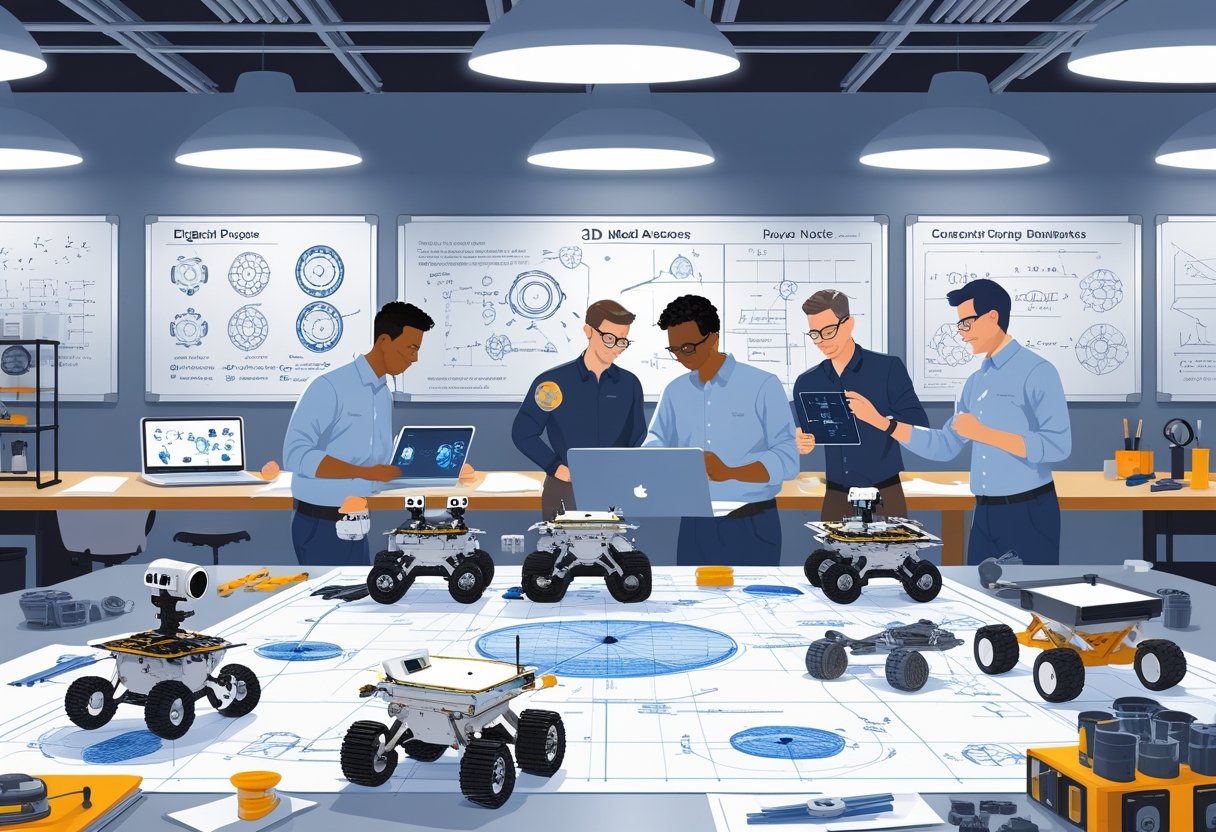
You’ll learn how engineers turn bold ideas into reliable machines that survive alien dirt, freezing nights, and months without real-time help from Earth. Engineers balance mission goals, harsh environments, and limited power to design rovers that move, sense, sample, and send back science—and this article breaks those choices down into clear, practical steps you can follow.
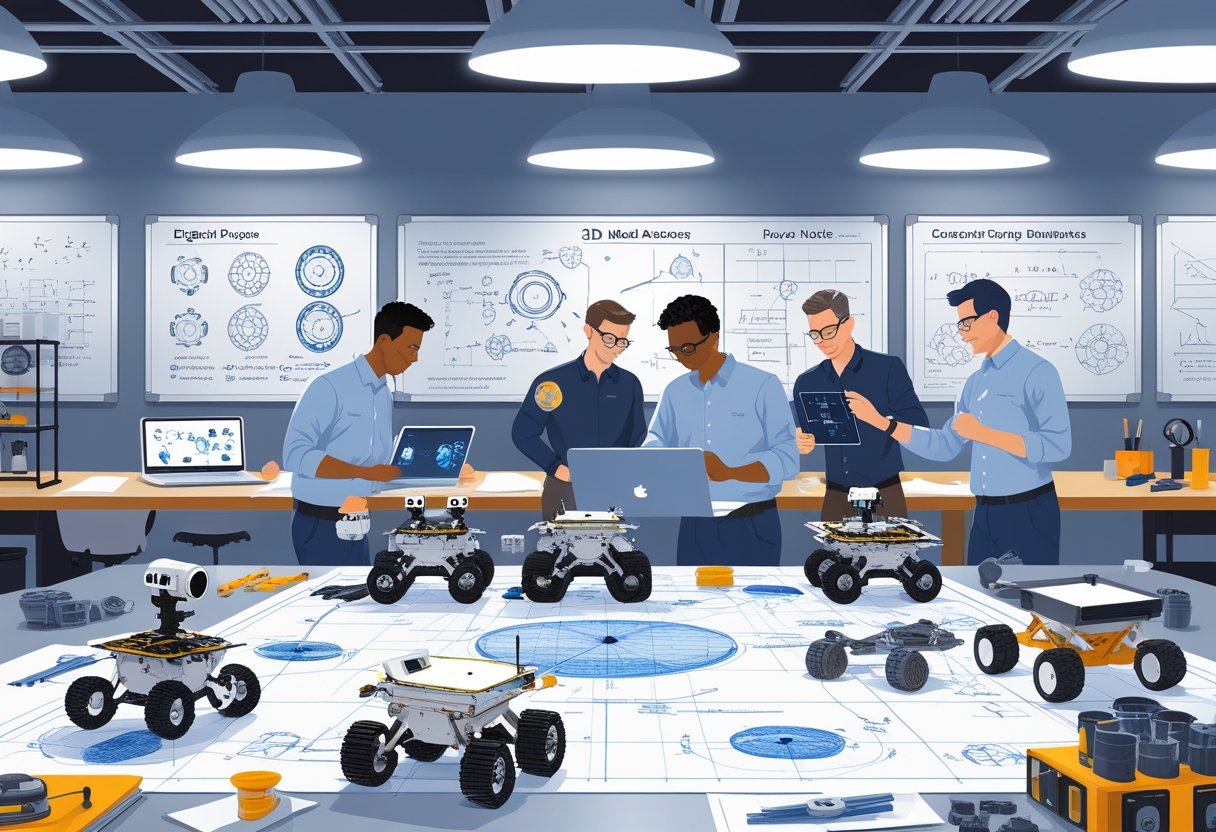
Expect plain explanations of what makes rovers different from ordinary vehicles, how teams choose wheels, power, and software, and why testing on Earth matters before launch. By the end, you’ll know the core components and design trade-offs that guide every decision, and you’ll spot how future innovations may change what rovers can do on other worlds.
What Makes a Space Rover Unique?
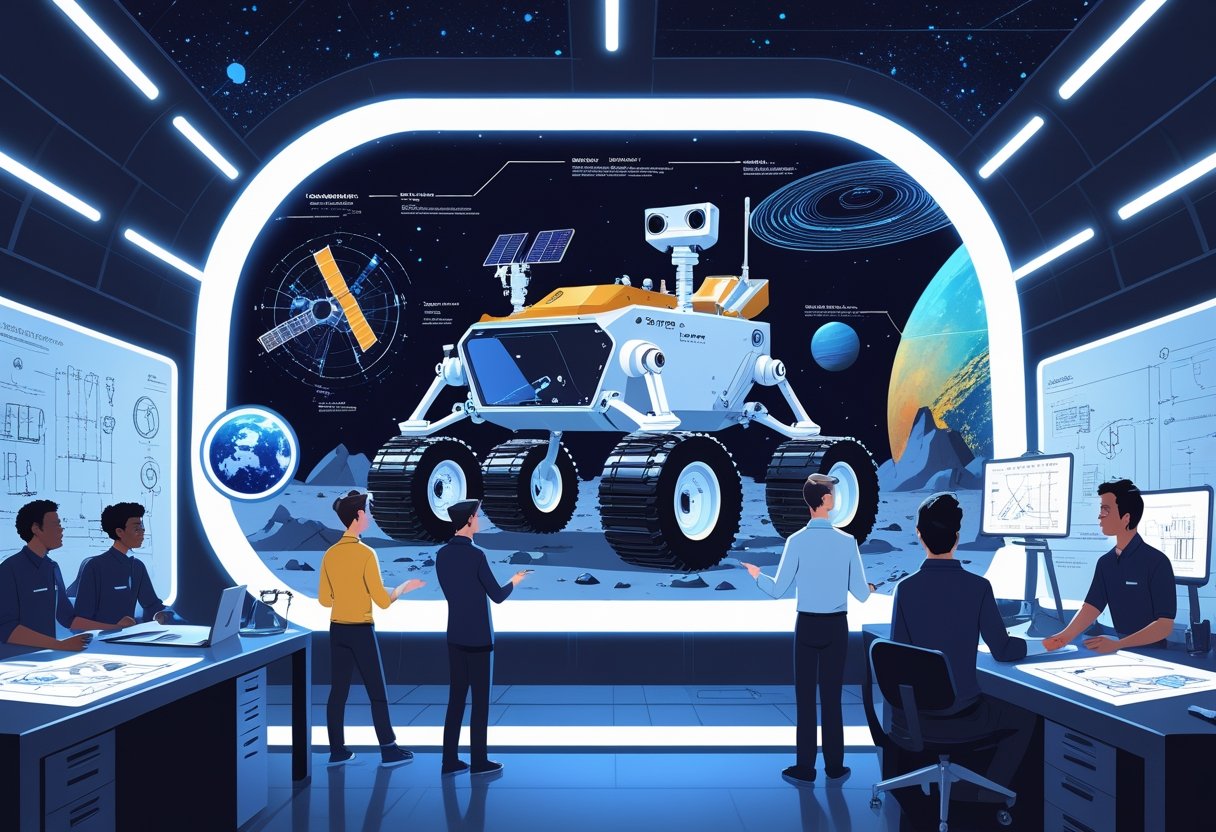
Rovers combine mobility, scientific instruments, autonomy, and rugged engineering into a single vehicle that must survive launch, landing, and years of operation. Design choices target specific science goals, terrain types, and the extreme temperatures, dust, and communication delays of other worlds.
Purpose and Mission Goals
You design a rover around clear objectives: sample collection, geological mapping, climate monitoring, or scouting for future human habitats. Those goals dictate payload mass, power budget, and instrument choices—drill depth for core samples, number and type of cameras for stereo mapping, or spectrometers for mineral ID.
If your mission prioritizes long-distance traverse, expect larger batteries or radioisotope power, stronger suspension, and higher wheel torque. If close-up chemistry matters, you trade range for precise sample-handling mechanisms, contamination controls, and calibration targets.
You also balance lifetime against cost: a multi-year planetary rover needs redundant electronics, radiation-hardened parts, and robust thermal control. Short-duration landers can use simpler systems but still require careful contamination and deployment planning.
Types of Space Rovers
You’ll see several rover classes tailored to mission needs: small tethered scouts, medium robotic explorers, and large crewed rovers.
- Small scouts: <50 kg, carry cameras and pathfinding sensors, used for site reconnaissance or tech demonstrations.
- Medium robotic rovers: 100–1000+ kg, carry complex lab instruments, sample caches, and autonomous navigation systems—examples include Mars explorers.
- Large crewed rovers: designed for astronauts, prioritize life support, pressurization, cargo capacity, and human ergonomics.
Design differences show up in mobility choices: articulated wheel-leg hybrids for very rough terrain, rocker-bogie suspensions for stable wheel contact, or wide low-pressure wheels to avoid sinkage. Your selection of autonomy level—teleoperation, supervised autonomy, or full autonomy—depends on distance from Earth and communication latency.
Key Challenges in Space Environments
You must solve constraints that don’t exist on Earth: extreme temperatures, abrasive dust, radiation, and long communication delays.
- Thermal: Electronics and batteries need heaters or radiators; materials must tolerate cycles from -130°C to +30°C on some bodies.
- Dust: Fine, electrostatically sticky regolith can jam joints, coat optics, and abrade surfaces; designers use seals, dust-tolerant bearings, and protective covers.
- Radiation and vacuum: You choose radiation-hardened components and lubricants that don’t outgas in vacuum.
- Mobility hazards: Rocks, slopes, and soft soils demand high-torque drivetrains, wide wheels, and active slip detection.
- Autonomy & operations: With delays measured in minutes to hours, your rover must detect hazards, replan routes, and manage power without real-time control.
You prioritize fault protection: watchdogs, safe modes, and modular hardware that can tolerate single-point failures. Every design decision traces back to these environmental risks and the mission’s scientific priorities.
Design Thinking in Space Rover Engineering
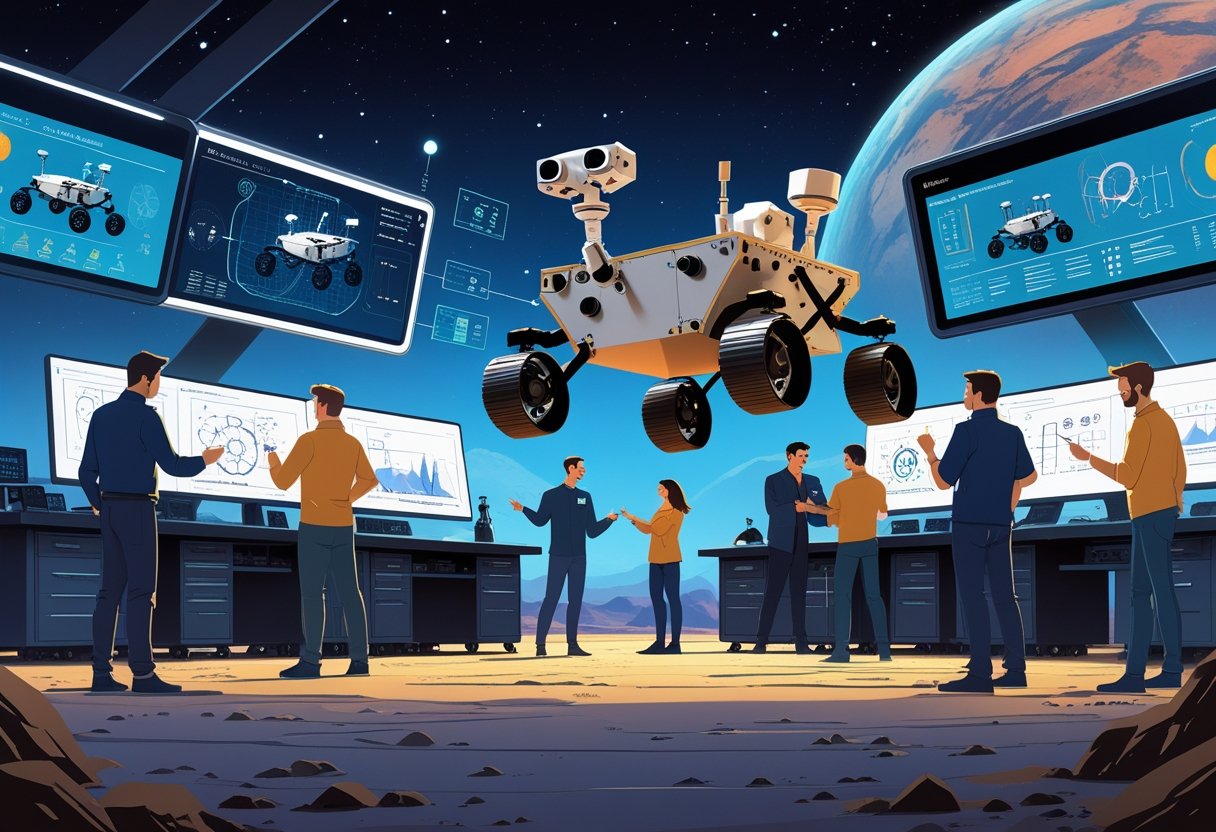
Design thinking in rover engineering focuses on defining clear mission goals, matching capabilities to constraints, and iterating quickly on hardware and software. You’ll see tight links among requirements, human needs, and team tradeoffs that shape every subsystem.
Problem Framing and Defining Requirements
Start by translating mission goals into concrete, testable requirements you can measure. If the mission is to collect sediment from an ancient river delta, specify sample size, drill depth, allowable contamination levels, traverse distance per sol, and maximum slope angle the chassis must handle.
Identify constraints early: mass budget, power budget, launch volume, thermal limits, and communications latency. Put these in a short requirements matrix with priorities (must, should, nice-to-have). Use that matrix to drive design trade studies—compare wheel types, suspension layouts, and power systems against the prioritized list.
You’ll validate requirements with prototypes and environmental tests like thermal-vacuum cycles and sand-box mobility trials. Keep requirements living: update them after test failures, and log rationale for every change so the design remains traceable.
Human-Centered Design for Rovers
Think of human-centered design as designing for the people who operate, maintain, and interpret rover data. For mission operators, prioritize clear telemetry, health indicators, and predictable autonomy behaviors so you can plan safe drives without surprises.
For scientists, design payload interfaces and sample handling to preserve scientific integrity. That includes contamination controls, easy-to-reach sample chambers in test rigs, and metadata tagging for each sample. For public stakeholders, create imagery and data products that communicate findings without requiring specialist tools.
Use rapid user feedback cycles: run simulated mission days with ground teams, get scientist reviews of sample workflows, and refine UI displays based on real user actions. Document ergonomics decisions and ensure the rover’s autonomy supports—not replaces—human decision-making.
Team Collaboration in Engineering
Rover projects require multi-disciplinary teams working to tight schedules and budgets. You need clear roles: systems engineering coordinates requirements; mechanical leads handle structures, mobility, and thermal; electrical engineers own power and wiring; software teams manage autonomy and data systems; and payload scientists define instrument needs.
Adopt regular integration checkpoints: weekly design reviews, interface control document (ICD) updates, and physical integration milestones. Use shared tools—a single requirements database, version-controlled CAD, and continuous-integration for software—to prevent misalignment.
Resolve trade-offs in formal risk and cost matrices. When a subsystem change affects others, run a short cross-discipline impact review and capture decisions in the ICD. Keep communication lightweight but documented so your team stays aligned and engineering choices remain auditable.
Core Components of Space Rovers
You’ll read about the physical systems that let a rover move, generate and manage power, talk with Earth, and collect samples. Each part must survive extreme temperatures, limited mass, and strict reliability requirements.
Mobility Systems
You control a vehicle that must traverse rocks, slopes, and loose sand without tipping or getting stuck. Engineers pick a suspension type (like rocker-bogie) to keep all six wheels in contact with uneven ground and to allow climbing over obstacles up to roughly the wheel diameter. Wheels balance diameter, width, and tread: larger diameter eases crossing, narrower wheels reduce drag and damage, and cleats (grousers) provide traction in sand and regolith.
Motors pair with encoders and slip detection so you can measure distance driven. Steering may use individual wheel motors for zero-radius turns and precise path control. Designers add motor torque margins and redundant actuators to tolerate partial failures. Thermal coatings and heaters protect motors and bearings from −100°C nights.
Power and Energy Management
You must plan power for driving, instruments, communications, and thermal control over multi-sol cycles. Design choices center on power source (radioisotope thermoelectric generator or solar arrays), storage (battery capacity and chemistry), and an energy budget scheduler that prioritizes tasks when generation is limited.
Solar systems include deployable panels, dust mitigation strategies, and maximum-power-point tracking electronics. RTGs deliver steady baseline power and waste heat for thermal stability. Batteries handle peak loads and eclipse periods; you size them for depth-of-discharge cycles and margin for degradation. A power management unit monitors voltage, temperature, and state-of-charge, and enforces rules that protect critical systems by shedding nonessential loads when needed.
Communication and Data Transmission
You need reliable two-way links across vast delays and limited bandwidth. Rovers use UHF relays through orbiters for high-rate science downlinks and X-band direct-to-Earth for command and telemetry. Antenna types include low-gain for omni-directional contact and high-gain for focused, higher-bandwidth sessions. Pointing accuracy and RF link budgets determine achievable data rates.
Onboard radios implement error correction, packet retransmission, and prioritized queues so high-value science gets transmitted first. Engineers build store-and-forward protocols because real-time control is impossible. You’ll see scheduling software on Earth coordinate orbiter passes, commanding windows, and data returns to make the most of limited contact opportunities.
Sample Collection Tools
If you want physical material, engineers design corers, drills, scoops, and a sample caching system to gather, seal, and store material for later return. Tools mount on a turret at the end of the robotic arm; the turret typically holds multiple instruments: coring drill, abrasion tool, and close-up imagers. Coring drills balance penetration force, bit wear, and contamination control.
The Sample Caching System handles tubes: it receives tubes, images the sample, seals them, and stows them in a protected cache. Mechanisms include precision actuators, latches, and cleanliness controls to avoid cross-contamination. Sensors verify sample volume and seal integrity. Redundancy in sample handling (spare tubes, backup motors) increases mission resilience and preserves scientific value.
Testing and Prototyping the Rover
You’ll verify that the rover moves, survives, and performs its tasks through hands-on builds, lab simulations, and repeated redesigns. Testing focuses on mobility over loose soil, electronics under temperature swings, and software that decides safe routes.
Building Prototypes
You start with scaled or simplified models to check core ideas fast. Engineers often build a 1/6th-mass prototype to mimic lunar gravity effects on traction, then test wheel designs and suspension on packed sand or gravel.
Use a parts list that separates structural, mobility, power, and sensor subsystems so you can swap components without rebuilding the whole vehicle. That speeds troubleshooting and lets you isolate failures to a single subsystem.
Keep test rigs for repeatable measurements: a tilt table to measure rollover thresholds, a traction sled to measure slip, and a vibration shaker for launch loads. Run each rig with consistent payloads and scripts so results compare over design iterations. Record video, sensor logs, and step-by-step failure notes; that documentation shortens debugging and helps you reproduce problems in later prototypes.
Simulating Space Conditions
You’ll recreate the environment the rover will face, but on Earth. Vacuum chambers test thermal control and outgassing of materials. Thermal cycling rigs expose electronics and batteries to the expected lunar or Martian temperature ranges to reveal brittle solder joints or failing seals.
For traction and digging, you build analog testbeds using regolith simulants and large sandboxes; engineers have used lightweight test rovers in desert sand to predict behavior under lower gravity by scaling mass and wheel torque appropriately.
Radiation, dust, and communications latency also get targeted tests. Use dust chambers with fine particulates to check motor seals and optical window coatings. Run autonomy stacks with simulated 10–20 minute round-trip delays so your navigation software learns to plan and recover without real-time commands. Archive all environmental profiles so you can rerun simulations when designs change.
Iterative Improvement
You’ll iterate: test, analyze, redesign, and test again. After each test campaign, quantify failures into corrective actions—replace a motor with a higher torque unit, add a gasket, or change control gains. Prioritize fixes by mission risk and ease of implementation.
Use versioned hardware and software baselines so you can compare performance across iterations. Maintain a short checklist for “must-pass” tests (mobility, thermal survival, comms) and a longer list for enhancements (power margin, autonomy smoothness). Track metrics like traverse speed over simulated regolith, mean time between failures, and energy per meter traveled to measure progress.
Schedule full-system integrated tests before any environmental extremes—run the rover through a representative mission timeline including driving, instrument use, and communications—to uncover interface issues that single-subsystem tests miss.
Preparing for Launch and Operation
You’ll focus on checks that keep the rover and launch stack safe, the phases of transit and entry, and how ground teams run the vehicle from millions of kilometers away.
Prelaunch Safety and Checks
Before liftoff, you verify structural integrity and flight software behavior. Technicians perform vibration and acoustic tests that simulate rocket launch loads; you inspect for cracked fasteners, loose harnesses, and clearances around moving parts. Thermal-vacuum testing confirms electronics and batteries survive vacuum and temperature swings.
You run end-to-end communications checks: antenna pointing, modems, and encryption keys must pass a link margin analysis. Flight software undergoes regression testing and a final “no-go” checklist that includes watchdog timers, safe-mode logic, and autonomous fault responses. Launch vehicle integration demands interface control documents (ICDs) and connector pinouts match exactly.
Documented contingency procedures and a final launch readiness review (LRR) give you formal approval to proceed.
Journey from Earth to Destination
During transit, you monitor orbit insertion, mid-course correction burns, and spacecraft health telemetry. You track propulsion performance, propellant usage, and attitude control thruster firings to ensure the carrier and entry systems will meet the destination timeline. Precision of navigation updates determines where and when the rover will land.
You also manage thermal control and power budgets for cruise. Radiators, insulation, and heaters keep components within temperature limits; solar arrays or RTGs are evaluated for expected output. Radiation forecasts shape shielding and safe-mode thresholds. For planetary entry, descent, and landing (EDL), you rehearse the sequence in high-fidelity simulators and validate the landing ellipse and hazard-avoidance parameters.
Remote Operations and Control
Once on the surface, you operate the rover using command sequences and daily planning cycles. Due to long communications delays, you send time-tagged command scripts rather than real-time joystick control. Each sol’s plan includes drives, instrument activities, and contingency branches; teams assemble these using mission planning tools and simulation replay.
Telemetry health checks run continuously; automated fault protection will put the rover into a safe state if anomalies appear. You prioritize data downlink: critical engineering telemetry first, then high-value science products. Relay satellites or orbiters often handle bulk data transfer, so you schedule passes and manage queueing. Software uplinks require checksum verification, and you maintain version control and rollback plans in case an update introduces problems.
Future Directions in Space Rover Innovation
You’ll see advances that change how rovers move, power themselves, and work with other nations’ machines. These changes focus on autonomy, durability, and international cooperation to enable longer, riskier missions.
Emerging Technologies
Expect compact AI systems that let rovers plan multi-day routes without Earth commands. Onboard neural planners will evaluate terrain risk, energy use, and science value in real time, so you get more useful data per sol. Sensors will improve too: combined lidar, ground-penetrating radar, and multispectral cameras will let rovers detect subsurface ice and map hazards beneath loose regolith.
Mobility innovations will include adaptable wheel-legs and adjustable suspension that change geometry for sand, rocks, or slopes. You’ll also see cooperative swarms—small, task-specialized robots that share mapping and transport duties—demonstrated by NASA’s CADRE-style projects and similar efforts. These technologies cut single-point failure risk and expand coverage without bigger launch masses.
Sustainability and Longevity
You’ll rely on modular hardware designed for in-field servicing and part replacement. Standardized interfaces let you swap damaged motor modules or sensor pods with a future servicing rover or astronaut crew. Power systems will shift beyond fixed solar arrays: radioisotope heaters paired with regenerative fuel cells and deployable high-efficiency panels will extend operations through long nights and dust events.
Materials and dust mitigation matter too. You’ll benefit from coatings and electrostatic cleaning systems that reduce abrasive wear and maintain thermal control. Software longevity will come from fault-tolerant operating systems and onboard self-testing that isolates failing subsystems and reassigns tasks—so a single motor or computer fault doesn’t end the mission prematurely.
Collaboration Between Countries
You’ll see more multinational payload mixes on single landers, where instruments from different agencies share a common power and data bus. This approach lowers cost per participant and increases scientific return by combining complementary experiments. Cooperative mission architectures also enable regional hubs: one nation’s lander can host small rovers from several partners, each focused on distinct science objectives.
Standardized communication protocols and docking/charging interfaces will let you coordinate cross-national robotic servicing and sample transfers. That interoperability reduces duplication and speeds technology adoption. Joint test campaigns on Earth—improving terrain models and validation methods—will further reduce the risk of getting rovers stuck in unexpected soil, addressing problems highlighted by recent rover testing studies.
Leave a Reply