
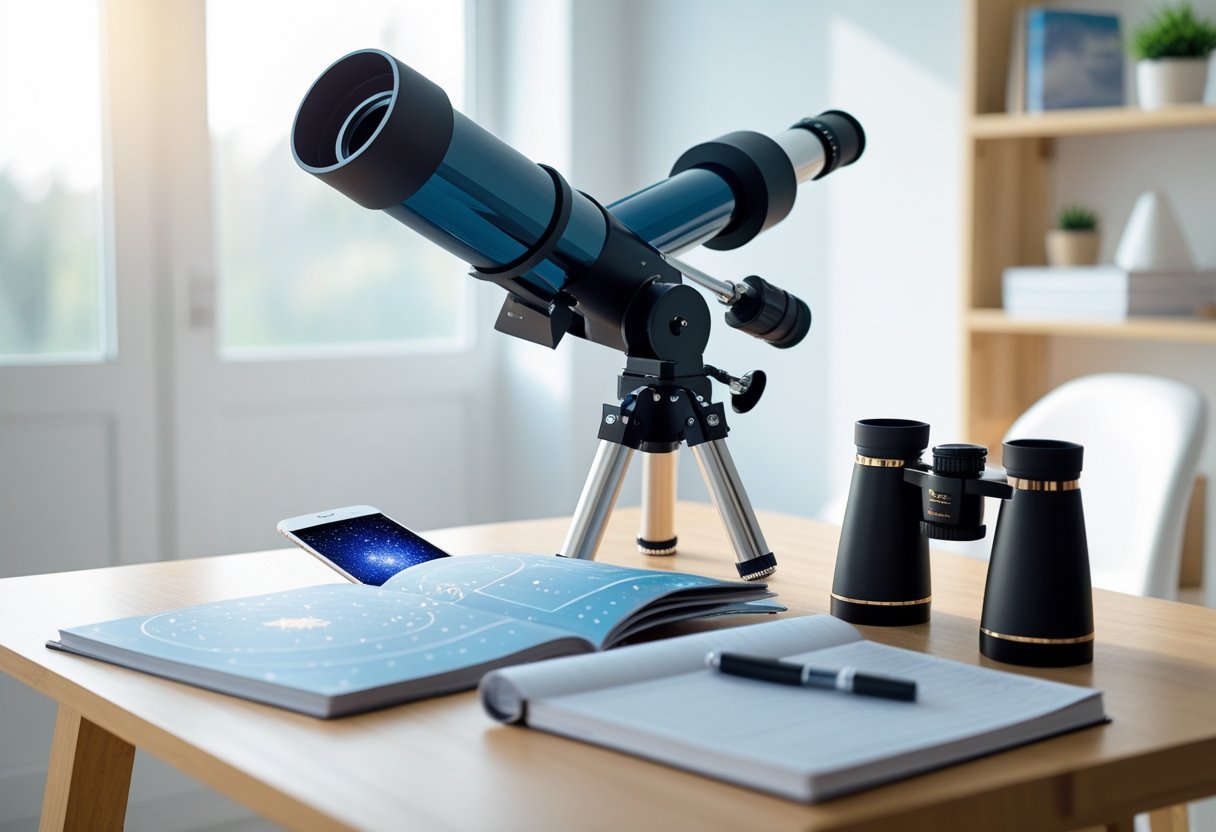
You want to start stargazing tonight without getting overwhelmed by jargon or gear you won’t use. You only need a reliable optical tube, a steady mount, a couple of eyepieces, and the confidence to point and focus — everything else is optional or an upgrade.

This guide walks you through choosing the essential components, setting up and aligning your mount, and practical tips that get you observing quickly. Expect clear, step-by-step help for assembly, calibration, and your first successful observing session so you spend more time looking up and less time troubleshooting.
Essential Components for Your First Telescope

You’ll need a telescope that matches your budget, observing goals, and storage space. Focus on optical design, mount stability, and a small set of eyepieces and accessories that actually get you under the sky quickly.
Choosing the Right Telescope Type
Pick a type that fits how you plan to use the scope. For mostly planetary and lunar viewing, a small refractor (70–120 mm) or a short-tube Maksutov delivers crisp, low-maintenance views. If you want deep-sky targets and the best aperture-per-dollar, a Dobsonian reflector (6–10″ aperture) gives brighter, wider views but is bulkier.
Consider portability: an 80–100 mm refractor or a 6″ tabletop Dobsonian travels easily. Think about maintenance—reflectors need occasional collimation; refractors generally do not. Balance aperture, weight, and storage. Choose a mount that matches the scope: Alt-az mounts and Dobsonians are simple; an equatorial mount helps if you want to track objects or do basic astrophotography.
Understanding Eyepieces and Focal Length
Eyepieces determine magnification together with your telescope’s focal length: Magnification = telescope focal length ÷ eyepiece focal length. For example, a 1000 mm telescope with a 25 mm eyepiece yields 40× magnification.
Start with a small set: a low-power wide-field eyepiece (20–32 mm) for star hopping and open clusters, a medium (8–12 mm) for planets and the Moon, and a high-power (4–6 mm) only if your telescope and seeing conditions support it. Prioritize eye relief and apparent field of view when buying eyepieces—comfortable viewing beats the last bit of magnification. Keep a Barlow lens (2×) to effectively double your eyepiece collection without extra weight.
Finder Scopes and Accessories
A reliable finder gets you on target fast. A simple red-dot finder or a 50 mm right-angle correct-image (RACI) finder helps you center objects quickly without adding complex alignment steps. Practice aligning the finder during daylight on distant landmarks before your first night session.
Essential accessories: at least two eyepieces (wide-field and medium), a 2× Barlow, a moon filter for lunar brightness control, and a basic collimation tool if you buy a reflector. Add a sturdy tripod or Dobsonian base—flimsy supports ruin views. For guidance and parts, check a practical setup walkthrough like this step-by-step beginner guide.
Mount Selection and Setup Basics

Choose a mount that matches your observing goals, telescope weight, and how much you want to carry. A stable tripod, smooth controls, and correct balance matter more than fancy features for clear, steady views.
Alt-Azimuth Mount Setup
Alt-azimuth (altaz) mounts move in altitude and azimuth, making them intuitive to point and fast to set up. You attach the telescope to the saddle or dovetail, tighten the clamp, and use the altitude and azimuth knobs or slow-motion controls to center objects. Check that the tripod legs are fully extended and the mount head is securely bolted to the tripod plate; even small looseness causes vibration that spoils high-magnification views.
Level the tripod and place a weight or use leg spreaders if the mount feels light. For Dobsonians the base replaces the tripod and must sit flat; for small photographic sessions add motorization to both axes or use a wedge. Balance the tube front-to-back and side-to-side by sliding the dovetail in the saddle until the scope holds position without locking the clutches.
Equatorial Mounts and Counterweights
Equatorial mounts require polar alignment because their RA axis tracks the sky with a single motion. Set your tripod latitude scale roughly to your location, mount the head, and use a polar scope or software-assisted method to place Polaris in the correct reticle position. Accurate polar alignment reduces field rotation and makes long visual tracking or basic astrophotography possible.
Attach counterweights to the counterweight shaft and slide them so the telescope stays balanced when the RA clutch is released. Balance RA by unlocking the axis and moving the weights until the mount neither swings to the east nor west. Then balance declination by adjusting the tube rings or dovetail until the OTA stays put. Tighten clutches and confirm smooth motion. If you plan astrophotography, add a motor drive or guiding solution after polar alignment.
GoTo Mounts and Smart Features
GoTo mounts combine motors, a handset, and onboard databases to automatically point to objects. Mount the scope and polar-align or level per the manufacturer’s startup guide. Power the mount, enter time, date, and location, and perform the alignment routine the handset requests—usually two or three stars you center in the eyepiece. Accurate centering during alignment is crucial for pointing precision.
Ensure the mount can carry your OTA plus accessories; check total payload specs. Balance the optics and counterweights to avoid stressing motors. Use periodic error correction (PEC) and, for imaging, connect autoguiding or plate-solving if supported. Keep firmware and handset databases updated, and park the mount when finished to protect gears and repeatable alignment. For an overview of mount types and setup steps, see this practical guide to telescope mounts.
Setting Up Your Telescope Step-by-Step
You’ll get the tripod solid, the optical tube secure, and the finder aligned so targets land in your eyepiece quickly. Focus on checking parts, balancing the tube, and aligning the finder before you head outside.
Unboxing and Identifying Parts
Open the box on a clean table and check every item against the manual parts list. Lay out the tripod, mount (alt‑az or equatorial), optical tube, eyepieces, diagonal, finder scope or red‑dot, screws, counterweights (if EQ mount), and any cables or adapters.
Inspect the optical tube for dents, the focuser for smooth travel, and the mirror (if a reflector) for dust but not fingerprints. Keep foam and screws together in a small container so nothing gets lost. If your telescope is a reflecting design, look for a loose secondary mirror cell or a removed primary mirror cover; don’t touch mirror surfaces with bare hands.
Organize eyepieces by focal length and label them if necessary. Charge or insert batteries for any electronic finders or motor drives. If the manual shows a diagram, use it to confirm dovetail bars, mounting rings, and the correct orientation for the diagonal and eyepiece.
Mounting the Telescope Tube
Set the tripod on firm, level ground and spread the legs fully. Use a bubble level or phone app to make the tripod top level; this reduces strain when you mount the tube.
Attach the mount head to the tripod and secure screws hand‑tight. If you have an equatorial mount, install the counterweight shaft and loosely fit counterweights for later fine balancing. With an alt‑az mount, make sure the saddle plate is clear and free of debris.
Lift the optical tube by its balance points and slide it into the saddle or mounting rings. Tighten the mounting screws evenly—snug, not overtight—so the tube won’t shift but can still be adjusted. For tubes with dovetail bars, slide the bar into the saddle until it clicks, then clamp.
If your mount requires balancing, unlock the axes and move the tube until it stays in place with minimal friction. For reflectors, check mirror cells for any loose screws; perform collimation only after the tube is mounted and cooled to ambient temperature.
Attaching and Aligning the Finder Scope
Fasten the finder scope or red‑dot sight to its bracket on the optical tube. Use the supplied thumbscrews and confirm the bracket sits square and firm; a loose finder defeats aiming.
During daytime, point the main telescope at a distant, fixed object 100–200 meters away—such as a chimney top or telephone pole. Center that object in the main eyepiece using slow‑motion controls or the mount’s motion handles.
Without moving the main scope, adjust the finder’s alignment screws until the same object sits on the finder’s crosshairs or within the red dot. Recheck at higher magnification eyepieces to ensure centering holds across focus changes.
For a red‑dot finder, set the dot brightness low and align similarly. If you plan to use computerized pointing, perform this manual alignment first; software will be more accurate when the physical finder and tube point together.
Alignment and Calibration
Get your mount tracking right and your optics delivering sharp stars. Precise polar alignment keeps objects centered during long exposures, and proper mirror alignment (collimation) prevents soft or distorted images.
Polar Alignment for Equatorial Mounts
Start by leveling the tripod and setting the mount’s latitude to match your observing site. Point the RA axis roughly toward Polaris (Northern Hemisphere); use a polar scope or a phone app to center the pole precisely.
Perform a quick star-check: pick a medium-bright star near the celestial equator, center it, and let the mount track for a few minutes. If the star drifts north/south, tweak azimuth and altitude screws. Repeat until drift is negligible for your planned exposure length.
Tools that speed this process: a polar scope, drift-alignment method for sub-arcminute precision, or plate-solving software for computerized mounts. For GoTo mounts, follow the hand controller’s multi-star alignment after rough polar alignment to improve pointing.
Mirror Alignment (Collimation) Tips
Collimation matters most on reflector and Schmidt-Cassegrain designs. Start at low magnification and center a bright star; use a Cheshire eyepiece or laser collimator for mechanical checks on the primary and secondary mirrors.
Primary steps: loosen the primary mirror’s locking screws if present, then adjust the collimation bolts until the mirror’s reflection concentric rings align with the focuser tube. For the secondary, adjust tilt screws so the primary’s reflection sits centered in the eyepiece.
Confirm with a star test: defocus a bright star and look for concentric airy rings. Rings off-center indicate mirror tilt; uneven brightness suggests spacing issues. Recheck after every mount movement and before imaging sessions. For detailed guides, see a practical walkthrough on easy telescope alignment.
Optimizing Your Stargazing Experience
Focus on clear views and fast target acquisition: pick eyepieces that match your telescope’s focal ratio and use accurate, up-to-date sky maps or apps for planning and locating objects.
Choosing and Using Eyepieces
Choose eyepieces by focal length and apparent field of view. Match eyepiece focal length to your telescope’s focal length to get useful magnifications: Magnification = telescope focal length ÷ eyepiece focal length. For a 1000 mm scope, a 25 mm eyepiece gives 40x, a 10 mm gives 100x.
Keep a short kit: a low-power wide eyepiece (~25–40 mm or a 50°+ AFOV) for star fields and nebulae, a medium one (10–15 mm) for galaxies and clusters, and a high-power (4–6 mm) for planetary detail when seeing allows. Consider a 2x Barlow to double effective magnifications without buying extra eyepieces.
Mind exit pupil: Exit pupil = eyepiece focal length ÷ telescope focal ratio. Aim for 0.5–7 mm; around 2–5 mm is optimal for most observers. Use a low-distortion, multi-coated eyepiece for sharper stars at the edge of the field. Store eyepieces in padded cases and keep a small cleaning kit—lens tissue and blower—to maintain contrast.
Using Star Charts, Maps, and Apps
Plan sessions with a reliable star chart or an app that shows your local horizon. Paper charts work well when battery life matters; foldable charts cover seasonal skies. For dynamic planning, use Stellarium or other stargazing apps that let you set location, time, and display planetarium-style views.
Use the app’s search and goto markers to find targets quickly. Practice star-hopping: identify a bright anchor star, then move in measured steps using your finder and low-power eyepiece. Toggle labels and grid overlays in apps to learn constellation boundaries and right ascension/declination coordinates.
Keep two tools: a phone app for live pointing and a printed chart for backup. Calibrate your finder to the telescope each night with a low-power eyepiece on a bright star. If you use Stellarium, enable planet and deep-sky catalogs, and adjust the magnitude limit to match your sky brightness for realistic target lists.
Tips for Successful First Observations
Plan your first night: pick a bright target (the Moon, Jupiter, or Saturn), check moon phase and cloud cover, and let your scope reach outdoor temperature before observing.
Best Practices for Setup and Storage
Start setup at least 30–40 minutes before you intend to observe so your telescope can acclimate to outside temperature. That reduces internal air currents and gives sharper views of lunar craters and planetary detail.
Assemble the tripod on level ground and tighten clamps; a shaky mount ruins high-magnification viewing. Use a bubble level or phone app to level the tripod quickly.
Align the finderscope or red dot with a distant daytime target first, then refine on a bright star once it’s dark. Begin with a low-power eyepiece (20–25mm) to center targets, then switch to higher power in small steps.
Keep spare eyepieces, a Barlow, and a soft lens brush in your kit. Store optical elements in padded cases and keep moisture out with silica gel packets. For longer breaks, collapse the tube and store the OTA horizontally to avoid stress on focuser bearings.
Common Beginner Mistakes to Avoid
Don’t expect astrophotography-quality images through your first telescope; visual observing emphasizes contrast and detail, not the color-saturated photos you see online. Manage expectations so you enjoy the view you actually get.
Avoid using the highest magnification first. High power makes images dim and unstable; start low and increase only when the seeing is steady.
Do not skip polar or star alignment for equatorial or GoTo mounts — sloppy alignment leads to missed targets. Always enter accurate date, time, and location into your mount.
Finally, don’t transport your telescope hot from indoors to cold outdoors without acclimation, and don’t leave eyepieces or finder optics uncovered — dust and dew are the easiest damage to prevent.
Leave a Reply