
You want a clear, practical answer: for most physics explanations that balance accuracy, depth, and accessible teaching style, Claude and ChatGPT typically perform best, with Gemini often excelling when multimodal examples (images, diagrams, or videos) matter most. If you need rigorous, step-by-step derivations and logical clarity, Claude tends to be strongest; for conversational clarity, real-world analogies, and broad tool integrations, ChatGPT usually gives the most usable results.
I’ll compare how each model understands physics concepts, how they show their work, and how reliable their answers are for academic and educational use. You’ll see methods I used to test explanations, examples of strengths and failure modes, and practical guidance on which model to pick depending on whether you teach, study, or build instructional tools.
Understanding the AI Models
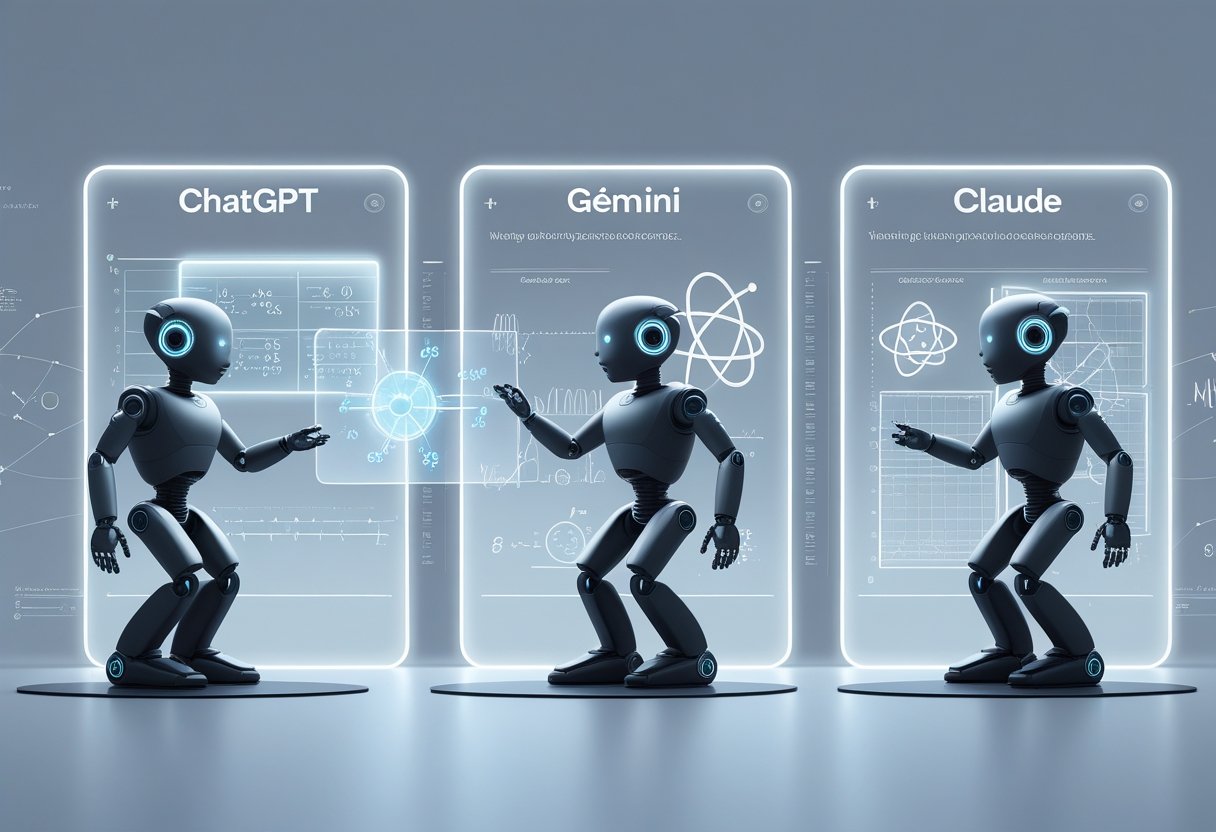
I focus on how each model processes physics questions, their multimodal strengths, and practical limits for deriving explanations, calculations, and stepwise reasoning.
ChatGPT Overview
I use ChatGPT (family including GPT-3.5, GPT-4, GPT-4o) when I need conversational, prompt-driven explanations that combine concise prose with symbolic math. GPT-4 and GPT-4o offer stronger reasoning and broader knowledge than GPT-3.5; they handle derivations, unit conversions, and common physics textbook problems well.
When I require runnable code, I rely on ChatGPT’s tool-enabled setups (code interpreter and plugins) to execute numerical checks, plot results, or call Wolfram-style computations. That makes it practical for verifying integrals, solving differential equations numerically, and producing step-by-step calculations.
I notice GPT variants prioritize clarity and pedagogy: they break problems into labeled steps, show intermediate algebra, and flag assumptions (small-angle approximations, nonrelativistic limits). Their weakness appears with very long chain-of-thought-style derivations or niche experimental details where hallucination risk rises.
Gemini Overview
I turn to Gemini (including Gemini 2.5, Gemini Advanced, Gemini Pro, Gemini 2.5 Flash) for multimodal physics tasks and language-context integration inside Google’s ecosystem. Gemini 2.5 handles image+text inputs well, so I can feed diagrams or experimental photos and ask for Feynman-diagram annotations or error-source identification.
Gemini Advanced / Pro variants emphasize low-latency responses and integration with Drive, Sheets, and Docs, which I use to cross-check datasets or embed model outputs into collaborative workflows.
For heavy symbolic math, Gemini performs competitively but often pairs best with external calculators. I find it strong at interpreting figures, experimental setups, and translating visual information into equations, though it sometimes favors concise summaries over full stepwise algebra unless prompted explicitly.
Claude Overview
I consult Claude (Claude 3.7, Claude Opus, Claude 4, Claude 4 Sonnet) when I need rigorous, safety-conscious reasoning on long or complex physics texts. Claude 4 Sonnet and Opus excel at processing long documents—ideal for parsing papers, extracting assumptions, and producing structured explanations spanning many pages.
Claude emphasizes conservative, well-cited phrasing and systematic decomposition of problems. I use it to check logical consistency, trace derivation steps in lengthy proofs, and summarize sections of technical papers without losing context.
Its strengths include handling large-token contexts and producing methodical, formal write-ups. Weaknesses include occasional verbosity and a tendency to avoid committing to numerical estimates unless prompted to compute or allowed tooling access.
Model Versions and Releases
I track releases because capabilities shift between versions: GPT-3.5 serves lightweight prompts; GPT-4 and GPT-4o raise reasoning and multimodal skill; GPT-4o often prioritizes lower-latency interactions.
Gemini’s 2.5 series (standard, Pro, Flash) marks improvements in math and multimodal processing, with Gemini 2.5 Pro offering higher throughput and Gemini 2.5 Flash optimized for cost-sensitive tasks. Gemini Advanced layers in Google service integrations for research workflows.
Claude’s evolution from 3.7 to Opus and Claude 4 (including Sonnet) increased context window sizes and reasoning stability. Claude 4 Sonnet specifically targets very long-document reasoning and hybrid analysis tasks.
When I choose a model I weigh token limits, tool availability, multimodal needs, and cost tier—matching the release characteristics above to the physics task at hand.
Methods for Explaining Physics
I focus on concrete tactics that improve accuracy, clarity, and pedagogy when teaching physics with large models. The methods below emphasize how I generate content, interpret technical language, structure stepwise solutions, and incorporate analogies or images.
Approach to Content Generation
I start by selecting the learning objective and the target grade level or background—for example, “explain Pascal’s principle to a 13-year-old” or “derive hydrostatic pressure for undergraduates.” I choose a content format: brief summary, worked example, multiple-choice quiz, or lab activity. That choice determines length, tone, and level of math.
I prioritize factual correctness by cross-checking formulas (units, constants) and requesting intermediate steps from the model. I assess output quality by verifying numerical examples and boundary conditions. When multimodal capabilities are available, I prompt for diagrams or annotated images to complement text and to reduce reliance on long verbal descriptions.
I iteratively refine prompts: specify assumptions, required symbols, and desired rigor. This yields content that matches the learner’s needs and reduces hallucination risk.
Language Understanding in Scientific Contexts
I demand precise term usage: “force” vs “pressure,” “scalar” vs “vector,” and correct axis labels. I test language understanding by asking the model to rephrase definitions with progressively stricter constraints, such as forbidding informal metaphors or requiring SI units. This exposes gaps in conceptual mapping.
I evaluate models’ ability to handle symbolic expressions and LaTeX-like notation. Clear variable definitions and dimensional analysis are non-negotiable; I flag outputs that omit units or conflate concepts. For multimodal AI that accepts images, I provide annotated figures to ground terminology and check whether the model links text to visual elements accurately.
I maintain a checklist: correct definitions, units, consistent symbols, and appropriate complexity for the audience. That checklist guides edits and follow-up prompts.
Step-by-Step Explanations
I break problems into numbered logical steps, each focusing on one operation: state knowns, choose principles, perform algebra, check units, and interpret results. This structure helps learners follow reasoning and spot errors.
I include brief calculations with intermediate values visible. When possible, I show alternative solution paths (e.g., energy vs force approach) and note when one is more efficient. I explicitly mark assumptions—frictionless, ideal gas, incompressible fluid—so readers understand limits.
I use small worked examples to demonstrate each step and end with a quick sanity check: limiting cases or unit consistency. For output quality, I ensure numerical examples align with stated assumptions and I request the model to highlight potential misconceptions.
Use of Analogies and Visual Aids
I apply analogies sparingly and precisely: compare pressure distribution to water depth rather than to vague “weight” metaphors. Each analogy maps specific physical quantities to concrete counterparts and I state where the analogy breaks down.
I prompt multimodal models to generate simple diagrams: free-body diagrams, pressure-depth plots, or annotated cross-sections. For image generation, I require labeled axes, consistent color coding, and scale indicators. I critique generated images for accuracy—labels, vector directions, and units—before using them in explanations.
I pair analogies with visual aids when possible. That combination improves comprehension while limiting misleading simplifications.
Depth, Accuracy, and Reliability of Physics Explanations
I compare how each model handles technical detail, how it cites and grounds claims, and how it applies stepwise logical reasoning to reach correct conclusions. Expect specific differences in handling advanced math, reference quality, and error modes.
Handling Complex Scientific Concepts
I test models on multistep derivations, units-consistent calculations, and conceptual distinctions like conservation laws versus symmetry arguments. GPT-style models tend to produce clear step-by-step algebra and show work for intermediate steps; this helps catch unit or sign errors early. Gemini’s multimodal design can incorporate diagrams or image prompts when available, which boosts clarity for spatial problems. Claude variants often emphasize concise conceptual framing and can reduce irrelevant algebra, but sometimes skip intermediate algebraic detail that a reader needs to verify results.
For high-precision tasks I run multiple trials and compare outputs, watching for inconsistent constants or dropped terms. I also check whether the model flags assumptions (small-angle approximations, idealizations). That practice separates reliable procedural math from plausible-sounding but incorrect shortcuts.
Reference and Source Quality
I evaluate whether models provide verifiable references, cite standard textbooks, and signal when they lack direct evidence. Models differ: some generate plausible-looking citations without accessible links; others integrate recent reporting tools better. When I need authoritative grounding, I prefer answers that name sources like canonical textbooks or peer-reviewed papers and include equation provenance.
I use external research tools to validate claims and note when a model’s wording implies certainty beyond the evidence. Reports and deep research mode outputs that include explicit derivations, numeric checks, and clear attributions score higher for trust. I avoid relying on model-only citations unless I can corroborate them independently.
Logical and Analytical Reasoning
I judge reasoning by the presence of explicit premises, sequential derivations, and error-checking steps. Strong outputs show a chain of logic: define variables, state assumptions, perform algebra, then sanity-check units and limits. GPT variants often present that chain visibly, aiding debugging. Claude tends to produce a compact logical summary and can be good at reframing problems for clarity. Gemini’s strength appears when combining text with visual aids for geometric or field-line reasoning.
I look for common failure modes: unjustified leaps, circular arguments, or misapplied theorems. I run the same prompt across models and compare output quality and reproducibility. That cross-model comparison reveals whether an answer is a robust result or an artifact of a single model’s heuristic.
Performance in Academic and Educational Use
I evaluated how each model handles stepwise problem solving, lesson creation, and access to recent research. I focus on correctness, pedagogical clarity, and the models’ ability to bring in up-to-date data when needed.
Explaining Problem-Solving in Physics
I test explanations by asking for worked solutions to representative problems: kinematics derivations, Gauss’s law applications, and quantum perturbation sketches. GPT-4 Turbo usually provides structured, step-by-step solutions with clear equations and intermediate results. It often formats math cleanly and flags assumptions (small-angle approximations, boundary conditions) so students can follow reasoning.
Gemini 2.5 Pro matches GPT-4 Turbo on calculation clarity and adds strong multimodal potential for diagrams when I supply images. Its computational outputs can be concise, but I verify algebra and units because occasional simplifications hide intermediate steps.
Claude Pro emphasizes conceptual clarity over algebraic detail. I find its verbal scaffolding useful for students who struggle with abstractions, though I sometimes request more explicit symbolic manipulation. For all models I confirm final numeric answers and units; I also prompt them to show error estimates or domain of validity for approximations.
Generating Educational Materials
I use prompts to produce homework sets, stepwise solutions, slide outlines, and assessment rubrics. GPT-4 Turbo creates varied problem difficulty levels and concise instructor notes; I can ask it to output LaTeX-ready problems or Markdown slides directly. Its balance of rigor and readability makes it my go-to for polished handouts.
Gemini 2.5 Pro excels when I need multimodal assets—figure suggestions, image captions, or annotated diagrams—especially if I pair it with Google search integration for up-to-date figures. I still cross-check technical captions and data sources the model cites.
Claude Pro generates clear lesson narratives and formative assessment items that emphasize conceptual checkpoints. Its prompts yield pedagogically sequenced steps and hints for common misconceptions. I often combine Claude’s explanatory prompts with GPT-4 Turbo’s technical polishing for a complete package.
Real-Time Research and Current Information
When I require the latest experimental values, recent preprints, or evolving curricula, model access to external search and research tools matters. GPT-4 Turbo with browsing plugins can retrieve contemporary papers and produce citations, but I verify links and dates; the model may summarize before giving full bibliographic details.
Gemini’s tighter Google integration gives me fast retrieval of recent news, arXiv entries, and datasets; that helps when I need current constants or experimental results. I check original papers for methodology and numerical tables rather than relying solely on summaries.
Claude Pro is more cautious about definitive claims and often states uncertainty, which helps avoid overstating preliminary results. For real-time insights I combine Claude’s calibrated language with Gemini’s rapid retrieval and GPT-4 Turbo’s formatting to produce citations and reproducible calculation steps.
Capabilities Beyond Explanations
I compare how each model moves past plain explanation into creative, computational, and multimodal support for teaching and researching physics. I focus on where they add measurable value: narrative framing, runnable simulations, and image-plus-text reasoning.
Creative Writing of Physics Topics
I use creative writing to make abstract physics concrete for learners. ChatGPT produces vivid analogies and can craft a sonnet about entropy that preserves technical accuracy while engaging emotion. Claude (including Claude Opus) tends toward formally structured essays and metaphors that favor clarity over flourish; I rely on it when I need precise pedagogical framing. Gemini Advanced writes tightly factual narratives and integrates recent research examples when I request contemporary context.
I check for technical fidelity in every output. Creative pieces must avoid simplifying away key constraints, so I prompt for explicit equations, boundary conditions, or caveats within the narrative. When I ask for a classroom-ready piece, I instruct models to include a brief glossary and two follow-up questions to test comprehension. That approach yields creative material that remains teachable and accurate.
Coding and Simulating Physics Problems
I rely on code interpreters and runnable examples to validate concepts. ChatGPT pairs well with a code interpreter to generate Python scripts for numerical integration (RK4), Monte Carlo sampling, or simple finite-difference heat equations. I ask for modular functions, docstrings, and unit tests; ChatGPT typically provides these cleanly.
Claude Opus gives careful, well-documented pseudocode and is conservative about numerical stability; I use it to review algorithmic choices. Gemini Advanced excels at connecting code to up-to-date libraries and can suggest relevant packages or datasets. For every simulation I request, I require: (1) a short description of the physical model, (2) parameter ranges, and (3) expected qualitative behavior. That helps me spot errors quickly and run reproducible experiments.
Multimodality in Physics Teaching
I combine images, plots, and text to explain spatial concepts. Gemini Advanced’s multimodality supports diagrams and can interpret student-uploaded figures, so I use it for tasks like annotating ray diagrams or identifying interference fringes in microscope images. ChatGPT’s multimodal tools also generate LaTeX-formatted equations and labeled plots when paired with a plotting environment. I prompt for alt-text and stepwise figure-building instructions for accessibility.
Claude handles long-form multimodal lesson plans well and integrates annotated image descriptions into coherent narratives. When I assemble lessons, I request: a sequence of 3 visuals (diagram, simulation snapshot, data plot), a one-sentence learning objective per visual, and two assessment prompts. This structured output makes it straightforward to convert model content into slides or interactive notebooks.
Usability, Integrations, and Practical Considerations
I look at how each model fits into real teaching and research workflows, what limits affect everyday use, and which safety systems shape responses. The right choice depends on platform connections, practical quotas, and the model’s ethical guardrails.
Integrations With Educational Platforms
I evaluate how well ChatGPT, Gemini, and Claude plug into learning management systems, interactive notebooks, and assessment tools. ChatGPT offers a mature plugin ecosystem and a well-documented API that many universities already use for Canvas and Moodle integrations; that makes automating content generation and grading workflows straightforward. Gemini benefits from deep ties to Google Workspace and Google Classroom, which simplifies embedding multimodal assistance into Slides, Docs, and Sheets for lab reports and visual problem sets. Claude provides robust APIs and focuses on long-context reasoning, which I find useful for integrating with research notebooks such as Jupyter or Colab where large documents or dataset annotations matter.
I check authentication, data residency, and LTI or SCORM compatibility. ChatGPT’s ecosystem often has third-party LTI plugins ready; Gemini’s native Google auth reduces friction for schools on G Suite; Claude’s enterprise offerings emphasize stricter controls. When I need citation tracing or exportable reasoning chains, I prefer providers that support structured outputs (JSON, XML) and webhooks for downstream LMS processing.
Usage Limits and Accessibility
I pay attention to context window size, rate limits, and client access models because they directly affect course design and experiment reproducibility. Claude typically offers larger context windows, which I rely on for summarizing long lectures or multi-file problem sets without chunking. ChatGPT balances fast response times with broad availability and generous free-tier options for students, though rate limits vary by subscription and API tier. Gemini’s performance shines for multimodal classroom tasks, but usage quotas tied to Google Cloud billing can confuse administrators.
I also evaluate accessibility: cross-platform clients, keyboard navigation, and screen-reader compatibility. ChatGPT has broad third-party client support; Gemini integrates smoothly into mobile and web Google apps; Claude emphasizes clear, stepwise outputs that can aid assistive technologies. I test quota exhaustion behavior—how the models degrade (queued requests, errors, slowed replies)—because predictable failure modes prevent classroom disruptions.
Ethical and Safety Aspects
I compare safety architectures and how they affect physics explanations, especially when models must avoid hallucinating equations or unsafe experiments. Claude’s Constitutional AI approach embeds explicit principles that guide refusal and safer reasoning; I find it often flags risky lab protocols and asks clarifying questions. ChatGPT uses reinforcement learning from human feedback and internal truthfulness checks that reduce confident-but-wrong numerical claims, while still requiring prompt engineering to get verifiable derivations. Gemini applies multimodal guardrails tied into Google’s broader content policies and often cross-checks visual inputs before asserting conclusions.
I prioritize transparency and auditability. I look for features like conversation export, provenance metadata, and opt-outs for using user content in model training. When I design assignments, I require models to provide derivation steps and cite references. That practice reduces reliance on black-box answers and aligns with institutional compliance needs around ethical AI and student data handling.
Summary and Best Use Cases for Physics Explanations
I compare how each model handles clarity, mathematical rigor, and real-world examples so you can pick the right tool for your physics task. I focus on specific strengths, typical failure modes, and practical recommendations for classroom, research, or coding workflows.
Strengths and WeaknessesCompared
I find ChatGPT gives conversational clarity and strong step-by-step walkthroughs for standard problems. It often frames concepts intuitively and produces worked examples suitable for students. Its weakness is occasional algebra or unit errors in multi-step derivations.
I see Gemini excel at multimodal context and numerical accuracy when paired with Google tools. It handles diagrams, image-based problems, and data lookups well. Gemini can be less thorough in explaining underlying assumptions unless prompted to expand.
I observe Claude tends toward cautious, precise explanations and better logical structure for advanced reasoning. Claude can handle long, document-level context with fewer hallucinations, but it sometimes produces overly formal prose that can be dense for novices.
Key practical limits across models: they all struggle with novel research-level proofs, subtle experimental interpretation, and numerical precision without external calculators. I recommend verifying algebra and units independently.
Situational Recommendations
For teaching basic mechanics or electromagnetism, I use ChatGPT to generate multiple analogies, simple problems, and graded exercises. I prompt it to show steps, check units, and produce multiple-choice variants for class use.
For image-based tasks—interpreting lab photos, plotting data, or extracting values from graphs—I turn to Gemini because of its strong multimodal handling and Google integration. I ask for stepwise extraction and then re-run numerical checks.
For complex derivations, formal proofs, or long literature summaries, I prefer Claude. I use it to draft rigorous explanations, parse long papers, and maintain consistency across large documents. I still cross-check calculations with a symbolic tool.
If I need reproducible code or numerical simulations, I pair any model with a code interpreter or external calculator and validate outputs line-by-line.
Leave a Reply