
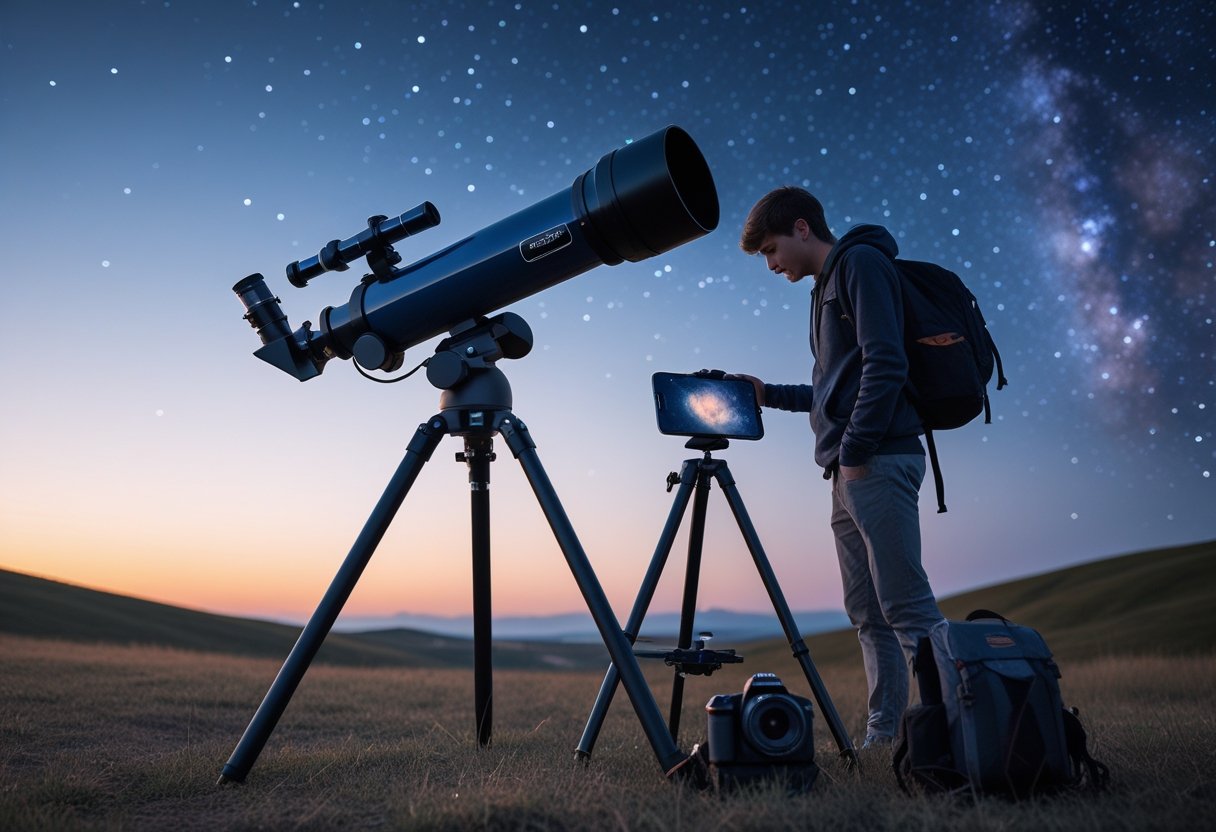
You can capture striking night-sky photos without spending more than €500 by prioritizing a few key items: a modest but optically solid telescope, a stable mount or tracker, and a simple camera or smartphone adapter. With the right choices and techniques, a budget telescope plus a basic mount gets you real astrophotography results for under €500.
This guide shows which affordable telescopes and mounts deliver the best value, how to attach a phone or entry-level camera, and which targets and settings give the biggest visual payoff. Expect practical tips on balancing cost, portability, and image quality so you start capturing stars and nebulae on your very next clear night.
You’ll also find straightforward advice on accessories, autoguiding alternatives, and framing tips that magnify your results without inflating the budget. Follow the steps here and transform simple stargazing into rewarding astrophotography.
Choosing the Best Budget Telescopes for Astrophotography
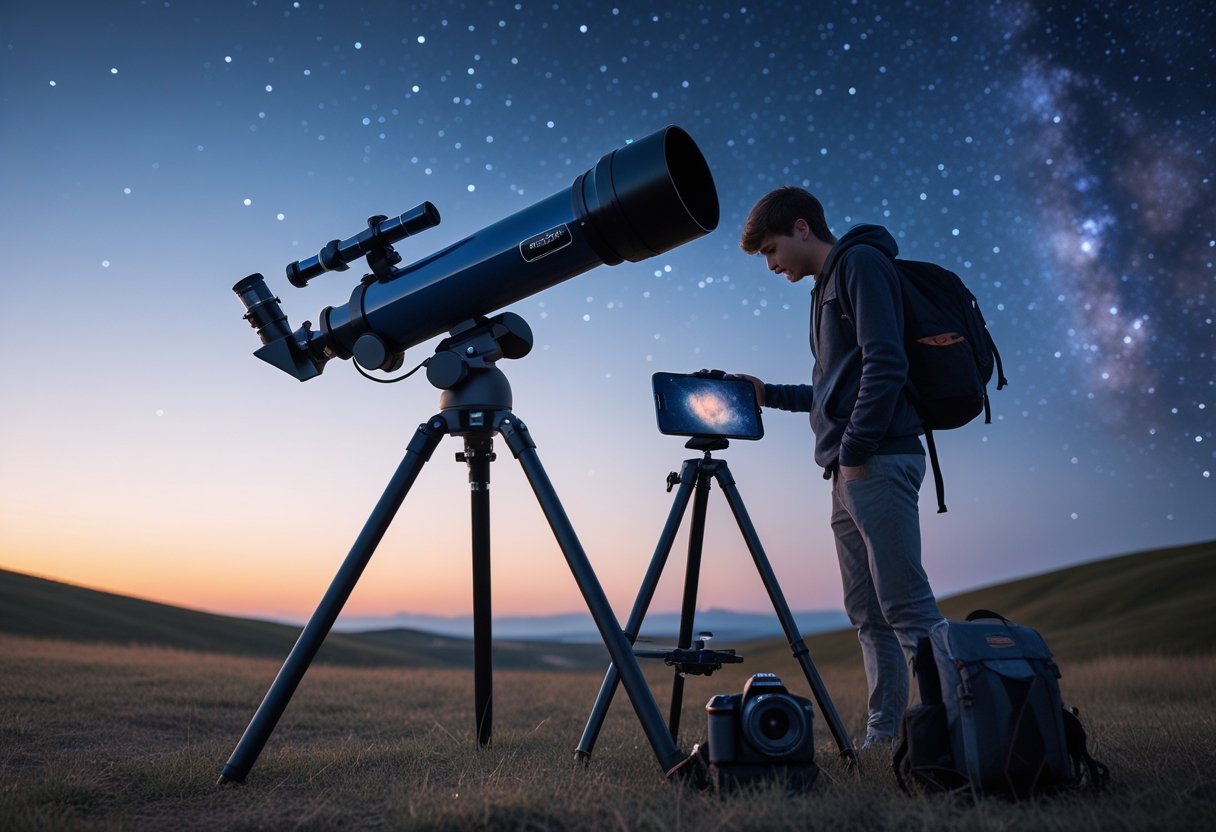
You want gear that balances image quality, portability, and price so your first nights producing usable deep-sky or planetary frames don’t end in frustration. Focus on small, well-corrected refractors or compact Newtonians with reliable mounts and a clear understanding of aperture and focal length trade-offs.
Key Features to Prioritize
Prioritize optical quality, stable mounting, and compatibility with cameras and autoguiding gear. For astrophotography, a dedicated field flattener or a flat focal plane built into the tube matters more than raw magnification. Small refractors with apochromatic elements often produce round, color-free stars across the frame; that reduces time wasted on calibration and cropping.
Mount stability beats bigger aperture on a tight budget. A shaky Dobsonian or tabletop alt‑azimuth will ruin long exposures. Look for equatorial or tracking alt‑az mounts that accept polar alignment and guider ports. Also confirm the telescope’s attachment standard (e.g., 2″ or 1.25″ focusers) and whether you need extension tubes or a T‑ring for your camera.
Weight and portability influence how often you use the kit. Compact telescopes under 4–5 kg plus a lightweight mount are easier to carry to dark sites. Check for included dew protection, a finder or star diagonal, and the availability of aftermarket flatteners or adapters.
Top Budget Astrophotography Telescope Models
Several models repeatedly show good value for under €500 (or comparable USD pricing). The Celestron AstroMaster 130EQ and Celestron NexStar 130 SLT are 130mm Newtonian reflectors with parabolic mirrors that deliver strong light‑gathering for planetary and some deep‑sky work when paired with a steady mount. They often appear on lists of the best telescopes under $500.
If you prefer a compact refractor, the Orion StarBlast II 4.5 is a portable Newtonian-style scope that’s easy to mount and transport; it’s popular as an affordable telescope that’s ready for simple DSLR or smartphone imaging. For wide-field astrophotography, consider small 70–80mm apochromatic refractors; they produce tighter stars and work well with short focal-length cameras.
A tabletop or small equatorial mount paired with these tubes makes a practical package. Avoid cheap alt‑az mounts for long exposures unless you plan to use short guided sub‑exposures. When shopping, compare included accessories and the availability of T‑rings, flatteners, and guide-scope mounts to keep future upgrades affordable.
Refractor vs Reflector Telescopes
Refractors (especially apochromatic triplets) deliver high-contrast, low‑maintenance optics that suit color-sensitive imaging and short focal-length framing. They typically have sealed tubes, which reduces collimation needs and makes them more portable. An 80mm or 70mm APO often outperforms larger cheap reflectors for wide-field nebula work.
Reflectors (Newtonian) give you larger aperture per euro and stronger light-gathering for faint objects. A 130mm Newtonian with a parabolic mirror will collect more light than an 80mm refractor, improving resolution for galaxies and nebulae. However, Newtonians require regular collimation and often need a sturdier mount to handle the tube’s weight and balance.
Dobsonian designs maximize aperture cheaply but use alt‑az mounts that are poor for long exposures without an equatorial platform. If you want visual and basic planetary imaging, a Dobsonian or Sky-Watcher style Newtonian is excellent value. For dedicated astrophotography, lean toward small refractors or Newtonians mounted on a tracking equatorial mount.
Understanding Aperture and Focal Length
Aperture determines light-gathering and resolution. Larger aperture (e.g., 130mm) resolves finer detail and shortens required exposure time, but demands better mounts and more careful collimation. Smaller apertures (70–80mm) produce wider fields and are more forgiving with unguided exposures.
Focal length sets image scale. Short focal lengths (300–500mm) suit wide-field targets like large nebulae and fit small sensors; they pair well with compact telescopes or short refractors. Long focal lengths increase magnification for planets and small galaxies but need higher tracking precision and often longer focal reducers or field flatteners.
Match focal length to your camera’s sensor size and pixel size to achieve roughly 1–2 arc‑seconds per pixel for balanced sampling. On a strict budget, choose a telescope with a focal ratio between f/5 and f/7 for flexibility; fast scopes (f/4–f/5) shorten exposure time but require better flatteners and may show more coma on the edges unless corrected.
Essential Mounts and Accessories
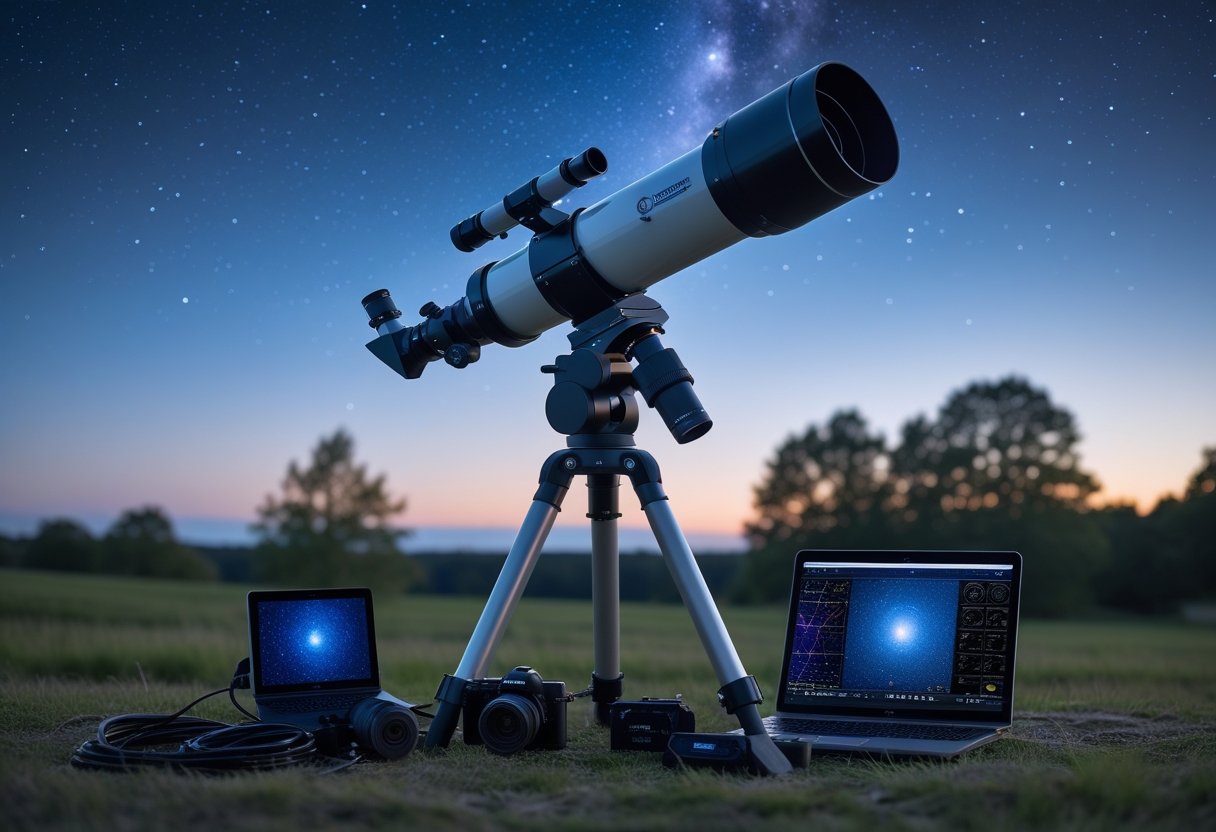
Good stability, easy aiming, and a couple of simple optical add-ons will make the rest of your budget setup work. Focus on a mount that keeps your gear steady, provides useful manual controls, and pairs with affordable finders and eyepieces.
Mount Types Explained
Pick an altazimuth mount or an equatorial mount depending on what you plan to shoot. An altazimuth is the simplest: it moves up/down and left/right, works well for wide-field Milky Way shots with a camera and tripod, and is usually cheaper. Look for models with slow-motion control knobs so you can nudge framing without introducing vibration.
An equatorial mount (including German equatorial mount) aligns with Earth’s axis and lets you track stars by turning one axis. That tracking is essential for longer exposures with a small scope or guided imaging. For under €500, you can find entry-level equatorial mounts that accept a lightweight refractor or small SCT; prioritize mount stability and payload rating over extra features.
If you prefer visual observing, a Dobsonian mount offers huge aperture per euro and rock-solid stability for manual viewing. Dobsonians lack motorized tracking, so they’re not ideal for long-exposure astrophotography, but excellent for lunar and planetary imaging with short video captures.
Finder Scopes and Red Dot Finders
Choose the finder that helps you acquire targets quickly. A small finderscope (50–9x) provides magnification and crosshairs for centering objects; it’s preferred when you need precise alignment for eyepiece work or guiding. Mount it rigidly and collimate it to the main tube so your object stays in frame.
A red dot finder or Starpointer projects an illuminated reticle and is faster for wide-field targets and camera setups. It’s ideal for beginners who want to point at constellations without exact magnification. Red dot finders are lightweight and won’t upset a marginal mount’s balance.
Use one or the other; don’t rely on loose, flimsy brackets that shift. Secure mounting and a quick alignment routine at dusk will save a lot of time when you’re under a cold sky.
Eyepieces and Barlow Lenses
Start with a small set of eyepieces and one barlow lens to extend range affordably. A basic trio—25mm, 10mm, and 6mm—covers low, medium, and high magnification. Plössl eyepieces hit a good balance of sharpness and cost; a 25mm Plössl yields wide-field views for star-hopping, while a 10mm brings lunar detail.
Add a 2x barlow lens to double every eyepiece’s focal length and effectively double your eyepiece inventory for a small price. Keep in mind that poor quality barlows introduce softness; choose one with multicoating and positive reviews.
For astrophotography, you’ll often use manual focus through the camera or an eyepiece projection adapter. Practice focusing on bright stars and use short video captures for planets, or longer stacked exposures for deep-sky work.
Smartphone and Camera Adapters for Astrophotography
Adapters let you turn inexpensive optics and your everyday device into a capable imaging rig. Pick a stable mechanical mount, confirm eyepiece diameter compatibility, and prioritize easy alignment and firm clamping.
Smartphone Adapters
Choose a phone adapter that clamps securely to your eyepiece and holds your phone without sagging. Look for models with adjustable jaws and rotatable mounts so you can center the phone camera over the eyepiece and switch between landscape and portrait quickly. Metal-bodied adapters or those with solid aluminum frames resist flex better than cheap plastic clamps.
Use a Bluetooth remote or timer to avoid vibration when exposing. If you have a Celestron NexYZ–style adapter, the three-axis adjustment speeds precise alignment. For quick setup guides and product choices, see a roundup of the best smartphone adapters for telescopes and binoculars.
If you own a Celestron StarSense Explorer DX 130AZ, remember its mount and finder aid allow faster framing; pair it with a rigid phone adapter and the StarSense app for slewing targets to your field of view.
Key checklist:
- Eyepiece diameter fit (measure mm)
- Sturdy clamp and rubber protection
- Fine X/Y adjustment or 3-axis controls
- Remote shutter and rotation capability
Attaching Entry-Level Cameras
Mounting an entry-level mirrorless or compact DSLR to a small refractor or spotting scope uses either a T-ring + T-adapter (for prime focus) or a universal camera-to-eyepiece adapter (afocal). For prime-focus, match your camera’s T-ring thread to the telescope’s visual back; this removes the eyepiece and yields sharper planetary and lunar images.
Afocal setups keep the eyepiece and require precise optical alignment; use a rigid adapter with thumbscrews and padding to prevent rotation. Balance the camera on the mount—heavy cameras need counterweights or a sturdier mount to avoid tracking errors. If you plan long exposures, consider a simple equatorial wedge or an inexpensive equatorial mount upgrade to improve tracking for stacked deep-sky shots.
Quick tips:
- Use a T-ring for best image quality with interchangeable-lens cameras.
- Check weight limits of your mount before attaching the camera.
- Trial-align during twilight; mark positions for repeatable setups.
Stargazing Targets and Deep Space Objects
You’ll focus on bright, high-contrast targets that work with short exposures, small sensors, and a fixed tripod or low-cost mount. Pick targets visible from your latitude, aim for high surface-brightness objects, and use simple filters or stacking to boost detail.
Galaxies and Nebulae You Can Capture
Galaxies like the Andromeda Galaxy (M31) and the Triangulum Galaxy (M33) are good first targets because they span large areas and show structure even with short, stacked exposures. You’ll get the best results with focal lengths between 200–600mm; wider fields let you capture M31’s companion galaxies as well.
Emission nebulae such as the Orion Nebula (M42) and the Lagoon Nebula (M8) concentrate light and show color through narrowband or light-pollution filters. If you’re in a dark-sky location, try the Dumbbell Nebula (M27) with a 135–300mm lens and 30–120 second subframes.
Use these practical steps:
- Frame the object near the sensor center to reduce vignetting.
- Stack many short exposures (30–120s) to improve signal-to-noise.
- Apply simple calibration frames (darks, flats) for cleaner results.
Viewing the Moon and Planets
The Moon yields dramatic detail with any modest camera or a 200–400mm lens; stop down slightly (f/5.6–f/8) for sharper crater edges. Capture during terminator phases (crescent to first quarter) to emphasize shadows and texture. You can shoot short bursts and select the best frames to reduce seeing blur.
For planets, start with Jupiter and Saturn. Jupiter’s cloud bands and the Galilean moons appear with 400–2000mm effective focal length and video capture plus stacking. Saturn’s rings require higher magnification and steady seeing, but even a small budget scope or a telephoto plus a barlow can reveal the ring outline. Use high frame-rate capture, and limit single-exposure times to avoid atmospheric smearing.
Star Clusters and Unique Celestial Sights
Open clusters like the Pleiades (M45) and the Beehive (M44) are bright, compact, and forgiving of shorter exposures. They work excellently with lenses from 50–200mm and add striking star fields to landscape compositions. Globular clusters such as M13 demand more focal length and benefit from dark skies; stack many subframes to reveal core concentration.
Look for special sights: meteor showers (use wide-angle lenses and long intervals), the Milky Way’s bright dust lanes (best with dark sky sites and fast wide optics), and occasional comets that can appear unexpectedly. For light-polluted locations, prioritize high surface-brightness objects and consider a light-pollution filter to recover contrast.
Optimizing Performance and Image Quality
You will focus on improving sharpness, contrast, and practical usability: align optics precisely, reduce skyglow, and make the rig quick to set up and stable for long exposures.
Collimation and Telescope Maintenance
Keep optics precisely aligned. For reflector and some affordable compound scopes, use a Cheshire or laser collimator to check primary and secondary alignment before each session. Small misalignments blur stars across the frame and waste integration time.
Clean optics sparingly. Use a bulb blower and distilled water or optical-grade wipes for stubborn grime; avoid household cleaners. Check screws, dew shields, and the focuser for play—tighten loose fasteners and lubricate simple drawtubes if they stick.
If you use inexpensive telescopes or binoculars, verify collimation often. Even small offsets on cheap optics cause noticeable loss of light-gathering and contrast. For manual focus, mark a sweet-spot on the focuser after achieving pinpoint stars so you can return quickly between targets.
Controlling Light Pollution
Reduce skyglow with filters and framing. A broadband light-pollution or L-pro filter helps for city or suburban skies and improves contrast on emission nebulae; test filter insertion points to avoid vignetting. Point your setup away from direct streetlights and use a simple cardboard baffle or hood to block offending lamps.
Choose targets low in light-polluted areas. Galaxies and globular clusters in darker sky directions yield better signal-to-noise than faint nebulas near the horizon. Stack many short exposures instead of a few long ones to limit gradients from passing lights or low clouds.
Use local solutions: a dark blanket over a laptop screen, black tape over tiny stray-reflection gaps, and shielding for any LED on your mount. These small steps reduce scattered light hitting your sensor and sharpen final images.
Improving Portability and Ease of Use
Lighten the load without losing stability. Pick a compact refractor or a pair of large-aperture binoculars on a small alt-az or star-tracker mount—many quality options fall near your budget and maximize portability. Weigh gear assembled once and note the balance point so you can mount quickly.
Prioritize mount stability. A flimsy tripod ruins long exposures. Add simple ballast (a backpack with gear) to the tripod spreader to reduce vibration. Use quick-release dovetails and pre-drilled cable paths to avoid accidental tugs that upset guiding.
Streamline focusing and setup. Fit a simple helical or dual-speed focuser adapter for smoother manual focus and mark positions per eyepiece or camera. Carry a small night-vision red flashlight and condensed checklist: polar alignment, balance, guide-cable routing, and a test frame to confirm focus.
Best Practices for Beginner Astrophotographers
Start with stable gear, learn a few camera and mount settings that consistently work, and choose targets you can reasonably reach from your location.
Tips for First-Time Users
Choose a simple, stable tripod and, if you can, a star tracker under €300 to extend exposures without star trails. If you prefer a telescope, look at a refractor beginner telescope or a Dobsonian-style first telescope in the telescope under €200–€300 range for easy setup and bright views.
Set camera basics: shoot in RAW, use manual mode, keep ISO between 800–3200 depending on sensor noise, and start with exposures of 10–30 seconds for wide-field Milky Way shots when unguided.
Use a remote shutter or intervalometer to avoid vibration and take multiple frames for stacking. Learn to focus precisely: use live view at 100% on a bright star or the Moon, and mark that focus for repeat sessions.
Practice polar aligning your tracker to within 1–2 degrees; that makes long exposures far more useful. Balance the mount with your camera or telescope to reduce motor strain and tracking errors.
Planning Your Astrophotography Session
Pick nights with low moonlight and a clear forecast; use apps for cloud cover and seeing predictions. Find a dark-sky spot when possible — even one magnitude darker improves faint-detail capture. If you must shoot from town, use a light-pollution filter and target brighter objects like the Moon, planets, or star clusters.
Plan your session checklist: charged batteries, formatted memory cards, lens cleaning cloth, warm clothing, and a headlamp with a red filter. For telescope users, bring eyepieces, finder-scope alignment tools, and a dew heater if humidity is high.
Select targets suited to your gear: wide-angle Milky Way with a fast lens, Moon and planets with a small telescope for beginners, or bright nebulae and star clusters with a beginner telescope plus tracking.
When possible, schedule calibration frames (darks, flats, bias). These improve stacked results and are quick to capture at the start or end of the night.
Leave a Reply