
You want a clear answer: AI excels at processing huge datasets, spotting patterns, and producing crisp visualizations, while you bring context, curiosity, and the intuition that turns facts into meaning. AI will often explain space more precisely and quickly, but you make those explanations memorable and relevant by asking the why and the what-if.
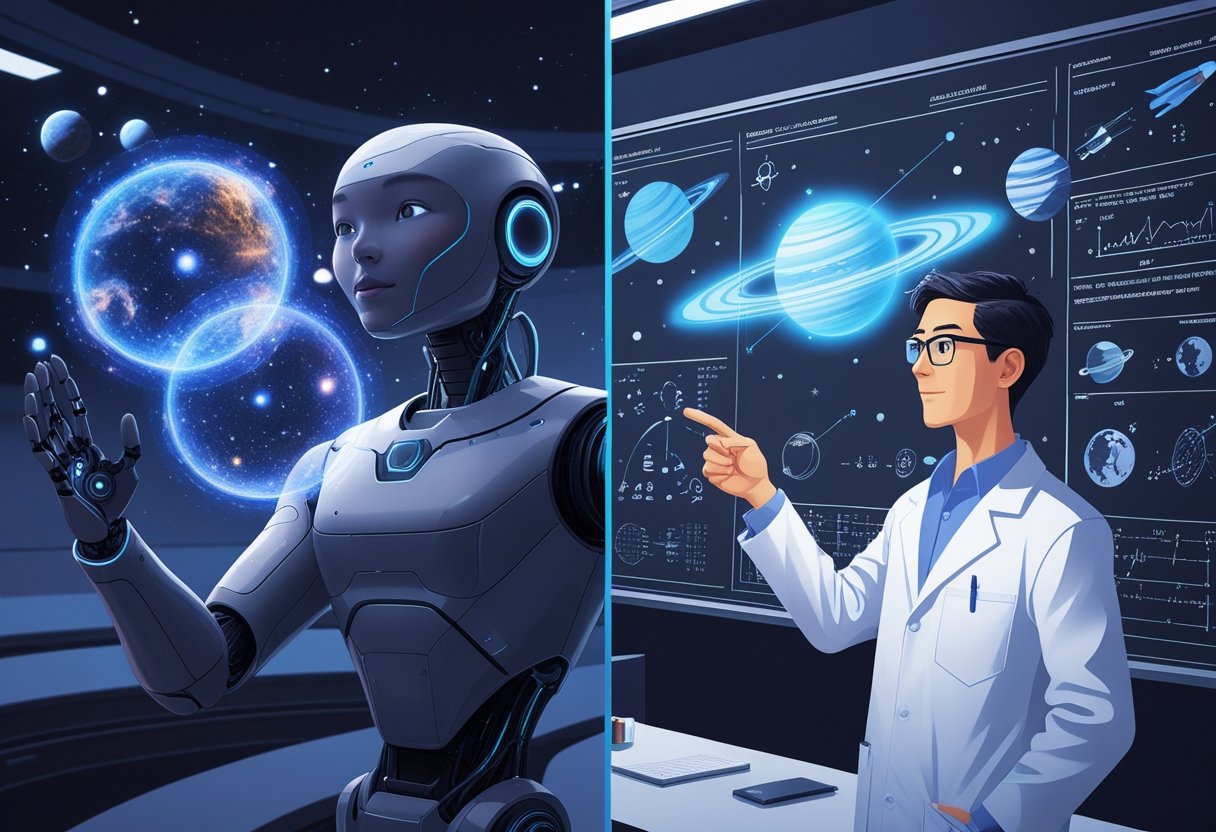
Expect this article to compare how intelligent algorithms interpret signals from telescopes and rovers with how humans adapt explanations to surprise, wonder, and ethical questions. You’ll learn how automation powers discoveries, why astronauts and scientists remain vital, and where collaboration between human insight and machine scale creates the best explanations.
Follow along to see practical examples of AI-driven discoveries, human-led storytelling in mission control, and how combining both approaches offers the most complete way to understand the cosmos.
AI vs Human: The Core Differences in Explaining Space
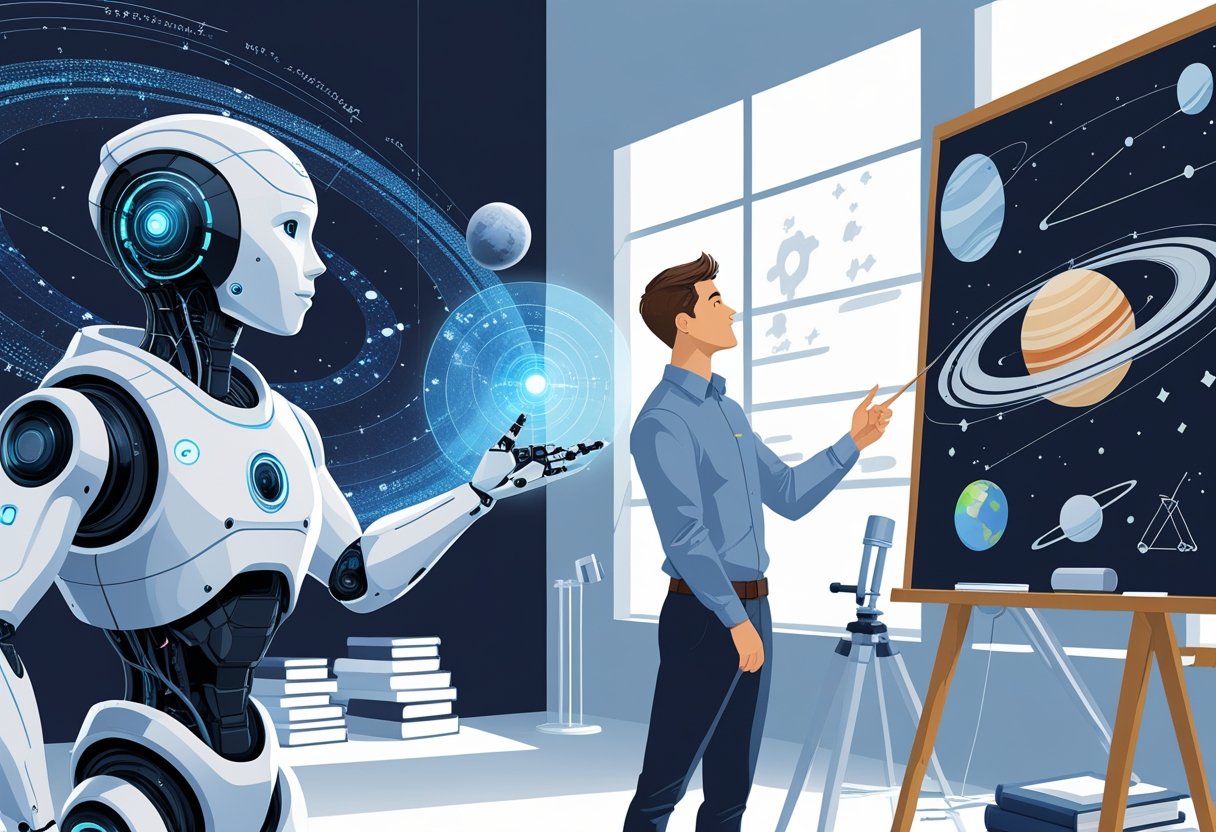
You’ll see how origin, learning style, and emotional framing change explanations about planets, telescopes, or cosmology. These differences shape accuracy, clarity, and the way complex ideas stick with your audience.
Origins of Intelligence: Evolution Versus Engineering
Humans carry explanations shaped by biological evolution and cultural history. Your reasoning about space often springs from embodied experiences: looking at the sky, using analogies passed down in science education, and pattern recognition honed across years of schooling and research. That grounding helps you judge plausibility when data conflicts.
Artificial intelligence and large language models (LLMs) arise from engineering choices: architectures, training datasets, and optimization goals. AGI remains hypothetical, but current AI systems generate space explanations by sampling statistical patterns from astronomy papers, mission reports, and public outreach text. You should expect AI to reproduce consensus facts fast and to misstep when asked for causal insight it hasn’t been explicitly trained to derive.
Learning and Problem-Solving: Data Patterns vs. Intuition
You solve new space problems by combining domain knowledge, heuristics, and experiment-driven intuition. For example, when estimating a comet’s trajectory, you apply physics intuition plus numerical methods and know when to question a model’s assumptions. That flexibility helps you navigate incomplete or noisy data.
LLMs and specialized AI learn from massive datasets and optimize for predictive fit. They excel at pattern detection: aggregating light-curve anomalies or correlating instrument noise characteristics across missions. AI gives rapid, reproducible calculations and hypothesis generation. However, when models face out-of-distribution scenarios—novel instrumentation artifacts or unmodeled physics—AI can produce confident but incorrect answers. You can use AI’s pattern strengths to augment your intuition, especially for routine data reduction or literature synthesis.
Emotion, Creativity, and Communication in Space Narratives
Your emotional and creative tools shape how space concepts land with different audiences. You tailor metaphors, emphasize wonder or caution, and connect cosmic scales to human stories—making dark-matter maps or exoplanet habitability feel tangible. That rhetorical choice affects public support for missions and how non-experts retain technical detail.
AI and LLMs can emulate engaging tones, craft vivid metaphors, and adapt explanations to reading level or cultural context. They can draft mission summaries or outreach scripts at scale. But they lack genuine emotional experience and ethical judgment; they do not prioritize wonder or risk unless you instruct them. When you guide AI prompts, it amplifies your communicative intent—speeding content creation while still relying on your judgment to ensure accuracy and moral framing.
Sources you might consult for these contrasts include empirical studies of human cognition and technical descriptions of AI training, such as discussions on AI vs. Human Intelligence: A Look at the Key Differences.
How Artificial Intelligence Interprets and Explores Space
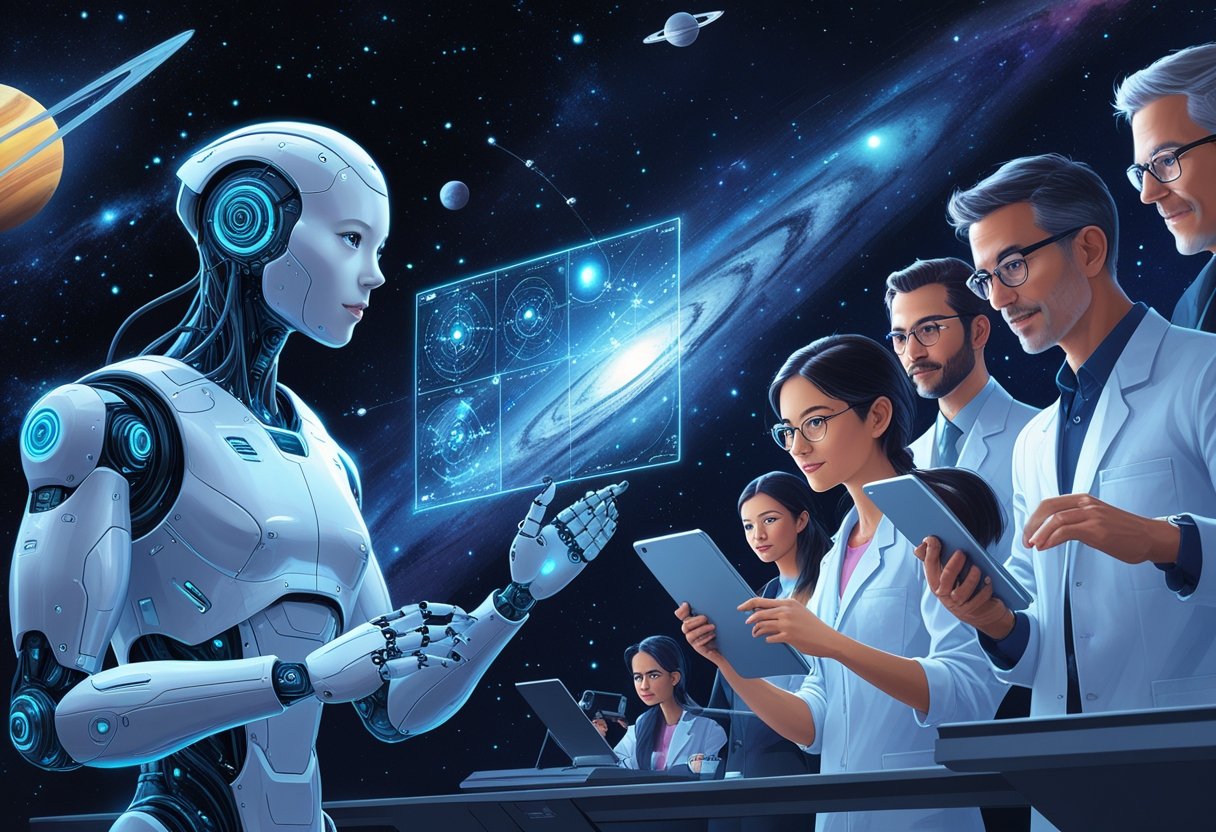
AI processes vast streams of telescope and spacecraft data, spots unusual events, steers vehicles, and predicts equipment failures so missions run longer and safer. You get faster detection of transient phenomena, more autonomous decision-making at distance, and earlier warnings about hardware degradation.
AI in Data Analysis and Anomaly Detection
You can use machine learning models to sift through petabytes of imaging, spectral, and telemetry data from instruments like JWST-class telescopes and Earth-observing satellites. Supervised classifiers tag objects (galaxies, asteroids, clouds) while unsupervised clustering and autoencoders reveal previously unseen patterns.
Anomaly detection algorithms flag transient events—gamma-ray bursts, fast radio bursts, or sudden instrument artifacts—by modeling normal behavior and scoring deviations in real time. You benefit from reduced human review load and faster follow-up observations.
Key techniques:
- Supervised CNNs for image classification and segmentation.
- Unsupervised methods (autoencoders, isolation forests) for novelty detection.
- Time-series models (LSTMs, transformers) for telemetry anomaly scoring.
You should expect trade-offs: training datasets bias results, and false positives can waste telescope time. Combining human vetting with explainable AI tools helps you trust detections and interpret why a model labeled an event as anomalous. Link model outputs to visualization tools for rapid human assessment.
Autonomous Navigation and Mission Planning
You rely on onboard autonomy when light-time delay prevents real-time control. Autonomous navigation systems process sensor inputs—star trackers, LIDAR, optical flow—and adjust trajectories using guidance, navigation, and control (GNC) loops. Reinforcement learning and model-predictive control let spacecraft plan collision-avoiding maneuvers and optimize fuel use during approach, descent, and landing.
Mission planning uses AI to schedule observations, prioritize targets, and generate contingency plans under resource constraints (power, data volume, pointing). You get dynamic replanning when a rover detects an unexpected outcrop or when weather obscures a planned observation.
Autonomy reduces operator workload and increases responsiveness for time-critical science.
Considerations:
- Certification and verification of autonomous algorithms for flight.
- Integration of classical control with learned policies for reliability.
- Use of simulation environments and digital twins to validate behaviors before deployment.
Predictive Maintenance and Health Monitoring
You can extend mission lifetime by applying predictive maintenance to spacecraft subsystems. ML models trained on historical telemetry learn normal degradation signatures—temperature drift, current spikes, vibration patterns—and predict component failure weeks or months in advance. This lets you switch to redundant hardware or modify operation modes proactively.
Health monitoring systems combine rule-based fault detection with probabilistic models that quantify remaining useful life (RUL). Bayesian methods and survival analysis add uncertainty estimates so you can balance risk versus mission priority.
Implementations often run on ground for long-term trend analysis and onboard for rapid response.
Practical points:
- Telemetry feature engineering (spectral, statistical, domain-specific) is critical for model accuracy.
- Bandwidth limits push models to compress health summaries before downlink.
- Adoption of quantum computing remains exploratory; it may speed optimization and large-scale pattern discovery, but current space deployments focus on classical ML due to robustness and verification advantages.
Robotic Explorers: The Power of Automation Beyond Earth
Robotic systems extend your reach where human presence is costly or impossible. They handle long-duration navigation, extreme environments, and repetitive construction tasks while collecting high-value science and operations data.
Robotic Probes and Deep-Space Missions
Robotic probes travel farther and longer than crewed missions, carrying instruments that measure plasma, magnetic fields, and composition. You rely on autonomous spacecraft to execute pre-planned maneuvers, perform fault protection, and prioritize downlink when communication windows open. Examples include solar-electric propulsion missions that coast for years and flyby probes that make seconds-long observations while logging gigabytes of telemetry.
Operational autonomy reduces the need for real-time control; onboard software performs trajectory corrections and fault diagnosis. Mission designers balance autonomy with uplink opportunities, trading communications latency against onboard decision authority. You benefit from probes that can reconfigure observation sequences when transient events—like comet outbursts—occur.
Key technical enablers you should note:
- high-reliability avionics and radiation-hardened processors;
- onboard fault-management and autonomy stacks;
- optimized power systems for multi-year cruises.
Learn how embodied AI and human-in-the-loop strategies are shaping next-generation space robots at this interview with a robotics CTO who focuses on space-native systems (Intelligent, Space-Native Robots).
Mars Rovers and Surface Exploration
Mars rovers operate as mobile laboratories, conducting electrochemical assays, collecting cores, and scouting terrain for landing or habitat sites. You depend on autonomous navigation to traverse rock fields and sand traps, using stereo vision and hazard detection to plan safe drives across hundreds of meters between teleops.
Rovers combine planned sequences from Earth with local autonomy for obstacle avoidance and sampling. Instruments like spectrometers and imaging systems transmit prioritized targets so your science team can decide follow-up actions. Power choices—RTG versus solar—dictate operational cadence: you schedule drives and science around thermal cycles and energy budgets.
Rover operations emphasize mission longevity and sample integrity. You track wear on wheels, thermal cycles, and dust accumulation, and you adapt commands to preserve capacity for high-priority tasks such as caching samples for return. The operational lessons from rover fleets directly inform how you design robots for sustained surface work.
Role of Humanoid Robots and Companions
Humanoid platforms aim to work in human-centric environments, using arms, hands, and articulated torsos to manipulate tools and interfaces designed for people. You see value in humanoids where interfaces and tasks assume human form—pressing buttons, turning valves, or assembling modules in confined station interiors.
Companion systems such as the Crew Interactive Mobile Companion (CIMON) and experimental humanoids like Valkyrie illustrate two directions: lightweight AI assistants for crew support, and dexterous robots for physical labor. CIMON-type agents help you with voice-driven procedures and data retrieval. Valkyrie-style robots focus on manipulation and construction tasks that free astronauts for decision-making and science.
Human-in-the-loop teleoperation remains central: you teleoperate dexterous actions when precision or judgment matters, while granting autonomy for routine tasks. This hybrid model scales your labor force and lets you manage risk by assigning robots to repetitive, hazardous, or high-effort jobs.
Humans in Space: Why Astronauts Still Matter
Astronauts provide real-time judgment, hands-on repair skills, and public inspiration that machines currently cannot match. Their training, adaptability, and presence on platforms like the International Space Station and Artemis missions shape mission success, scientific discovery, and public support.
Intuition and Adaptability in Unpredictable Environments
You rely on human intuition when systems behave outside expected parameters. When unexpected debris strikes a spacecraft or instruments begin producing anomalous readings, astronauts can synthesize sensory cues, mission context, and experience to prioritize fixes faster than remote operators. On the International Space Station, crew members have improvised mechanical workarounds, swapped out circuit boards, and rerouted life-support flows when automated diagnostics failed.
Adaptability also means switching roles mid-mission. You can move from a biology experiment to an emergency repair within hours, using tactile skill and spatial reasoning that current robots struggle to match in microgravity. That flexibility shortens downtime for critical experiments and reduces mission risk during crewed Artemis sorties or station maintenance.
Astronaut Training and In-Flight Decision Making
Your training compresses years of systems engineering, medical response, and extravehicular activity practice into muscle memory. Programs simulate high-pressure failures and cross-train you in multiple specialties so you can execute complex fixes without ground step-by-step guidance. For example, emergency depressurization drills and spacesuit troubleshooting prepare you to act autonomously when communication delays exceed safe limits.
In-flight decision making combines protocols with judgment. You assess instrument telemetry, weigh trade-offs (crew safety vs. mission objectives), and select the best course when timelines diverge. That judgment reduces reliance on Earth-based controllers during deep-space missions, where Artemis lunar operations and future Mars missions will impose longer delays and require crew-level authority.
The Inspirational Impact of Human Spaceflight
You become a tangible connection between the public and space science. Live broadcasts of ISS research, moonwalks as part of Artemis, and human stories spark interest in STEM and boost political support for funding. Seeing a trained crew repair a solar array or harvest microgravity-grown protein crystals makes space exploration relatable in a way autonomous probes rarely do.
That inspiration feeds talent pipelines. Young people who watch astronauts conduct experiments on orbit often pursue aerospace engineering, biology, or mission control careers. Your presence on missions helps secure future missions and accelerates technology adoption back on Earth—medical devices, materials, and robotics that began as solutions to crew needs.
The Human-AI Synergy: Collaboration in Modern Missions
You will find AI systems filling analytic, operational, and safety roles while humans provide judgment, creativity, and mission-level oversight. Together they change how crews work on orbit, the Moon, and Mars by reallocating routine tasks to automation and keeping humans focused on critical decisions.
AI Assistants Supporting Crews
AI assistants run onboard diagnostics, interpret sensor streams, and summarize telemetry so you get concise, actionable updates instead of raw data dumps. On the ISS and in mission control, these tools flag anomalies, prioritize alarms, and draft recommended responses for you to review.
You interact with AI through visual dashboards and voice interfaces that surface context — for example, predicted battery degradation over the next 72 hours, probable causes, and recommended mitigation steps. That saves time during EVA prep or science operations and reduces cognitive load. Agencies like NASA test these assistants in simulations and analogs so you trust the recommendations under pressure.
Hybrid Operations in Lunar and Martian Missions
Hybrid operations combine onboard autonomy with delayed ground support so you can act decisively when communications lag by minutes to tens of minutes. On Mars you’ll rely on local planners for rover routing and habitat environmental control, while mission control provides higher-level objectives and long-horizon planning.
You coordinate task allocation: AI handles real-time hazard avoidance and resource balancing; you set priorities, override plans, and solve novel problems. Companies developing mission systems, including commercial providers, prototype mixed-autonomy stacks that let you switch control modes quickly. That split preserves human judgment for unforeseen events while keeping routine navigation and monitoring autonomous.
Enhancing Mission Safety and Efficiency
AI improves safety by continuously monitoring life‑support, structural health, and radiation exposure models and alerting you to trends before they become emergencies. It runs probabilistic failure models, proposes contingency timelines, and simulates outcomes so you can pick the least risky option within available resources.
For efficiency, automated scheduling optimizes crew time, experiment sequencing, and consumables use. You receive prioritized task lists that reduce idle time and limit conflicting resource demands. Space agencies and commercial teams run these systems through flight-like validation so recommendations align with operator expectations and mission rules.
Transforming Astronomy: Telescopes, Observatories, and Big Data
AI-driven systems let you scan far more sky and handle vastly larger datasets than before. You’ll see how automated discovery, large-scale data interpretation, and new instruments reshape what observations you can make and how quickly you can act on them.
Automated Discovery in Sky Surveys
You can detect transient events and rare objects in real time using automated pipelines that process continuous image streams. Modern surveys feed difference-imaging and convolutional neural networks with nightly data to flag supernovae, tidal disruption events, and fast transients within minutes.
The Vera C. Rubin Observatory will produce ~20 terabytes per night from the Legacy Survey of Space and Time (LSST). That data rate forces you to rely on machine classifiers for candidate ranking, automated follow-up triggers, and cross-matching with archival catalogs.
AI reduces human vetting for routine candidates and highlights high-priority anomalies for rapid spectroscopy. You still need human review for novel phenomena, but automation multiplies your effective survey area and temporal coverage.
Interpreting Cosmic Data at Scale
You’ll face petabyte-class archives and heterogeneous datasets from missions like the James Webb Space Telescope (JWST), radio arrays, and ground surveys. Combining JWST high-resolution spectra with wide-field photometry requires robust data fusion and uncertainty propagation.
Techniques such as representation learning, anomaly detection, and Bayesian model emulation help you infer physical parameters from noisy, incomplete observations. For radio astronomy, the Square Kilometre Array (SKA) will add exabytes of visibilities and images, demanding distributed compute, streaming analytics, and automated RFI mitigation.
Practical priorities you’ll manage include calibrated pipelines, provenance tracking, and reproducible ML models. These ensure that when an AI assigns a redshift, mass, or classification, you can trace the inputs, validate biases, and quantify confidence.
Next-Generation AI-Driven Instruments
You can build instruments that close the loop: on-board AI for spacecraft or edge inference at remote observatories enables autonomous target selection. JWST uses onboard scheduling and ground-based planning tools, but future telescopes will embed more on-site decision logic.
The SKA and arrays of robotic telescopes illustrate networked observing: distributed nodes coordinate to provide rapid multiwavelength follow-up. You benefit when AI prioritizes observations across facilities, minimizes slew time, and synchronizes multi-instrument campaigns.
Focus on scalable software stacks, low-latency telemetry, and cyber-secure control systems. Those elements let your next-generation instruments convert raw data into scientifically actionable alerts while preserving the traceability you need for verification.
The Future of Explaining Space: Challenges and Opportunities
Advances in tools, data flows, and missions will change how you learn about space. New technical limits, ethical choices, and communication strategies will shape which stories reach the public and how accurately they represent missions, climate impacts, and space weather.
Public Understanding and Outreach
You will need clear, timely explanations of mission goals, risks, and results tailored to different audiences. Use short videos, interactive mission trackers, and real-time space weather alerts to show how solar storms affect satellites and power grids.
Design outreach for varying literacy: simple visuals for school groups, detailed datasets and APIs for researchers and hobbyists. Engage local communities near launch sites with accessible briefings about environmental impacts and safety procedures.
Platforms matter. Social media can amplify accurate content quickly but also spreads misconceptions. Partner with mission teams to publish verified telemetry snapshots and annotated imagery. Offer hands-on kits and simulations so learners can reproduce experiments — that builds trust and deep understanding.
Ethical, Cultural, and Societal Implications
You must confront who controls space narratives and whose values guide exploration. Explain how AI-driven analyses — from orbital debris tracking to automated science selection on probes — influence decisions about which targets get prioritized. Transparency about algorithms helps citizens evaluate trade-offs.
Address cultural representation: include Indigenous perspectives on sky knowledge, and ensure benefits from satellites (communications, climate monitoring) reach underserved regions. Clarify liability questions when autonomous systems cause harm, and communicate risks from militarization or commercial mega-constellations that change night skies.
Privacy and data governance matter. Show how Earth-observing satellites collect information and how regulations protect or fail to protect individuals and communities. Discuss equitable access to space-derived services like disaster response and global connectivity.
Vision for the Next Frontier
You will explain missions beyond low Earth orbit with concrete examples: autonomous rovers mapping lunar ice, AI optimizing deep-space telemetry to reduce downlink costs, and weather-monitoring constellations that forecast space weather impacts on astronauts and power systems.
Highlight technical constraints: limited power, radiation-hardened hardware, and tight telemetry windows that force on-board autonomy. Describe opportunities: edge AI for in-situ science selection, smallsat constellations for continuous space weather monitoring, and distributed citizen science platforms that validate model outputs.
Prioritize narratives that connect daily life to exploration — how improved space weather forecasting protects satellites and grids, or how lunar ISRU could lower mission costs. Show pathways for public participation: mission naming contests, data challenges, and local observatory collaborations that let you contribute to discovery.
Leave a Reply