
You’ll see how AI turns noisy, pixelated telescope outputs into crisp, scientifically useful images and why that matters for discovery and outreach. I’ll show you which AI methods actually improve clarity, where they fit in the imaging workflow, and what trade‑offs to expect so you can judge results confidently.
Expect a practical tour of the tools people use to clean, deconvolve, denoise, and even generate missing data—ranging from specialized astrophotography plugins to research-grade neural networks and calibration systems used on missions like JWST. I’ll point out real capabilities, current limits, and which approaches suit hobbyists versus professional projects.
As you follow this article, you’ll learn how algorithms interact with telescope fingerprints, atmospheric blur, and faint signals, and how automated systems and generative models are changing what telescopes can reveal about planets, stars, and galaxies.
How Raw Telescope Data Is Transformed Into Clear Images
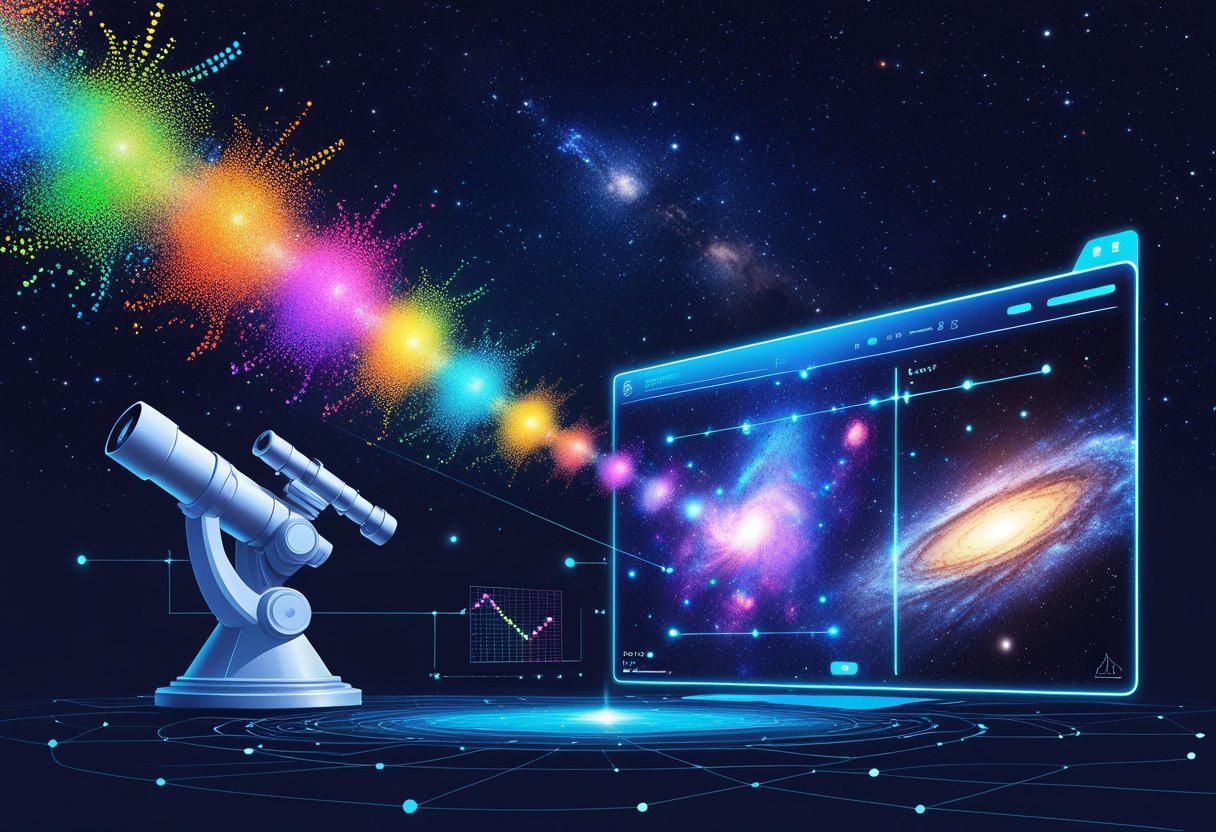
I describe the main steps that convert detector readouts into scientifically useful, visually sharp images: accurate calibration of pixels, targeted noise removal, and restoration of optical detail using deconvolution and AI models.
Data Acquisition and Preprocessing
I begin with raw detector frames saved as counts per pixel and associated metadata (exposure time, filter, temperature, readout mode).
Calibration frames—bias, dark, and flat-fields—get applied first to remove electronic offset, thermal signal, and pixel-to-pixel sensitivity differences. I check and flag bad pixels and cosmic-ray hits using statistical filters across multiple exposures.
Astrophotography pipelines often align and stack many short exposures to increase signal-to-noise ratio without saturating bright sources. I convert units to physical flux when needed and preserve World Coordinate System (WCS) information for astrometry. Accurate metadata and linearization are crucial; errors here propagate through every subsequent processing step.
Noise Reduction Techniques
I separate noise into deterministic patterns (e.g., column bias, correlated read noise) and stochastic components (photon shot noise, thermal noise). I remove patterned noise with model-based subtraction and median filtering on calibration frames.
For random noise, I apply denoising algorithms tuned to preserve faint astronomical structure.
I use a mix of classical and deep-learning denoising: wavelet thresholding or non-local means for texture-preserving smoothing, and convolutional neural networks trained on pairs of noisy/clean simulations for stronger suppression. I always validate denoising by injecting synthetic point sources to confirm flux and morphology remain accurate. Proper noise modeling also informs later deconvolution regularization to avoid amplifying residual noise.
Deconvolution and Image Enhancement
I treat deconvolution as an inverse problem: estimate the true sky by reversing the point-spread function (PSF) blur while controlling noise amplification. I measure or model the PSF from calibration stars and instrument profiles, including wavelength dependence and detector effects like the brighter-fatter phenomenon.
I choose algorithms—Richardson–Lucy for stable iterative recovery, Wiener filtering for linear regularization, or sparsity-promoting methods for high-contrast features—based on target science. AI-based deconvolution enters when complex, spatially varying PSFs or non-linear detector effects make classical kernels insufficient. I train neural networks on realistic simulated observations to learn deblurring operators that respect photometry.
Final image enhancement includes local contrast stretch, color mapping for multi-band data, and sharpening confined to scales where signal dominates noise. I document each step and store provenance so downstream analyses and reproducibility remain robust.
AI-Powered Tools for Astrophotography Image Processing
I focus on practical, task-oriented tools that correct blur, reduce noise, remove stars, and fix backgrounds so images retain real structure without artificial artifacts. Each tool set below targets a specific processing step and integrates into common FITS-to-final workflows.
RC Astro Suite: BlurXTerminator, NoiseXTerminator, StarXTerminator
I use the RC Astro plugins for targeted, automated fixes. BlurXTerminator performs AI-driven deconvolution that adapts to local image features instead of a single kernel; it restores fine detail while limiting ringing and amplified noise. That makes it useful on stacked subs that still show atmospheric or optical blur.
NoiseXTerminator separates signal from sensor and shot noise using a learned feature extractor. I apply it conservatively on stretched data to preserve faint filaments and galaxy arms while cleaning the background sky. It works well when combined with multiscale processing.
StarXTerminator builds precise star masks via a convolutional network and reconstructs the background to avoid halos. I remove stars before aggressive nebula processing and then blend the original stars back in. This workflow preserves morphology and color while maintaining star integrity.
PixInsight, DeepSkyStacker, and Specialized Software
I rely on PixInsight for granular, proven algorithms and DeepSkyStacker for straightforward alignment and stacking of raw frames. PixInsight gives me control with processes like Multiscale Linear Transform, DynamicPSF, and MorphologicalTransformation for manual or semi-automated corrections. I use those when scientific fidelity or fine control matters.
DeepSkyStacker handles calibration, registration, and median or sigma-clipped stacking efficiently for DSLR and OSC users. I feed its stacked FITS into PixInsight or other editors for further work.
When I need AI-specific features inside established pipelines I combine StarNet++-style models (as a plugin workflow) with PixInsight steps; that preserves reproducibility and keeps weight files and parameters auditable. I document parameter choices so results remain verifiable.
GraXpert and Background Gradient Removal
I use GraXpert to remove uneven gradients from light pollution, vignetting, and sensor artifacts. Its machine-learning approach analyzes intensity patterns to separate genuine nebulosity from background gradients, then applies subtraction or division corrections adaptively.
I validate GraXpert output by comparing the corrected background histogram and by inspecting faint structures at multiple scales. If GraXpert alters real detail I adjust mask thresholds or fallback to PixInsight’s Dynamic Background Extraction for point-controlled correction. This hybrid approach balances automation with manual oversight to protect astrophysical information.
Generative AI and Advanced Deep Learning Models in Astronomy
I describe how modern generative methods restore fine structure, enforce physical consistency, and scale to large survey volumes. Expect concrete techniques, typical inputs and outputs, and practical limitations for real telescope data.
Generative Adversarial Networks for Detail Recovery
I use Generative Adversarial Networks (GANs) to hallucinate high-frequency detail that telescopes miss due to limited resolution or noise. In practice I train a generator to map low-resolution or noisy images to higher-resolution versions while a discriminator learns to distinguish real high-resolution patches from generated ones.
Key losses I rely on include adversarial loss for texture realism, perceptual loss (VGG-based) to preserve semantic structure, and pixel-wise L1/L2 for photometric fidelity. I also apply conditional GAN variants so the model respects auxiliary inputs like PSF maps, exposure time, or wavelength bands.
GANs can produce sharp galaxy spiral arms and star-forming clumps that simple interpolation misses. However, I validate outputs against simulated high-resolution runs and reserve GAN outputs for visualization or downstream analyses only after rigorous statistical checks. For reproducibility I often publish architectures and training datasets on arXiv and share model checkpoints with the community.
Physics-Informed Neural Networks
I incorporate astrophysical constraints directly into network training so outputs obey conservation laws and instrument physics. Rather than purely learning mappings, I add penalty terms or constrained layers that enforce, for example, flux conservation across bands, known point-spread functions (PSFs), or radiative-transfer priors.
This approach reduces physically implausible artifacts common to unconstrained generative models. I implement these constraints as differentiable modules—PSF convolution layers, analytic priors on noise distributions, or loss terms comparing recovered properties (total flux, shape moments) to catalog values.
When labeled simulations exist, I jointly train on simulated and real telescope images using domain adaptation techniques. That helps the network generalize while still respecting physics. I typically report both image-level metrics and scientific metrics (photometric bias, shape bias) in any publication or arXiv preprint to show the model’s physical fidelity.
Diffusion and Transformer-Based Models
I apply diffusion models and transformers when I need stable, high-fidelity reconstruction and scalable context reasoning across large fields. Diffusion models iteratively denoise a latent code toward a target image, which gives me fine control over stochasticity and uncertainty quantification. They often outperform GANs on mode coverage and produce fewer hallucinated artifacts.
Transformers excel at capturing long-range correlations across mosaicked exposures or multi-band cubes. I feed patch tokens with positional and band encodings so the model learns cross-scale and cross-wavelength relationships. Combining transformers with diffusion samplers yields reconstructions that preserve faint extended emission and coherent background structures.
For practical deployment I balance compute cost and latency: diffusion-plus-transformer pipelines require more GPU time than CNN-based GANs, so I use them for deep reprocessing of survey subsets and reserve lightweight CNN emulators for real-time instrument pipelines.
Smart Telescopes and Automated Imaging Systems
I outline how modern smart scopes automate target acquisition, capture, and basic processing so you can spend less time fiddling and more time observing. The subsections examine a leading consumer model, the typical end-to-end workflow hobbyists use, and how these devices connect to remote observatories.
Vaonis Vespera and Current Market Devices
I evaluate the Vaonis Vespera as a representative of compact, consumer smart telescopes and compare its capabilities to similar devices. The Vespera uses an integrated camera, onboard processing, and a wifi link to a tablet or phone to plate-solve, auto-align, and live-stack images in real time. That design removes the need for polar alignment or manual guiding for short-to-moderate exposures.
Price and portability matter to buyers. The Vespera targets users who want quick deep-sky views without complex setup, while other market devices (e.g., ZWO Seestar, DwarfLab units) trade off portability for larger apertures or interchangeable optics. I note practical limits: small-aperture smart scopes excel at bright nebulae and wide-field galaxies but struggle with very faint targets and high-resolution planetary imaging.
If you plan long exposures or precise photometry, you’ll need a traditional Dob or SCT with an external mount. For casual astrophotography, the Vespera-style systems deliver immediate results and lower the learning curve for amateur astronomers and newcomers to celestial targets.
Automated Workflows for Amateur Astronomers
I describe a typical automated imaging workflow that smart telescope owners adopt from target selection through basic processing. Stepwise, it looks like: 1) choose a target from an app catalog, 2) let the scope plate-solve and slew, 3) run an automated capture sequence with autofocus and dithering, 4) apply live-stacking or save raw frames, 5) perform post-processing on a desktop or cloud tool.
Live-stacking in-device reduces noise and yields viewable images quickly, but saving raw frames preserves flexibility for advanced post-processing. I recommend keeping both: use the device’s stacked preview for immediate sharing and archive raw FITS or RAW files for fine calibration (bias, darks, flats) later. Automation features such as scheduled sequences and meridian flip handling let me run multi-hour sessions unattended. That setup scales well for evenings when I want to collect multiple celestial targets back-to-back.
Integration With Remote Observatories
I explain how smart telescopes and automated systems tie into remote observatories to extend capability beyond backyard seeing. Many platforms provide APIs or web portals to queue observations on larger, professionally hosted instruments, which improves limiting magnitude and spatial resolution compared with consumer scopes.
For example, users can start with a personal smart scope for scouting targets, then submit high-priority targets to a remote robotic observatory for long integrations. Integration commonly uses standard formats (FITS for raw data, JSON/XML for job metadata) and supports authentication and scheduling. I pay attention to latency and data volume: remote runs produce more and larger files, so robust download and cloud-processing options matter.
Remote integration also supports collaborative observing: amateurs can coordinate target lists, share calibration frames, or jointly fund time on larger telescopes. That workflow broadens what I can achieve with modest on-site equipment while still engaging directly with the chosen celestial targets.
Applications: Enhancing Images of the Universe’s Wonders
I focus on how algorithmic deblurring and learned priors reveal faint structures, recover true shapes, and preserve photometric accuracy for scientific use. The techniques reduce atmospheric and instrumental blur while keeping quantitative measurements usable for analysis.
Deep-Sky Objects: Nebulae, Galaxies, and Star Clusters
I apply AI deconvolution to nebulae to recover filamentary details and contrast between emission regions, which matters for mapping ionization fronts and shock boundaries. For example, restoring narrow features in the Orion Nebula can change measurements of electron density and temperature by improving line-of-sight morphology.
When processing galaxies, I prioritize preserving isophotes and ellipticity so weak-lensing and morphological studies remain valid. My models learn telescope point-spread functions (PSFs) and avoid creating artificial spiral arms or compact cores. That matters for surveys like the Vera C. Rubin Observatory, where accurate galaxy shapes feed cosmological constraints.
With star clusters, I separate blended point sources and recover faint members near bright stars. The result increases completeness in luminosity functions and improves cluster mass estimates. I tune denoising strength by signal-to-noise ratio to avoid removing low-surface-brightness features around clusters and galaxies.
Supernova Remnants and Other Celestial Targets
I use supervised learning to enhance supernova remnants (SNRs), recovering filament networks and shock fronts that trace explosion physics. Sharper SNR images help measure shock velocities and map element-rich knots, aiding nucleosynthesis studies.
For planetary nebulae and small comets, I emphasize preserving spectral line ratios and surface-brightness gradients so scientific flux measurements remain reliable. In time-domain targets such as variable stars or transient afterglows, I apply rapid, low-latency processing to deliver cleaner frames without introducing temporal artifacts.
I also validate outputs against simulated observations and independent instruments to ensure enhancements do not create spurious structures. That practice reduces the risk of false detections in faint-object searches and transient identification.
Science Communication and Public Engagement
I adapt enhanced imagery for outreach while keeping a separate, science-grade pipeline for quantitative work. For public visuals, I increase contrast and color mapping to highlight structures in nebulae and galaxies, but I label any cosmetic adjustments and retain the calibrated data for researchers.
I provide interactive products—zoomable mosaics and annotated overlays—that let educators compare raw and processed frames side by side. These tools make features like star-forming knots, supernova remnants, and cluster cores visible to non-experts without misrepresenting scientific content.
I publish code, processing parameters, and example datasets so other groups can reproduce enhancements and vet claims. That transparency supports trustworthy communication and helps institutions incorporate AI-improved images into exhibits and curriculum.
Challenges, Limitations, and Future Directions
I highlight trade-offs in fidelity, access, and collaboration that shape how AI processes telescope data and how communities use the outputs.
Balancing Image Quality and Authenticity
I prioritize reproducibility and traceability when enhancing faint signals from instruments like CCDs and infrared arrays. Noise reduction and super-resolution can reveal structure in nebulae or distant galaxies, but aggressive denoising risks inserting features not present in the raw frames. I document preprocessing steps, model checkpoints, and hyperparameters so results can be audited and reproduced.
I use physics-informed priors and constraints to limit hallucination. That includes embedding simple radiative transfer or point-spread-function models into the loss function and validating outputs against archival observations (for example, comparing against published arXiv datasets).
- Key practices I follow: keep original FITS files, publish enhancement scripts, and report an “authenticity score” that quantifies pixelwise deviation from inputs.
Accessibility and Democratization of Astronomy
I build workflows that run on modest hardware and cloud tiers so amateur astronomers can use them without large HPC budgets. Web-based tools that accept standard FITS uploads, offer one-click preprocessing, and provide transparent parameter presets lower the barrier to entry.
I encourage community model sharing and documentation. Amateur observers benefit when trained models and usage notes live alongside example datasets. This reduces repeated trial-and-error and improves collective understanding of model failure modes. I link to public model repositories and openly documented pipelines to accelerate trustworthy adoption.
Emerging Trends and Community Collaboration
I track diffusion and physics-informed models for better texture and temporal interpolation, and I follow reproducibility discussions in arXiv papers to adopt best practices quickly. Research increasingly focuses on explainability metrics and on-line learning to adapt models to new instruments.
I promote collaborative validation campaigns: coordinated observations, cross-validation between professional and amateur datasets, and shared benchmarks. Practical steps I take include standardized challenge datasets, clear evaluation metrics, and community-run leaderboards to surface robust methods and flag overfitting or artifact-prone approaches.
Leave a Reply